Thursday’s bird is off the table, the serving bowls are stacked by the sink, and the fridge is already claiming more shelf space than it has. Somewhere in there is a carved turkey, a pan of stuffing, a bowl of cranberry sauce with a serving spoon still standing in it, and enough gravy to keep the whole crew in sandwiches until the middle of next week. Most of that food is looking at a deadline, and the deadline does its best work when somebody writes it down before Friday lunch.
What to do with Thanksgiving leftovers is really two jobs wearing one apron: keep the food safe without guessing at the calendar, and spread the good stuff across the next few days before the seventh container of mashed potatoes quietly grows a fur coat. The federal guidance for the first job is short and worth memorizing. The second job is where the fun is, and where a little planning refuses to let a single spoonful of gravy go in the bin.
This guide runs in that order: the rules first, then the plan. Nothing here is a recipe box; think of it as the rundown the recipe box assumes you already have.
| At a glance | The rule |
|---|---|
| Use-or-freeze deadline | The Monday after Thanksgiving is the deadline. Labeled example: in 2026: Monday, Nov 30 (our own date arithmetic for that year; the rule is what stays constant). |
| Fridge | 3 to 4 days from the day the food went into the fridge (USDA FSIS). |
| Freezer | USDA FSIS puts frozen leftovers at 3 to 4 months; FoodSafety.gov’s Thanksgiving page says best quality within 2 to 6 months. Either way, frozen food stays safe indefinitely, and what fades is quality, not safety. |
| Cooling | Straight to the fridge in shallow containers. The 2-hour rule applies (1 hour when it is over 90f outside). |
| Reheat | 165f with a thermometer; bring sauces, soups and gravies to a rolling boil. |
In this article
The four-day window, dated
What the federal rules say
Two USDA Food Safety and Inspection Service rules carry the whole system. Bacteria grow rapidly between 40f and 140f, so hot food stays hot and cold food stays cold. Within 2 hours of cooking, or of coming off an appliance keeping it warm, leftovers go into the refrigerator; perishable food that sits out longer than 2 hours gets thrown out, and past 1 hour if the room is over 90f, like an unheated garage party in July or a kitchen that has been running the oven all day.
The second rule is the clock on the container. FSIS says leftovers keep in the refrigerator for 3 to 4 days. FoodSafety.gov frames the same window for the holiday in plain language: use the Monday after Thanksgiving as a reminder that it is the day to finish the leftovers or freeze what is left. Put those together and every container that cooled into the fridge on Thursday night has a date stamped on it in your own handwriting. Write it on a piece of tape now; future you, staring into the fridge on Monday morning, will not remember which pan is which.
The Monday date, written down
Counting is simple when it starts at cooking day. Food that went cold in the fridge on Thursday gets 3 to 4 days, so its last good day is the Monday after the holiday. Food that waited a day and went in on Friday shifts with it: count 3 to 4 days from Friday instead. Late food shifts every deadline forward by the same amount, so a bird that lingered on the counter and went in Saturday ends on Wednesday, two days after the Monday a Thursday bird would make. The rule is the same every year. The calendar date under it changes with the holiday.
One wrinkle worth naming: the 2-hour cooling rule runs from when the food finished cooking, not from when somebody found room in the fridge. A dish that sat out through the whole evening does not get a fresh clock when it is packed; it gets the bin if the window closed hours ago. The deadline math below the fold assumes food that went into the fridge properly and on time.
Why the rule says skip it
USDA’s FoodSafety.gov blog says, describing a recent USDA study, that 76 percent of respondents would refrigerate leftovers after letting them cool to room temperature first, and calls that habit unnecessary and a way to make food unsafe. The same page says 31 percent of participants in its recent research reported they would eat leftovers kept longer than four days in the refrigerator. The page does not date the research or link a study, so treat the figures as the department’s own blog numbers rather than a dated report. What they describe is a habit worth skipping: the food cools faster in a shallow container inside the fridge than on the counter, and the four-day wall is a spoilage line as well as a safety one.
Cooling it fast, packing it well
Shallow containers and the turkey carve-down
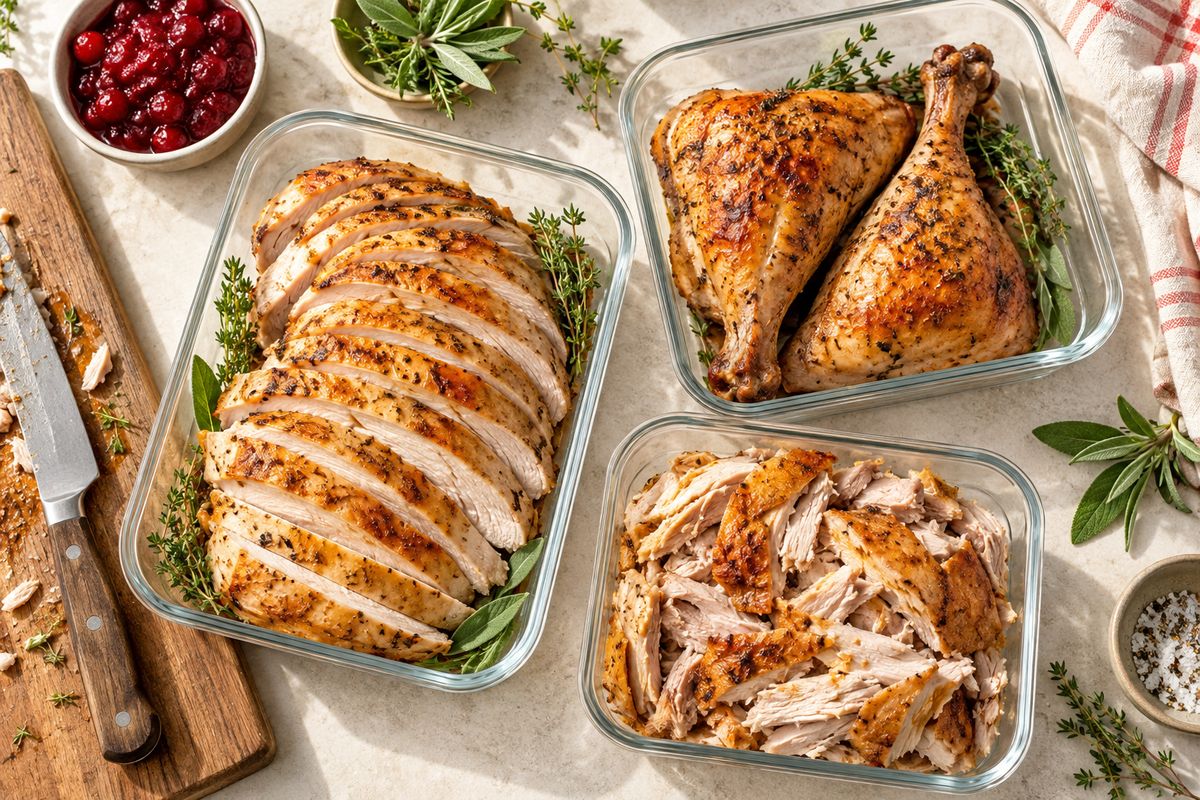
FSIS asks for shallow containers, and there is a reason with a stopwatch behind it: a big pot of soup takes most of the night to reach fridge temperature, and every hour spent in the danger zone is an invitation. Divide large amounts into smaller vessels, and cut large items down. The bird meets the knife directly: slice the breast meat, and the legs and wings may be left whole. Hot food can go straight into the refrigerator without a counter cool-down first, and an ice or cold water bath can speed up a stubbornly deep pot before it goes in.
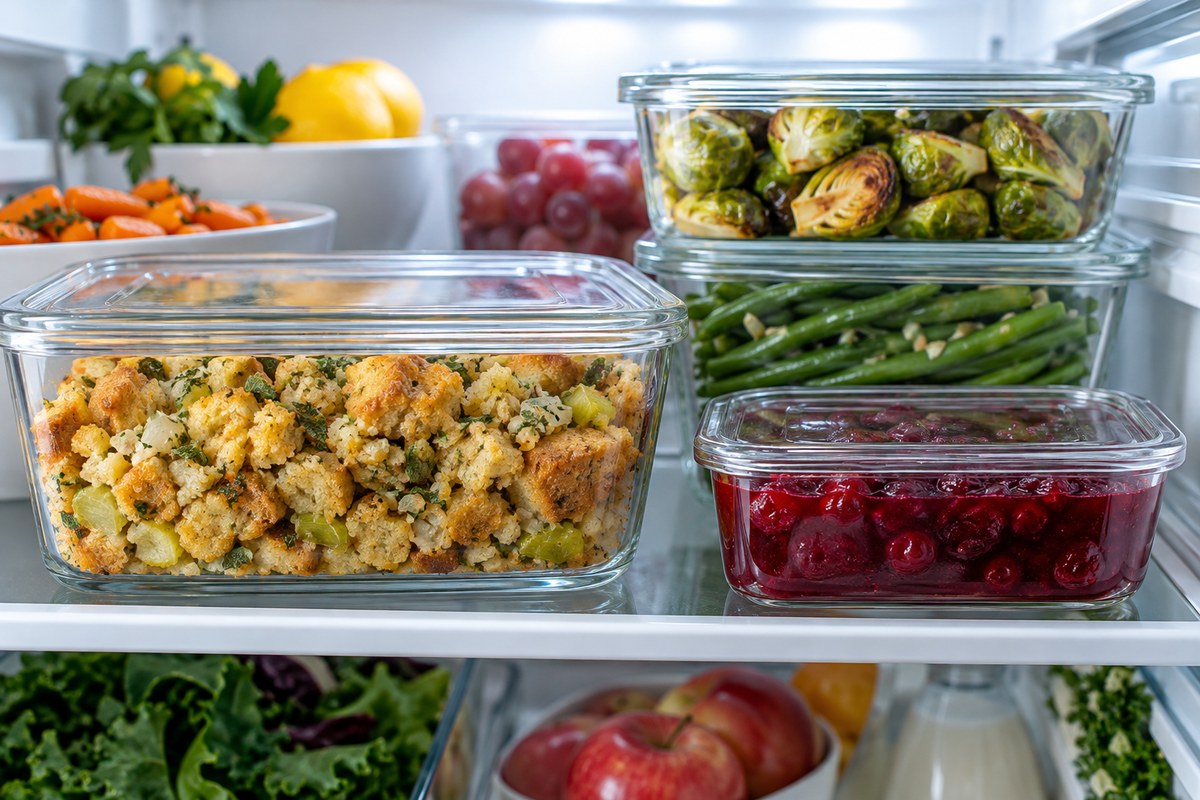
Then cover everything. Wrapped well, in airtight packaging or sealed containers, leftovers keep their moisture and stop absorbing the smell of the open container of cranberry sauce next door. On the Thursday-night tally, that is breast meat sliced into a flat dish, the dark meat in one tub, stuffing packed wherever a shelf will take it, and gravy in whatever vessel is both flat and lidded. Our own Thanksgiving dinner timeline ends right about here: the plates are cleared, the rule clock has started, and the rest is up to the fridge.
What gets wrapped for the freezer the first night
Everything you know Thursday night will not be eaten by Monday is cheaper to process now than to rescue later. Food Network’s practical packing rundown for this job is small containers and freezer-specific bags, pressing the air out of the bag before it closes, and portioning cooked turkey and grains in 1-to-2-cup amounts so a future dinner only has to defrost one bag. That is kitchen craft, not a safety claim. It also means the frozen stash itself can pour straight into the meal plan in the other direction: a bag of portioned turkey is exactly what a soup pot or a fried rice needs with no thawing ritual attached.
Keep it in the fridge, or freeze it
Freezing inside the window
Freezing has to happen inside the same window the fridge clock lives in; the day is for using or freezing, not for deciding which one. After that the two USDA-family pages describe the freezer in their own words: USDA FSIS puts frozen leftovers at 3 to 4 months; FoodSafety.gov’s Thanksgiving page says best quality within 2 to 6 months. Either way, frozen food stays safe indefinitely, and what fades is quality, not safety. If you have the freezer space, last Thursday becomes a January soup.
Thawing it back
FSIS lists three thawing routes. The refrigerator takes the longest and leaves the food safe the entire time; once it has thawed there, use it within 3 to 4 days or refreeze it. Cold water thawing wins on speed but needs a leak-proof package, and food thawed this way gets cooked before it goes back into the freezer. The microwave is the fastest of the three; heat what it thaws to 165f before refreezing. And when a thawed batch is bigger than one dinner, the remainder does not have to be wasted: thaw in the fridge, take out the portion you need, and refreeze the rest without reheating it first.
Reheating to 165f
Reheat leftovers to 165f as measured with a food thermometer, and bring sauces, soups and gravies to a rolling boil. Cover the dish to hold its moisture through, and in the microwave rotate the container partway through, add a little liquid where the food wants it, and let a resting time go by before the thermometer takes the second reading. Microwaves heat in cold spots; one hot spoon is not proof for the bowl.
Four days of meals, planned
Here is where the fridge earns its electricity bill. In 2026, Thanksgiving is Thursday, Nov 26, so Day 4 is Monday, Nov 30. That is our own date arithmetic; the rule is what stays constant. The ideas below are ideas, not a schedule. They trace back to the phrases people actually type when the fridge is full: sandwich and breakfast, soup and casserole, and the pot pie and shepherd’s pie crowd. The clusters show what jobs people are hunting for. They are not a cookbook.
Day 1, Friday
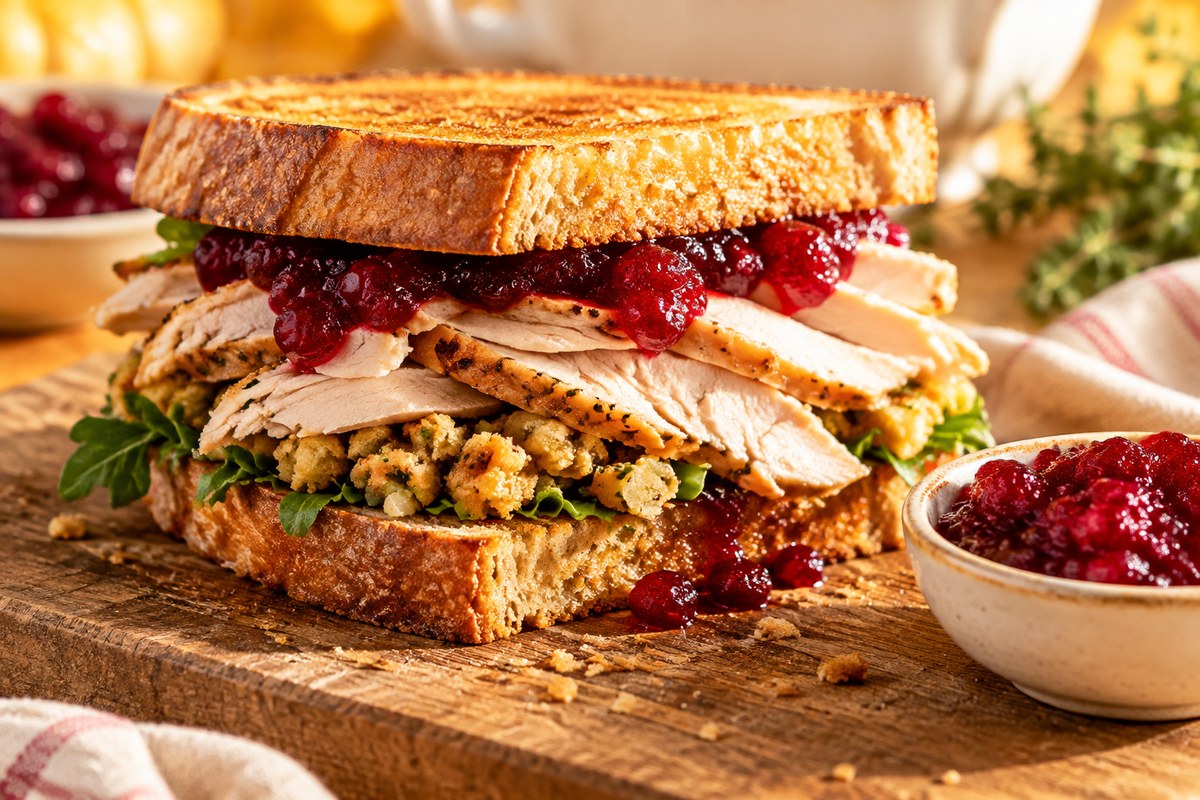
Friday is the sandwich and grazing day: the good bread comes out, the cranberry sauce is still bright, and the turkey is at its most generous. Breakfast on this day usually runs on stuffing hash and eggs, ideas straight from the leftovers breakfast search. Nothing needs cooking beyond reheating to spec. Day 1 is also when a house guest who helped with the cooking can get sent home with a container or two; if you are the guest with foil in your bag, our dinner party bring-and-skip logic is the other half of that exchange.
Day 2, Saturday
Saturday, one day after the bird, is when soup and casserole start making sense: the bones are free to become stock (a good pot of stock is worth the counter space, and it freezes), and the mash is ready to be reintroduced as a topping instead of a side. Day 2 ideas: soup, casserole. The casserole dish, of course, is a recipe’s business, and this guide does not do recipes. Here is where the video belongs precisely because of that: it is the recipe execution this planning guide deliberately does not give.
Day 3, Sunday
Sunday is the pot pie and fried rice day: two more ideas from the leftovers crowd, a pie the mashed potatoes can borrow crust duties in, and a fried rice that takes the last of the turkey plus whatever vegetables are still in the crisper. Day 3 ideas: pot pie, fried rice, shepherd’s pie. If the stash already looks bigger than the remaining meals, Sunday night is the moment to notice it. The freeze-before-the-clock-runs-out decision can start a day early without breaking any rule.
Day 4, Monday: the use-it-up decision day
Monday is the day the rule names: everything still in the fridge is either eaten today or frozen tonight. Nothing goes into Tuesday’s refrigerator in between as if no clock applied. What survives the decision day – typically the stock, the extra turkey, the last wedge of pie, and the condiment family – goes to the freezer in portions rather than as one hopeful casserole dish, where the same shelf-life math applies in slow motion. From here the measure that matters is the freezer’s quality window, not the fridge’s four-day count.
Bookmark the pattern and let the calendar roll: the deadline changes with the holiday, the rules don’t. Next year’s version of this week solves itself with the same arithmetic, and the same tool below.
The use-it-up planner
The rules above are stable. The two posts that come before this weekend on the calendar carry the other jobs: our Friendsgiving potluck planner runs the who-brings-what math before anyone cooks, and the Thanksgiving dinner timeline runs the oven clock on the day itself. What changes from household to household afterward is which containers went in on which day, and therefore which deadline is the urgent one. A container of stuffing in the fridge since Thursday and a pan of sweet potato casserole in since Friday cannot share a deadline. That calculation is simple; doing it by hand at half past Sunday evening is not everyone’s idea of a good time.
So here is the planning aid rather than a ceremonial quiz: check what you have, say which day it went into the fridge, and the tool writes the date on the metaphorical tape, orders each item by how much time it has left, and slips in meal ideas alongside its dates. It is a planning aid, not a safety certification; the 2-hour cooling rule outranks whatever the calendar says.
The use-it-up planner
Check what you have and see the date each item needs using or freezing by, with meal ideas. Tap or click to open.
Check an item that went into the fridge to see its date.
This planner is a planning aid, not a safety certification. Counted from the day the food went into the fridge; the 2-hour cooling rule (1 hour when it is over 90f outside) applies first, whatever the clock says. USDA FSIS puts frozen leftovers at 3 to 4 months; FoodSafety.gov’s Thanksgiving page says best quality within 2 to 6 months. Either way, frozen food stays safe indefinitely, and what fades is quality, not safety.
Frequently asked questions
How long do Thanksgiving leftovers last in the fridge?
USDA FSIS gives leftovers 3 to 4 days in the refrigerator. For food that went cold in the fridge on Thanksgiving Day, that lands on the Monday after the holiday; FoodSafety.gov calls that Monday the use-or-freeze deadline. If your food went in the fridge a day late, shift every deadline forward by that day.
Can you freeze Thanksgiving leftovers after four days?
The day to freeze is inside the four-day window rather than after it: Monday is the day to eat what is left or freeze it. USDA FSIS puts frozen leftovers at 3 to 4 months; FoodSafety.gov's Thanksgiving page says best quality within 2 to 6 months. Either way, frozen food stays safe indefinitely, and what fades is quality, not safety. So the freezer is the right answer to "after four days" as the safety valve, but stock it before the fourth day.
Do leftovers have to cool down before refrigerating?
No. USDA FSIS food-safety guidance is to pack leftovers into shallow containers and get them into the refrigerator promptly, without waiting for a full cool-down on the counter. The 2-hour rule applies on the way in, and it is 1 hour when the temperature is over 90f.
How many days past Thanksgiving is turkey still safe to eat?
The same 3 to 4 day refrigerated window applies to the carved turkey as to every other leftover, so for a bird that went cold in the fridge on Thanksgiving Day, Monday is the last day to eat it or freeze it. Whole roasts get cut down for cooling (slice the breast meat; legs and wings may be left whole), and every deadline shifts with the day the food actually went in the fridge.
How do you reheat Thanksgiving leftovers safely?
Reheat leftovers to 165f, measured with a food thermometer, and bring sauces, soups and gravies to a rolling boil. Cover to hold moisture; in the microwave, rotate partway through and check the temperature in more than one place.
Sources
All sources below were read in October 2026.
- USDA Food Safety and Inspection Service: Leftovers and Food Safety
- FoodSafety.gov: Leftovers: The Gift that Keeps on Giving
- FoodSafety.gov: Thanksgiving Leftovers for Safe Keeping, Weekend Grazing
- FoodSafety.gov: FoodKeeper app
- Food Network: The Shelf Life of Thanksgiving Leftovers (practical packing tips only)
The dates and the day arithmetic in the worked example are the desk's own; the safety numbers come from the pages above.
This article is for general information and entertainment, not financial advice.
Researched and written by Richie with the help of modern digital tools. Images: AI-generated.

Leave a Reply