It is nine at night, the guests arrive in an hour, and there are two ways this goes wrong. Either you have made so much punch that you are still pouring it out on Monday, or the bowl is dry by 8:15 and you are in the kitchen squeezing lemons while everyone else is having fun. Both come from the same missing number.
Here it is for fifty guests and a four-hour party, with punch as the only thing you pour: 250 drinks, about 10 gallons of punch, about fifteen bottles of 40 percent spirit, and 122 pounds of ice. That is 25 fluid ounces per person, five of those five-ounce cups, or a little over three kitchen cups.
How much punch for a party comes down to the arithmetic behind that number, the ratio that turns it into something worth drinking, and a planner you can set to your own party. No guessing, no running out, and nothing left over that you have to drink yourself out of politeness.
| Guests | Drinks, all kinds | Punch if it is the only drink | Punch if it is one of three | Ice |
|---|---|---|---|---|
| 20 | 100 | 3.9 gal (500 oz) | 1.3 gal | 49 lb |
| 30 | 150 | 5.9 gal (750 oz) | 2.0 gal | 73 lb |
| 50 | 250 | 9.8 gal (1,250 oz) | 3.3 gal | 122 lb |
| 100 | 500 | 19.5 gal (2,500 oz) | 6.5 gal | 244 lb |
In this article
Batch planner: your party, your numbers
Set the guest count and the hours, and get the volume, the four parts, the bottles and the ice. Tap or click to open.
Assumptions: 1.5 lb of ice per guest for chilling, doubled outdoors and plus 1 lb per guest if it also chills food; 3 oz of serving ice per drink; one 5 oz serving cup per drink; all figures are this desk’s arithmetic from the cited rules. The drinks rule counts all beverages, not only punch.
How much punch for a party: the three numbers behind the plan
Every punch quantity comes from three inputs: how many people, how long they stay, and how big the cup is. The rest is multiplication, and the multiplication is where most hosts go wrong, because they multiply the wrong thing.
The buying rule Tasting Table gives is two drinks per guest in the first hour and one drink per hour after that. That rule counts all beverages at the party, beer and wine and soda included. It is a shopping assumption for the whole bar, not a target for anyone's evening, and not a promise that five drinks will find five takers.
For a four-hour party, the rule means five drinks per guest: two in the first hour, then one for each of the next three. Multiply by your cup size and you have a volume. A five-ounce punch cup is the sensible default, because it is the size of a normal wine pour and it fits a normal hand. Fifty guests times five drinks is 250 drinks. Times five ounces is 1,250 ounces. Divide by 128 and you get 9.8 gallons.
That is the whole method. Everything else on this page is a correction for the ways real parties differ from the model: punch is rarely the only drink, the ice is never enough, and the ratio has to taste like something.
How much punch for 20, 30, 50 or 100 guests
The table at the top of this page is that same arithmetic for the four guest counts people ask about most. Use the column that matches your bar, not the biggest column. If you are also pouring wine with dinner and keeping a cooler of beer on the porch, the "one of three" column is your answer, and "punch if it is the only drink" is a number you should ignore.
Scaling is linear, which makes the mental math easy. Every ten extra guests at a four-hour party adds 50 drinks, which is 250 ounces, or about two gallons of punch and 75 ounces of spirit. Seventy-five ounces is almost exactly three 750 ml bottles. Thirty guests instead of fifty means six bottles fewer.
How much punch per person
Five drinks at five ounces is 25 fluid ounces per person over four hours, or five of the five-ounce cups. That number is useful because it divides and multiplies cleanly. Cut the party to three hours and each guest accounts for 20 ounces. Run it to six hours and you are at 35 ounces, which is where a second bowl starts to make sense.
It is also the number to hold onto when someone tells you their grandmother's punch bowl served forty people. Punch bowls vary enormously, and a bowl is a delivery method, not a quantity. A four-litre bowl holds a little over a gallon, so forty people drinking properly would empty it more than seven times.
If punch is not the only drink
Here is where a careful host saves the most money. The drinks rule above counts the whole bar, so if punch shares the work with wine and beer, punch should not be sized as if it were the whole bar. Dividing the total by three is the desk's plain planning assumption, not a sourced statistic: it reflects a party where the bowl is one of three things on offer. That is the "one of three" column in the table, and it turns ten gallons into about three and a quarter.
A welcome punch is a different animal again. If the bowl exists to hand people something the moment they walk in, one serving per guest is the whole job. Fifty guests at five ounces is 250 ounces, which is two gallons, or two bowls of that four-litre size. Nobody needs a refill from a drink that was designed to be the opening line.
The 1:2:3:4 rhyme, and when the experts ignore it
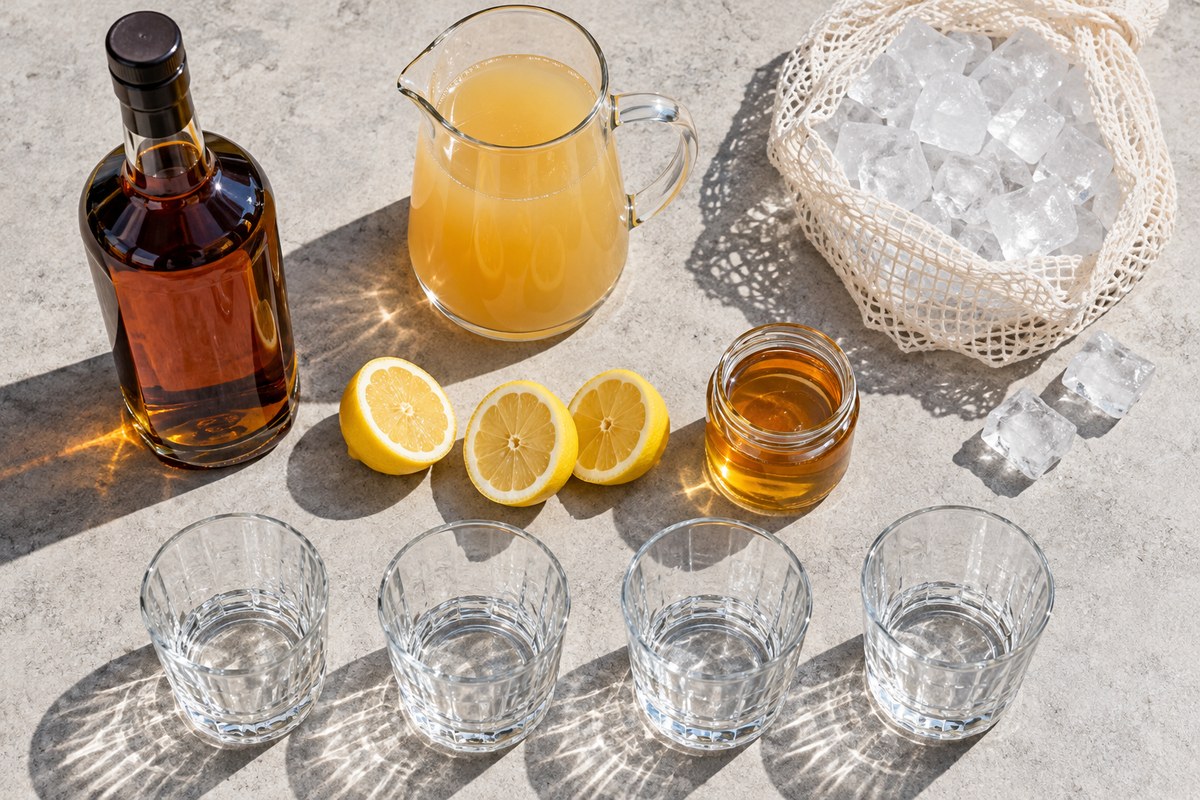
Punch has a memory aid that survives because it is easy to remember: one of sour, two of sweet, three of strong, four of weak. Epicurious walks through the Barbadian version part by part, where sour is lime, sweet is syrup, strong is rum and weak is water, with a dash of bitters and a grating of nutmeg on top.
What the four parts come to in a cup
Ten parts in total, which makes the arithmetic almost too easy. One part is a tenth of your volume. For fifty guests at 1,250 ounces, one part is 125 ounces. That gives you 15.6 cups of citrus, 31.25 cups of syrup, 46.9 cups of spirit and 62.5 cups of something weaker. The spirit works out to 11.1 litres, or about fifteen 750 ml bottles.
Now the useful part. Thirty percent of the cup is spirit, so a little arithmetic tells you exactly where you land. With a 40 percent spirit, the bowl is 12 percent alcohol before the ice goes in. A five-ounce cup therefore carries 1.5 ounces of spirit, which is 0.6 fluid ounces of pure alcohol, which is precisely one US standard drink by the NIAAA definition. It is the same alcohol as a five-ounce glass of 12 percent wine. That is a unit of measurement, not an allowance, and it is why the pour size moves the answer more than the bowl size does: at four ounces a cup carries 0.48 fluid ounces of alcohol, and at six ounces it carries 0.72.
Difford's Guide puts the serving target for a pre-diluted punch at 16 to 20 percent alcohol by volume, the strength of sherry, which is a stronger bowl than the rhyme builds. The two figures are not a contradiction; they are two stops on the same dilution curve. A bowl built at the rhyme's proportions starts near 12 percent and weakens as the block melts. A bar that bottles its punch fixes the strength at 16 to 20 percent so every guest gets the same drink. If you want to sit in that window, the strong slot needs a spirit of roughly 53 to 67 percent, or less of the weak part. Their own four-litre recipe works out to about 14 percent at a 40 percent spirit.
What the people who make punch in volume actually do
Difford's also prints the admission most recipe pages leave out: the merits of the rhyme are good to chat about around a punch bowl, and few of the people who make punch in volume actually follow it. David Wondrich, in the same piece, says punch is closer to barbecue than baking, a process rather than a recipe. Treat the parts as a starting point that keeps you honest about volume, then taste.
Tasting is the last step for a reason. Too sour takes more sweet. Too sweet takes more weak. Too strong takes more of anything wet. Make a single glass first, adjust, then scale that glass by the numbers above. The alternative, fixing six gallons at nine at night, is how decent ingredients become a story you tell later.
Ice: the number hosts get wrong
Every party runs short of ice, and almost nobody plans it with the same care as the drink. The rule is one to two pounds of ice per guest as a base, and this page plans at 1.5, the middle of that range, because the middle is a saner shopping number than the ceiling. Two adjustments matter. Double the base outdoors or in a warm room, and add another pound per guest if the ice is also keeping food cold.
Then add the ice that goes into the drinks. About three cubes per drink, at roughly an ounce per cube, is three ounces of serving ice per drink. For fifty guests and 250 drinks that is 750 ounces, or 46.9 pounds, stacked on top of 75 pounds for chilling. Call it 122 pounds, which is eighteen bags of seven pounds. The source's own worked example for twenty guests takes the top of its range: 40 pounds of chilling ice, 80 in the heat, plus 19 pounds of serving ice, for about 100 pounds total, which is their 80 plus their 19. They also move the same twenty guests onto the 2 lb-per-guest base outdoors, which is the real gap between their figure and this page's 49 lb indoors at 1.5 lb a guest.
Block ice in the bowl, cubes in the glass
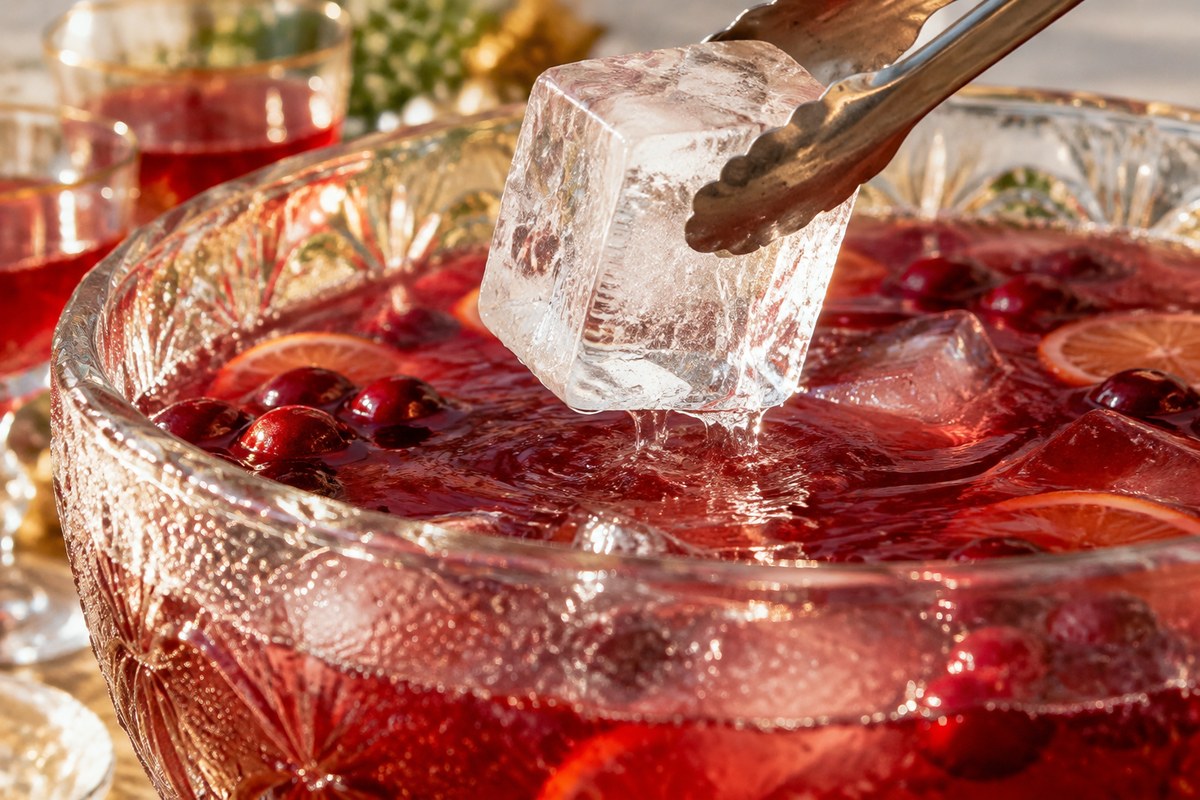
Cubes belong in glasses and coolers. In the bowl they melt fast and turn a well-built punch into cold pink water within the hour. Difford's is blunt about it: cubed ice is not suitable for a punch bowl unless the punch will be drunk almost immediately. A single block melts slowly and keeps the bowl cold while it dilutes at the pace the punch wants.
Make the block a day ahead by freezing water in a silicone bread mould or a plastic food container that fits your bowl. This desk's estimate is about three pounds for a four-litre bowl, which is not in the source and is not in the ice totals above, so add it to the shopping list.
Keeping the bowl cold without a second fridge
Three things do the work. Chill the punch base in the refrigerator overnight so the block is not fighting a warm liquid. Set the bowl in a shallow tray of ice so the outside stays cold. Keep a sealed cooler of backup ice out of the room, because ice in a warm kitchen is a losing race and guests will help themselves to whatever is visible.
Making it ahead
A punch you assemble while guests arrive is a punch you do not taste. Difford's default recipe is built backwards from service: peel the citrus and cover it with sugar the night before to make an oleo-saccharum, freeze the block, then combine everything just before people show up.
Their home-scale version is 180 ml of caster sugar, 180 ml of lemon juice, a 700 to 750 ml bottle of rum and a litre of cold water, which comes to about 2.1 litres. The recipe serves 24 at 90 ml each, which is 2,160 ml of servings in total. Note the distinction: four litres is the bowl's capacity, and 2,160 ml is the volume served, so a four-litre bowl is not forty-four servings.
Citrus is the clock. Difford's quotes Jillian Vose of New York's Dead Rabbit saying lemon juice is good for about 36 hours, which is how that bar times its punch refills. That is commercial practice, not a home food-safety rule, but it is a sensible ceiling: mix the base the morning of the party, keep it cold, and add the block at the door.
A non-alcoholic batch that does not taste like a consolation prize
The ten-part skeleton still works without spirits, but you have to replace the strong part with something that has body: strong brewed tea, a tart juice, or a mix of both. Keep the citrus and the sweet exactly where they were, and taste for the missing bite that alcohol normally supplies. Ginger, a little bitters if the household allows it, or a squeeze more lemon will find it.
If you are running one bowl for everyone, this is the version to make. It needs no explanation, and it means nobody has to ask what is in the glass. The mason jar cocktail kits make a nice gift alongside it, and the Friendsgiving potluck planner handles the food quantities while you handle the bowl.
If you want one proper cocktail on the side, the Manhattan is the one to mix, and if you are the guest rather than the host this year, here is what to bring to a dinner party.
That is the whole method: one guest count, one hours count, one cup size, and the arithmetic does the rest. The guesswork stops the moment those three numbers are written down.
Frequently asked questions
How much punch for 50 guests?
250 five-ounce cups, which is 1,250 ounces or about 9.8 gallons, if punch is the only drink at a four-hour party. If punch is one of three drinks, plan on about 3.3 gallons and let the wine and beer carry the rest.
How much punch per person?
About 25 fluid ounces over four hours, which is five five-ounce cups, using the five-drinks-per-guest assumption. Shorten the party and the number drops by roughly five ounces per hour.
How many bottles of spirit for a punch bowl?
At the 1:2:3:4 ratio and 50 guests, the strong part is 375 ounces, which is about fifteen 750 ml bottles. For 30 guests it is nine bottles, and for 100 guests it is about thirty.
How much ice do I need for a party?
Plan 1.5 pounds per guest for chilling, double it outdoors, and add three ounces of serving ice per drink. For 50 guests at four hours that is 122 pounds, plus a separate block for the bowl.
Can I make punch the night before?
Yes. Mix the base without ice, keep it cold, and add the block when the guests arrive. Citrus quality holds for about 36 hours by one New York bar's practice, so the morning of the party is the better target if you can manage it.
Sources
All sources below were read in October 2026. The guest-count, volume, parts, bottle and ice totals on this page are The Miser's Desk's own arithmetic from the rules cited here, except where a figure is quoted directly from a source.
- National Institute on Alcohol Abuse and Alcoholism. What Is A Standard Drink? The 0.6 fl oz definition and the 1.5 fl oz spirits, 5 fl oz wine and 12 fl oz beer equivalents.
- Tasting Table. Courtney Iseman, How To Figure Out Exactly How Much Ice You'll Need For A Party, May 28 2025. Ice per guest, the doubling and food adders, the two-then-one drinks rule, and the three-cubes-per-drink estimate.
- Difford's Guide. Simon Difford, Punch & Punches. The 1:2:3:4 rhyme, the 16 to 20 percent serving target, block ice, the four-litre recipe, the 36-hour citrus note and the opinion that few punch makers follow the rhyme.
- Epicurious. Joe Sevier, The Barbadian Rhyme That Explains How to Make Punch. The rhyme part by part and the bitters and nutmeg finish.
- Anders Erickson, YouTube. Prep your party with the Fish House Punch! A large-format punch built for a party, and the case for a block of ice.
This article is for general information and entertainment, not financial advice.
Researched and written by Richie with the help of modern digital tools. Images: AI-generated.

Leave a Reply