A cookie exchange invitation asks one practical question, and it is not which cookie to bake. It is the question of how many cookies for a cookie exchange to bring, and the answer Robin Olson calls the norm is six dozen per guest, 72 cookies, from a set of rules she wrote in 1997. That number is a house rule with a date on it, not a law of December, and it is worth checking against your own recipe before you preheat the oven.
The answer is a division problem wearing an apron. Work out how many cookies the table needs, divide by what one recipe actually produces, and round up once. Everything else, from the size of your take-home box to whether the host ends up with a platter of leftovers, follows from that number.
What follows is the arithmetic, the six-dozen convention Olson’s rules made standard, and a planner that does the division for your kitchen rather than an average kitchen. It is written for the person who has to bake this week, not for the person collecting cookie recipes. If you are also in charge of drinks, the punch quantity math uses the same logic for the bowl.
In this article
How many cookies for a cookie exchange?
Multiply the number of people by the number of cookies each one brings, and you have the size of the swap. Eight people bringing six dozen each put 576 cookies on the table. Each of them then takes home about 72, which works out to nine cookies from every one of the eight varieties.
That is the whole model: in a fair swap, what you take home is roughly what you brought, spread across everyone else’s baking. The number you bring is the number you carry out, divided into shares.
| Party | Cookies on the table | Each person brings | Take-home per person |
|---|---|---|---|
| 8 people | 576 | 72 (6 dozen) | 72, or 9 of each of 8 varieties |
| 6 people, office swap | 144 | 24 (2 dozen) | 24, or 4 of each of 6 varieties |
| 16 people, neighborhood | 1,152 | 72 (6 dozen) | 72, or 4 of each of 16 varieties, and 8 singles |
Those figures are my own arithmetic on the counts, not a rule handed down by anyone. The useful part is what the table exposes. A sixteen-person swap does not need anyone to bake more. It simply gives every guest a thinner slice of a much wider table, which is usually the point of a big swap and sometimes a disappointment if you were hoping for a serious stash of one favorite.
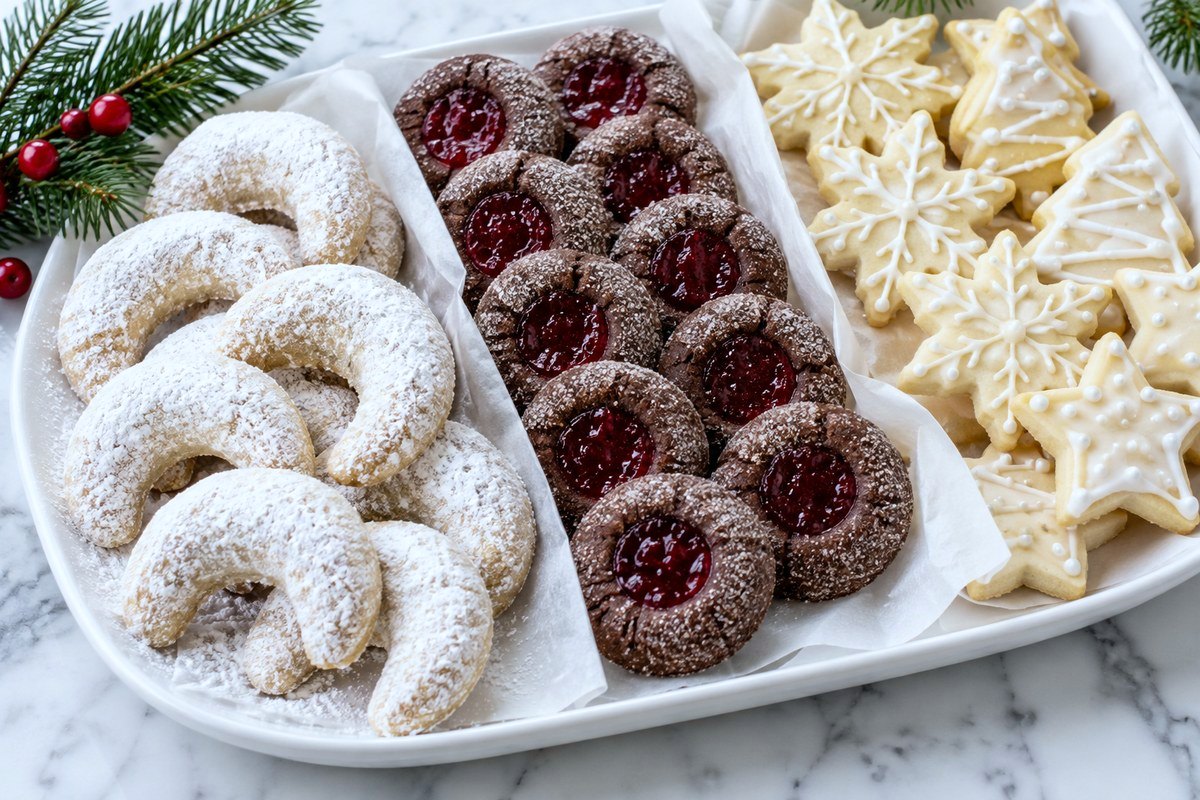
A party of eight, worked through
Say eight friends, each bringing six dozen, and a 36-cookie recipe. Two batches make exactly six dozen, so nobody has spare. The moment you want twelve cookies out on a plate for people to nibble while they swap, the numbers stop being tidy: two batches give you nothing to nibble, so someone has to bake a third. That single plate is why the honest answer for the host is three batches, not two.
The odd guest count
Seven friends, six dozen each, is where the tidy example falls apart. The table still holds 504 cookies and everyone still brings 72, but 72 divided by seven varieties is ten cookies each with two left over. Those two are not lost: every guest takes home ten of each variety plus two extra, and the host decides whether the extras go to whoever arrived first or into a plate for the neighbors.
Odd counts happen. Decide the remainder rule before the party, say it out loud at the table, and nobody has to do arithmetic with their coat on.
The office-swap version
Offices run on a different scale, and the convention that suits a neighborhood party is absurd in a conference room. Six colleagues bringing two dozen each produce 144 cookies, four of each of six varieties per person, and that is plenty for a Friday afternoon. One batch of a 36-cookie recipe covers your share with twelve left over for the break room.
Run the batch planner
Set the guest count and paste in the yield from your own recipe. The planner keeps the swap pool and a tasting plate separate, because mixing them is where most hosts either overbake or run short, and it tells you the spare that rounding up to whole batches leaves in your kitchen.
Cookie swap batch planner
Enter your guest count and your own recipe’s yield, and it works out how many batches each baker needs. Tap or click to open.
Count yourself among the people if you are baking, and label the yield field with your own recipe’s yield: the planner uses that number for every baker, so a table of mixed recipes will differ person by person. Left at its default, the field uses 36 cookies a batch, the yield of King Arthur Baking’s classic chocolate chip cookie recipe.
The 6-dozen convention, and when it is too much
Six dozen per guest is Olson's default, and her page reads like a host who has watched a few swaps go wrong. Her rules were written in 1997, posted that October, and carried today at Cookie-Exchange.com, copied and adapted and often miscredited ever since. Her list is blunt and practical: bring six dozen total, tell the host what you are baking, bring a container, and expect no duplicate recipes. It also rules out plain chocolate chip cookies, mixes, no-bakes, meringues and bars, which is worth knowing before you copy the classic chocolate chip yield below.
Her own explanation is the interesting part. Six dozen exists so the table looks like a feast instead of a plate, and so nobody drives across town for twelve cookies. She also writes, plainly, that the host decides what the right amount is for the party. It is a convention with a host attached, not a law of December.
Where the number comes from
Six dozen is 72 cookies. That is two batches of a 36-cookie recipe, which is what King Arthur Baking's classic chocolate chip cookie recipe produces at standard size, or one batch of a large-yield recipe.
Not every host runs that format. Summer & Cinnamon's cookie exchange calculator states its own standard as one dozen cookies per person attending, and its table scales the ask with the guest list: six guests means 72 cookies each, eight means 96, fifteen means 180. Its separate tasting-party format asks for two or three dozen. The two conventions cross at six people, where both ask for 72, which is worth knowing if your invitation does not spell the number out.
When to run a smaller swap
Scale the ask to the room. A neighborhood party with sixteen people and a long table earns the full six dozen. An office lunch, a book club, or a first-time swap among four friends does not. Two dozen each is generous at that size, and a single batch of a standard drop-cookie recipe covers it.
Whatever you choose, put the number in the invitation and put it in bold. The disappointment at a cookie exchange usually starts with guests guessing a different number than the host had in mind.
One variety per person, and how many you need
One variety per guest is the whole rule, and the guest list then sets the variety count: eight people take home eight kinds, sixteen take home sixteen. Everyone bakes one thing well, nobody duplicates, and every take-home box holds a proper spread.
So the host's job at the invitation stage is to collect one cookie name per guest and settle collisions before anyone shops. Olson's rules put it as no duplicate recipes allowed, and her reason is social rather than mathematical: nobody wants to discover that a neighbor bakes their family recipe better.
For a group that cannot agree, assign categories instead of recipes. One chocolate, one spice, one shortbread or sugar cookie, one fruit or jam cookie, one nut cookie, one wildcard. People keep their own recipe and the table stays varied.
How many batches is that?
Here is where most hosts go wrong, and it is not their fault. Recipes usually print the yield just above the ingredient list, and the number is a promise about that recipe at that size, not about cookies in general. King Arthur's classic chocolate chip recipe makes 36 standard cookies; the same dough scooped bakery-size, about the size of an adult palm, makes nine to eleven.
So the yield you feed into the planner has to be the yield of the cookie you are actually making, at the size you are actually scooping. Change the scoop and you change the batch count.
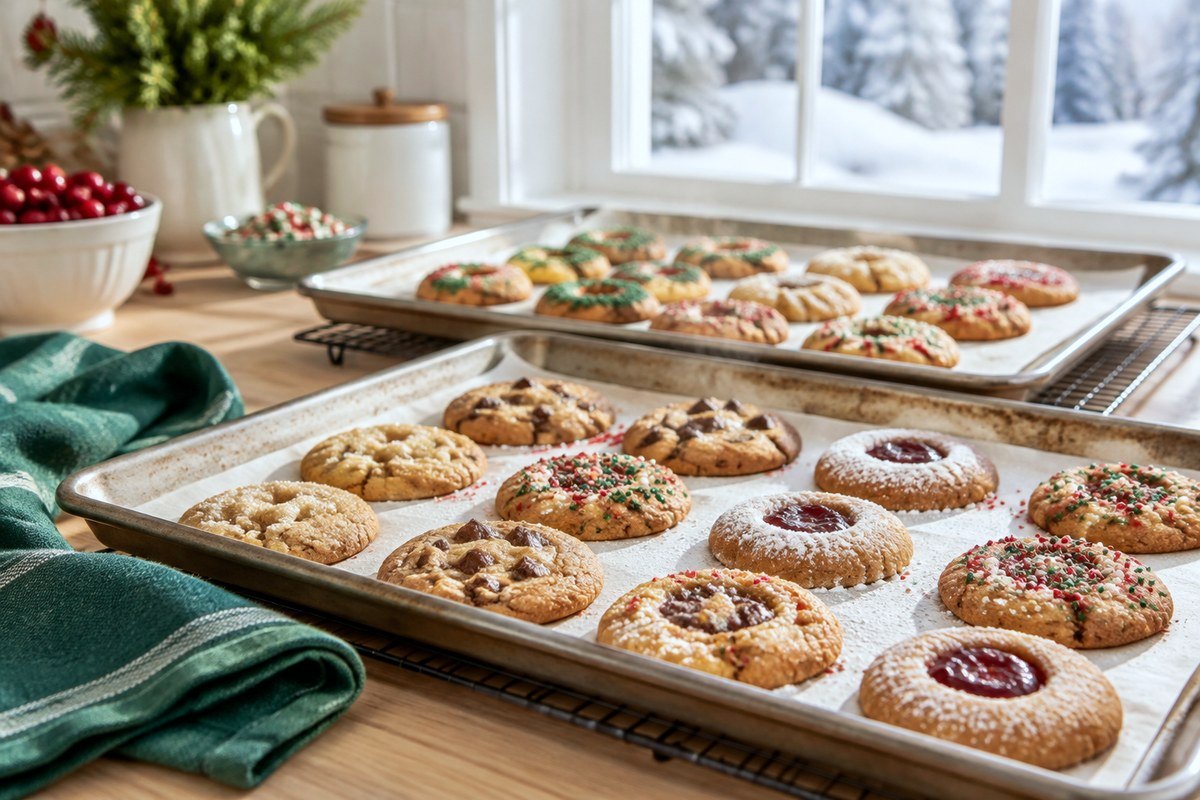
Where the yield appears on a recipe page
Look above the ingredient list, not in the headnote. Reputable recipe pages state servings or yield there, and some state both a count and a size. If a recipe says "makes about 4 dozen" with no size, assume small cookies and check one tray before you commit the whole batch.
A practical test: bake six cookies first, measure the spread, and count how many fit on your sheet with room between them. King Arthur's own instructions ask for about two inches between cookies on all sides, and that spacing, not the pan's area, is what sets your real capacity.
Doubling without ruining the batch
Which is the same arithmetic from the other direction: six dozen is two batches of a 36-cookie recipe, or one batch of a large-yield one. That fits a home kitchen: two bowls, one after the other, keep the dough at the consistency the recipe was written for.
If your dough spreads more than you expected, chill it for 30 minutes before baking: King Arthur's bakers measured a clear difference in spread after half an hour in the fridge. That also makes a tidier box at the end. Bake in the order you will pack: the prettiest batch goes on top of the tin, the homely ones go on the tasting plate.
Pick cookies that survive the trip
A swap is a logistics problem disguised as a party. Your cookies have to survive a car, a crowded table and a take-home box, and the ones that taste best straight from the oven are often the ones that arrive as crumbs.
Drop cookies, shortbread, biscotti and firm cut-outs travel well. Anything with soft icing or a custard filling does not, and Olson's rules make the same point for icing: cookies with it need to air dry and harden before they go to a swap. Her list also leaves meringues off the table entirely. If you love a gooey cookie, bake it for the tasting plate and bring something sturdier for the boxes.
The video is worth watching for the packing segment alone. Erin McDowell, who hosts Food52's Bake It Up a Notch, treats transport as part of the recipe rather than an afterthought, and the packing segment is the part to watch before you load the car.
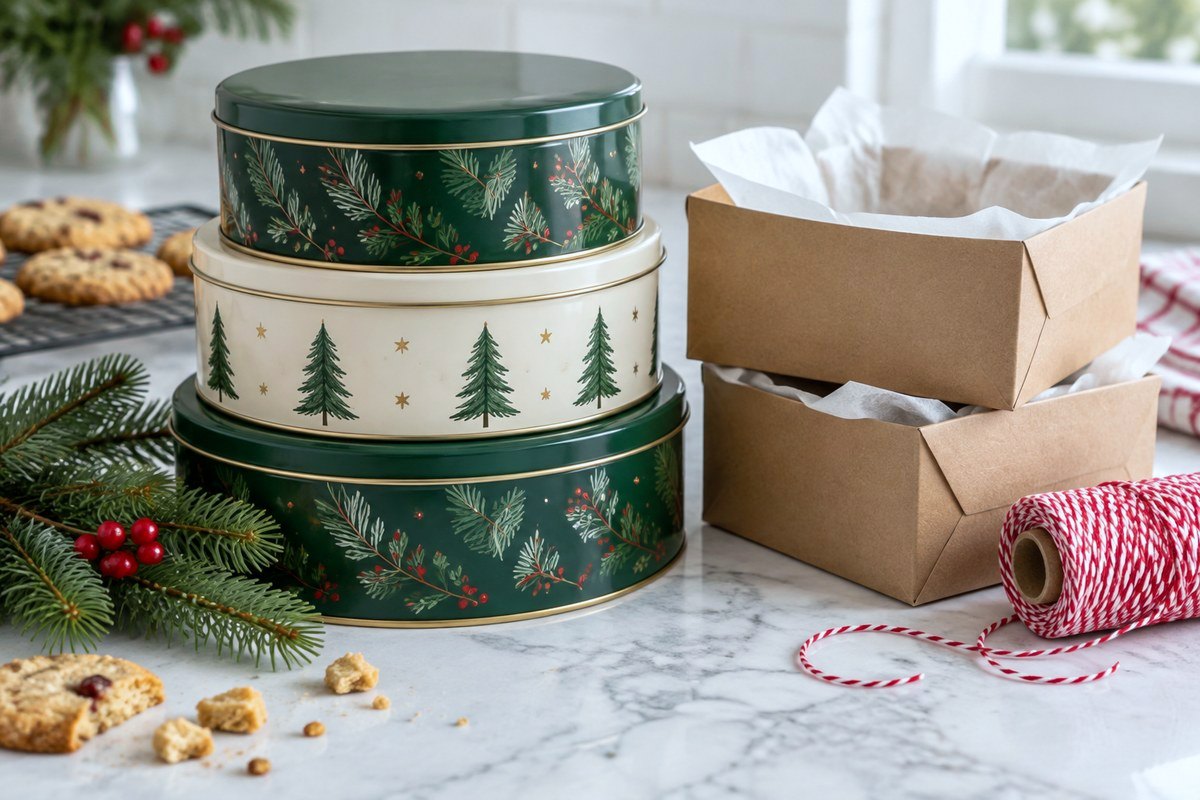
Then bring a container. Olson's rules ask guests to bring a large one, or the host to supply tins and trays, so it is worth its own line in the invitation. A sturdy box with parchment between layers beats a decorative tin that crushes the top row. If you are new to the guest side of hosting season, the guide to what to bring to a dinner party covers the same instinct in a different room.
Label every plate
Every plate at a swap should carry a small card naming the cookie and its ingredients. This is ordinary courtesy, and it matters more than most hosts assume, because nine ingredients account for the major food allergens recognized in United States labeling law: milk, eggs, fish, crustacean shellfish, tree nuts, peanuts, wheat, soybeans and sesame. Sesame joined the list on January 1, 2023. That law covers packaged foods sold with labels, not a plate a guest carries into a living room; the list is useful because it is a sensible checklist of what to write down.
Flour, butter and egg already put three of the nine on the card, and a butter cookie made with pure almond extract adds tree nuts to the list. A card listing flour, butter, sugar, eggs and any nut or seed tells a guest what they need without anyone interrogating the baker. The FDA's own guidance to consumers is to read labels and avoid what they are allergic to, so give them something to read.
Two practical details. Write the cards at home, not at the party, and write them large. And keep the nut cookies at one end of the table with their own tongs, so a guest with a nut allergy can serve themselves from the other end without navigating a shared platter.
Copy-ready rules for the invitation
Send these with the date, and adjust the numbers to your party. They are short on purpose, because a rules list nobody reads is worse than no list at all.
- Bring [number] cookies, all one variety, homemade and baked.
- Tell me what you are baking when you RSVP, so we do not double up.
- Bring a container big enough to carry your share home.
- Bring a small card with the cookie's name and its ingredients.
- Arrive with the cookies cooled and packed, not warm from the oven.
- We swap at [time], so come a little early to set up your plate.
Rules adapted from Robin Olson's cookie exchange guidelines. Some content courtesy of Robin Olson, Cookie-Exchange.com.
Add one line about allergies if you know your guest list: a note asking people to flag nuts, dairy or gluten in advance turns an awkward table conversation into a solved problem. It is also the kind of sentence that makes guests trust the rest of the invitation. For a swap that doubles as a meal, the potluck planner handles the same who-brings-what question for the savory side of the table.
The week-of timeline
Cookie exchanges fail in the last forty-eight hours, not in the planning. Here is the order that keeps the week calm.
- Ten days out: send the invitation with the number and the rules, and collect what each guest is baking.
- One week out: settle duplicates, assign categories if needed, and check you have twice the ingredients on hand.
- Three days out: bake the cookies that keep well. King Arthur advises storing its chocolate chip cookies well wrapped at room temperature for up to five days, and freezing them for longer, which is the window a swap needs.
- The day before: pack the cookies in their layers, write the ingredient card, and find the container.
- The morning of: bake anything delicate, set the table, and put out the cards before the first guest arrives.
That last point is worth repeating: set the table before people arrive, with a card at every place and a stack of containers at the end. A swap where the logistics are already solved is a party. A swap where eight people are hunting for tins is a committee meeting with cookies.
Frequently asked questions
How many cookies should each person bring to a cookie exchange?
Six dozen, or 72 cookies, is Robin Olson's 1997 convention and it is still widely copied. Four to six guests can stay at two dozen each, and some groups scale the ask with the guest list instead, so the host sets the number in the invitation.
How many cookies do you take home?
Roughly what you brought, spread across every variety. Eight people bringing six dozen each take home 72 cookies, which is nine from each of the eight plates. Six people bringing two dozen each take home 24, or four of each of six varieties. With seven people the split is uneven, so each guest gets ten of each variety and two extra cookies.
How many types of cookies should there be?
One per guest. Eight people take home eight kinds and sixteen take home sixteen, because the variety count follows the headcount rather than a separate rule. Assign categories when two guests want to bake the same thing.
Can I bring store-bought cookies?
The traditional answer is no. Olson's rules require homemade baked cookies and send anyone who runs out of time to a real bakery instead. If you want a more relaxed swap, say so in the invitation and call it a cookie and treat exchange, so nobody arrives expecting a baking contest.
How far ahead should I bake?
King Arthur says its chocolate chip cookies keep about five days well wrapped at room temperature, so check your own recipe for anything richer or softer. Iced cookies need to air dry and harden before a swap, which Olson's rules say plainly, so bake those last.
How should I label cookies so guests with allergies can choose?
Ask about allergies when people RSVP, and have every baker write an ingredient card. Name the nuts, dairy, eggs, wheat, soy and sesame plainly, and keep nut cookies at a separate end of the table with their own serving tongs. A guest with a serious allergy can then decide for themselves what to take.
Sources
All sources below were read in November 2026.
- Cookie Exchange.com, "The Rules of the Cookie Exchange" by Robin L. Olson (1997).
- King Arthur Baking, "Classic Chocolate Chip Cookies", recipe by PJ Hamel, page updated April 7, 2026.
- King Arthur Baking, "Chilling cookie dough: Does it make a difference?" by PJ Hamel, May 17, 2015.
- U.S. Food and Drug Administration, "Food Allergies", including the nine major food allergens and the FASTER Act change effective January 1, 2023.
- Summer & Cinnamon, "Cookie Exchange Calculator (How Many Cookies to Bring + Easy Chart)", the source for the one-dozen-per-guest convention and its swap formats.
- Food52 on YouTube, "How to Host a Holiday Cookie Party | Bake It Up a Notch with Erin McDowell", published December 11, 2022.
Researched and written by Richie with the help of modern digital tools. Images: AI-generated editorial illustrations.

Leave a Reply