Two trusted traveler programs promise to shorten a line at the airport, and the first question about them is the price. TSA PreCheck gets you through the security checkpoint with your shoes on. Global Entry gets you through the customs hall when you land back in the United States, and it includes PreCheck.
TSA PreCheck costs $79.75 to $84.95 for five years, depending on which of the three enrollment providers you use. Global Entry costs $120 for the same five years and includes PreCheck. Neither price is the number that decides a household budget. The number that decides it is what happens to your children under each program’s rules, and those rules are not the same.
This guide sets out what each program buys, what each one charges now, and how the family arithmetic actually runs. Then it hands you a planner: enter your adults and children, and it prints both five-year totals, both per-year figures, and the difference between them.
In this article
| Program | Fee for five years | What it adds | Children |
|---|---|---|---|
| TSA PreCheck | $79.75 to $84.95 by provider | The security checkpoint lane, shoes and laptops stay on | No membership needed to join an enrolled adult’s lane |
| Global Entry | $120 | The customs line on arrival, land borders, and PreCheck | Fee waived for a minor only while a guardian is enrolled or applying |
What each program buys you
The two programs sit on different sides of a trip, which is why comparing them as rivals gets confusing. One works on the way out, the other on the way home.
TSA PreCheck: the security checkpoint
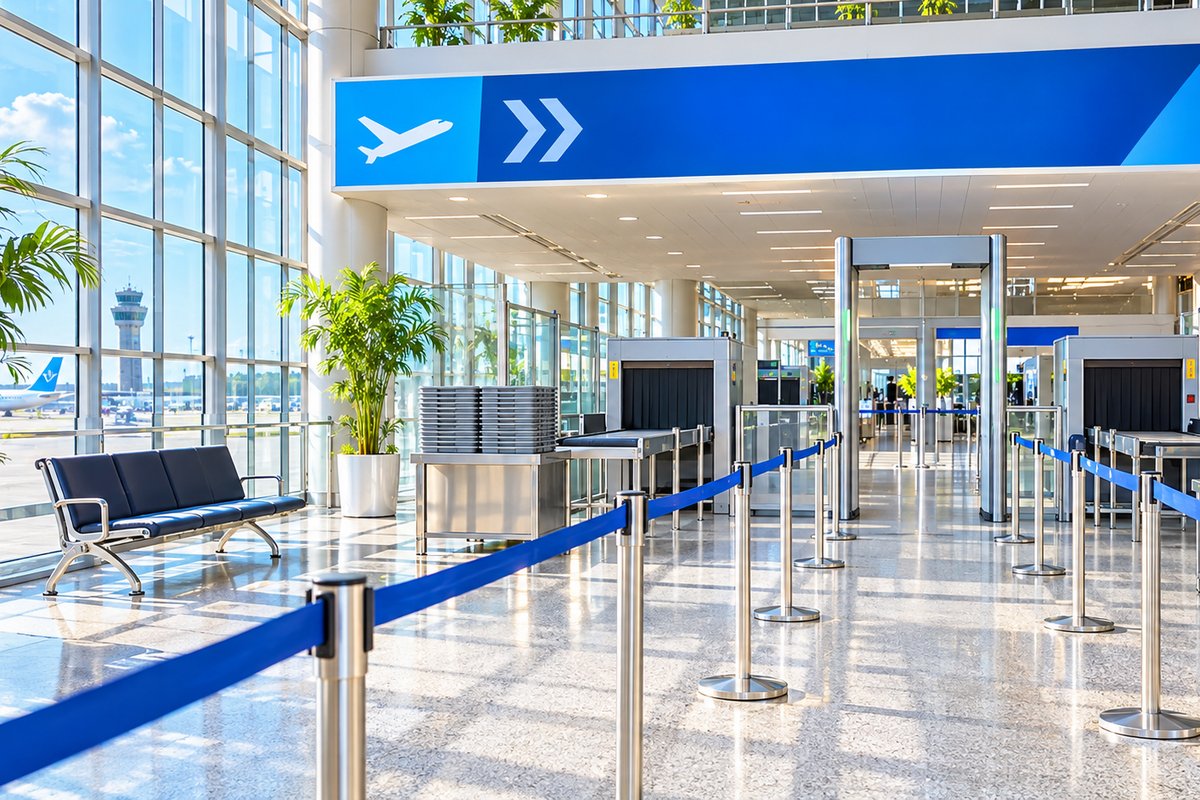
PreCheck is the Transportation Security Administration’s expedited screening program. Members keep their shoes, belts and light jackets on, leave laptops and liquids in the bag, and use a dedicated lane that the enrollment providers place at more than 200 airports, with more than 90 airlines taking part. The agency’s own page carries the sentence that matters more than any speed claim: no individual is guaranteed the expedited lane. The whole procedure for arriving at the airport around that lane is on our guide to how early you should get to the airport, so this page will not repeat it.
What PreCheck does not touch is the customs hall, the bag drop, or the airline’s check-in cutoff. It removes one line from the day, not the queue at the counter.
Global Entry: the line on the way home
Global Entry is Customs and Border Protection’s program for clearing back into the United States. Members use expedited processing lanes at major airports and at land borders, and the membership includes PreCheck, so a Global Entry card covers both lines. The agency is careful about what it promises: members may still be selected for further examination on entry, and a violation of the program’s terms ends the membership.
That inclusion is the reason the two programs get compared at all. Global Entry is the wider purchase, and it costs $120 against PreCheck’s $85 or less.
The three programs are easier to hold apart in motion. This explainer from Daily Drop compares TSA PreCheck, Global Entry and CLEAR side by side, which is useful here for one reason: CLEAR sells a separate lane service of its own, and on this page CLEAR appears only as one of the three providers that enrolls you for PreCheck.
What each one costs
TSA does not set one price. It authorizes three enrollment providers, and each publishes its own fee. The agency’s summary, on its PreCheck page, is “five years of benefits for $85 or less,” which is true of all three and precise for none of them. Here is what the providers’ own pages say today.
| Enrollment provider | New enrollment, five years | Renew online | Renew in person |
|---|---|---|---|
| IDEMIA | $79.75 | $58.75 | $66.75 |
| CLEAR | $84.95 | $72.95 | $84.95 |
| Telos | $84.95 | $69.95 | $58.75 |
Two details in that table are worth more than the totals. First, IDEMIA is the cheapest on both counts: $79.75 to enroll and $58.75 to renew online. Telos matches that $58.75 renewal in person, which is the quietest bargain in the table. Second, the gap between an online and an in-person renewal is real money at CLEAR, where renewing in person costs $12 more.
One name needs separating before the rest of the page. CLEAR is one of the three PreCheck enrollment providers, and it also sells CLEAR+, a separate service that verifies your identity at its own pods and walks you to the front of the screening lane. The membership price in that table buys PreCheck enrollment. CLEAR+ is a different product with a different price, and its own page advertises a bundle that includes the PreCheck enrollment.
Renewing, and when to start
Both programs run on a five-year clock. Telos says a member can renew up to six months before the current membership expires, and TSA’s renewal page lets members renew through any of the three providers, so a cheaper counter is a legitimate reason to switch. For Global Entry the pages read for this article state the $120 enrollment fee and no separate renewal price.
The family math
Two rules decide what a household actually pays, and they point in opposite directions. PreCheck charges for the adults and nothing for the children. Global Entry charges for everyone, then waives the minors’ fees under a condition that depends on the order of the applications.
The PreCheck rule is the simpler one. Children 17 and under can join an enrolled adult in the PreCheck lane without a membership of their own, which means a family of five buys two memberships, not five. There is a catch by age. Children 12 and under walk in with the adult and their boarding pass does not even need the PreCheck indicator. Children 13 to 17 may use the lane only when the indicator is printed on their own boarding pass, and getting it there requires three things: the adult and child on the same airline reservation, the adult’s boarding pass carrying the indicator, and the child’s Known Traveler Number field left blank. A teenager on a separate reservation with no number of their own does not get the lane. Neither does an adult escorting a child to the gate on a gate pass.
The Global Entry rule is the one that surprises people. Customs and Border Protection lists “Be 18 years of age or older (minors require a parent or legal guardian’s consent)” among its eligibility bullets, and then its children’s section settles the question: “There is no minimum age requirement for Global Entry.” For a family, the parenthetical and the children’s section are what govern. A minor needs a parent or legal guardian’s consent, and that guardian must be present at the interview, but the guardian does not have to be a member. The fee is a separate question. Customs and Border Protection waives the $120 for a minor under 18 only while a parent or legal guardian is enrolled in the program or has an application pending. So a family that files the teenager’s application first pays $120 for it, and the same family that files the adult’s application first does not. Order is the discount.
What both programs cost your household
Set your adults and children and see each five-year total, each per-year figure and the difference. Tap or click to open.
Enter your household above, then press the button.
Five-year totals at the fees read on 27 November 2026. Neither total includes travel to an enrollment center, passport costs, or any card, loyalty or employer reimbursement. Children 17 and under need no TSA PreCheck membership; a minor’s Global Entry fee is waived only while a guardian is enrolled or applying, and a waived minor still applies and still interviews with a guardian present.
For two adults with no children, the arithmetic runs like this. PreCheck comes to $159.50 at IDEMIA or $169.90 at CLEAR and Telos, which is $31.90 or $33.98 a year. Global Entry comes to $240, or $48 a year. That puts Global Entry $16.10 a year above the cheapest PreCheck and $14.02 above the other two. Add two children with a guardian enrolled first and the five-year gap stays where it was, $80.50 at IDEMIA and $70.10 at CLEAR and Telos, because Global Entry waives the minors and PreCheck never charged them. Add them with no guardian enrolled and Global Entry climbs by $240 while PreCheck does not move at all.
Can you be approved before your flight?
The fee is only half the question if you are flying soon. TSA’s PreCheck FAQ publishes the window itself: most applicants receive their Known Traveler Number within 3 to 5 days, and some take up to 60. The same page tells renewing members to start at least 60 days before expiry. A trip inside two months is a reason to apply now rather than to shop for speed, because no provider promises better than that 60-day worst case.
Global Entry is slower and less predictable. Customs and Border Protection says most applications are reviewed within two weeks, and some can take up to 12 months or longer depending on criminal history. A first-time applicant also needs an in-person interview, which means finding an appointment at an enrollment center. The agency offers two ways to skip the enrollment-center appointment: Enrollment on Departure and Enrollment on Arrival.
So the practical shape is not a tie. PreCheck is the quicker application. Global Entry is the longer one, and the interview is the part that decides whether it lands before a particular trip.
How each application runs
PreCheck is a two-step process. You submit the initial application online, which TSA says takes as little as five minutes, then finish in person at an enrollment location, where an officer checks your documents, takes fingerprints and a photo, and collects payment in about 10 minutes. CLEAR, IDEMIA and Telos together run more than 1,300 enrollment locations.
Global Entry has three steps before the benefit. You submit and pay for your own application, wait for Customs and Border Protection to finish a background check, and then attend an in-person interview for a first-time enrollment. The interview can be done at an enrollment center, or through Enrollment on Departure or Enrollment on Arrival. The membership then runs five years.
The field that silently cancels PreCheck
A membership does nothing until an airline knows about it. TSA is explicit that the benefit is not automatic: the Known Traveler Number has to be in the KTN field of the reservation, the name on the reservation has to match the name used at enrollment down to a middle initial, and the date of birth has to be right. A PreCheck number issued through CLEAR, IDEMIA or Telos starts with AC, TT or TE and runs 9 to 10 characters. A Global Entry, NEXUS or SENTRI member uses the nine-digit PASS ID instead, which usually begins with 10, 13, 14, 15, 16, 50, 70, 80, 95, 98 or 99.
Two mistakes come up again and again. A traveler who books with a nickname or drops the middle initial gets a boarding pass without the indicator and blames the program. A family that types an unenrolled teenager’s name into the KTN field gets the opposite problem, because TSA says to leave that field blank for a child who has no number of their own.
The rest of the airport day has its own moving parts, and the free in-flight internet picture is a separate question from the security line. Our comparison of which airlines have free Wi-Fi covers the flight, and the carry-on packing checklist covers what goes in the bag you carry through that lane.
Where PreCheck stops short
The customs hall is the line PreCheck cannot help with, and that is where the third option enters the picture. Customs and Border Protection puts the choice in its own words: “If you take fewer international flights, consider enrolling in TSA PreCheck and using the free Mobile Passport Control app to reduce wait time.”

Mobile Passport Control is free, works at most major U.S. airports, lets a group of up to 12 submit together from one phone, and accepts a submission from up to four hours before landing. The submission stays active for four hours in the air environment. What it does not do is replace a passport or any required travel document, and it does not include the PreCheck lane, which is why the agency pairs the two.
Its reach grew this year. Customs and Border Protection deployed the app for eligible pedestrians at selected land border crossings on 20 April 2026, and for eligible travelers at selected general aviation facilities on 28 September 2026, with more ports added through the year. Global Entry, for its part, already covers land borders as well as airports. So the land crossing is one place where the paid program and the free app overlap, and the customs hall is where the free app leaves the security lane out.
That leaves a clean split of the three options. PreCheck buys the security lane. Global Entry buys the customs lane and the security lane together. Mobile Passport Control buys part of the customs lane for nothing.
Frequently asked questions
Is TSA PreCheck cheaper than Global Entry?
Yes. PreCheck costs $79.75 through IDEMIA or $84.95 through CLEAR and Telos for five years. Global Entry costs $120 for five years and includes PreCheck.
Do children need their own TSA PreCheck membership?
No. Children 17 and under join an enrolled adult in the lane at no cost. Children 12 and under walk in with the adult, while 13 to 17 need the indicator on their own boarding pass.
Is Global Entry free for children?
The $120 fee is waived for a minor under 18 only while a parent or legal guardian is enrolled in Global Entry or has an application pending. File the adult’s application first and the minor’s fee is waived.
Does Global Entry include TSA PreCheck?
Yes. Customs and Border Protection lists TSA PreCheck access as a Global Entry benefit, so one membership covers the security lane and the customs lane.
Sources
All sources below were read in November 2026.
- Transportation Security Administration: TSA PreCheck
- Transportation Security Administration: TSA PreCheck for Families
- Transportation Security Administration: TSA PreCheck Renewals
- Transportation Security Administration: How to use TSA PreCheck benefits
- IDEMIA: Apply for TSA PreCheck
- CLEAR: TSA PreCheck through CLEAR
- Telos: Apply for TSA PreCheck
- U.S. Customs and Border Protection: Global Entry
- U.S. Customs and Border Protection: Global Entry eligibility requirements
- U.S. Customs and Border Protection: Mobile Passport Control
The per-year figures, the differences between them and the household totals are this desk’s own arithmetic on the published fees, not figures any source above prints.
This article is for general information and entertainment, not financial advice.
Researched and written by Richie with the help of modern digital tools. Images: AI-generated.

Leave a Reply