A Manhattan is the drink to order when you want one good cocktail and not a project, and it is the drink to make at home when the party is at yours. Two ounces of whiskey, one of sweet vermouth, a few dashes of bitters, stirred with ice and strained into a stemmed glass: three ingredients, one stir, and a result that tastes like more than it cost. Below is Miguel A. Suro’s recipe, the official measurements it differs from, and the arithmetic for making a pitcher for eight or twelve people.
It is also the drink that makes ordering out expensive. A Manhattan is a heavy pour of whiskey with a splash of wine in it, and a bar charges accordingly. Made at home from a bottle you already like, the same drink costs a fraction of that, and you can build it the way you want it rather than the way a busy bar does.
Why a Manhattan works with only three ingredients
Whiskey gives the drink its backbone, sweet vermouth softens the edges and adds a dark, herbal sweetness, and bitters keep the whole thing from tasting flat. Change the proportions and you change the drink: more whiskey makes it drier and sharper, more vermouth makes it rounder and sweeter. There is no single correct answer, which is why two bars a street apart make slightly different ones.
What there is, is a ratio worth starting from. Miguel’s is two parts whiskey to one part sweet vermouth, which lands on the sweeter side of the range and is the one this page follows.
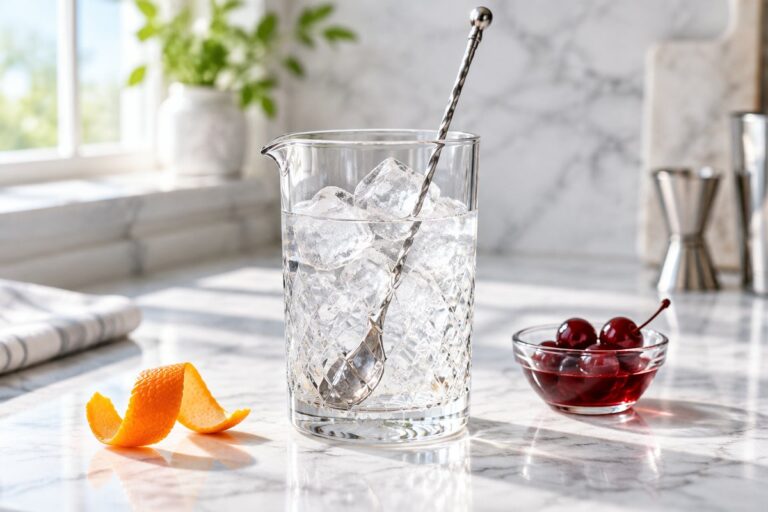
How to make the ideal Manhattan cocktail
- Gather your ingredients. Bourbon or rye whiskey, sweet vermouth, and bitters. A brandied cherry or a strip of orange peel is optional, and he would not skip the cherry. He has heard very good things about Antica Formula vermouth if you want to treat yourself.
- Fill a mixing glass with ice. Plenty of it. The ice chills the drink and adds the small amount of water that makes it drinkable rather than hot.
- Add two ounces of bourbon or rye whiskey.
- Add one ounce of sweet vermouth.
- Add three or four dashes of bitters. The exact number is a matter of taste, and four is not too many.
- Stir until the mixing glass is cold to the touch and the drink is well mixed.
- Strain into a chilled cocktail glass. Add the cherry or the orange peel now. For the love of good drinking, do not serve it over ice: strain it and serve it straight up, in a glass with a rounded bottom rather than a sharp cone.
- Sit back and enjoy.

What the IBA’s spec says, and why his pour is different
The International Bartenders Association lists the Manhattan as fifty millilitres of rye whiskey, twenty of sweet red vermouth and one dash of Angostura bitters, stirred with ice and strained into a chilled cocktail glass, garnished with a cocktail cherry. That is a drier drink than Miguel’s, roughly two and a half parts whiskey to one part vermouth, and with a single dash of bitters rather than four.
Both are correct Manhattans. The IBA number is the published reference point, and if you are making the drink for someone who likes whiskey neat, start there. Miguel’s is for people who want the vermouth to be part of the conversation, and it is the version to hand a guest who says they do not usually like whiskey.
How to make a pitcher for eight or twelve
Multiplying a Manhattan is easy because the drink is measured, not built by feel: 60 ml of whiskey and 30 ml of vermouth per serving before dilution, plus your bitters. Here is the whole thing for a party, with the bitters counted in dashes so nobody has to measure them.
| Drinks | Whiskey | Sweet vermouth | Bitters |
|---|---|---|---|
| 4 | 240 ml | 120 ml | 16 dashes |
| 8 | 480 ml | 240 ml | 32 dashes |
| 12 | 720 ml | 360 ml | 48 dashes |
Those numbers line up with the bottles you buy. A standard 750 ml bottle of whiskey at 60 ml a drink makes twelve and a half servings, and a 375 ml bottle of sweet vermouth at 30 ml a drink covers the same twelve with 15 ml left, which is the most satisfying way to plan a party: one bottle of each, twelve drinks, and a half pour left for the cook.
To make the batch, stir the whiskey, vermouth and bitters in a large pitcher with plenty of ice until the pitcher is cold to the touch, then strain the whole thing into a chilled bottle or carafe and keep it cold until the first guest arrives. Do not leave it sitting on the ice: the dilution you want happens while you stir, and a drink that rests on ice keeps taking on water.
Pour each drink into a chilled glass, add a cherry, and you have done in one pitcher what a bar does one order at a time. If you are also handling the rest of the drinks table, the punch volume math answers the same question for a bowl, and the host gift guide covers what to carry in the other hand.
Batch calculator: whiskey and vermouth for your party
Enter the drinks you need and your own measures. Tap or click to open.
Twelve drinks: 720 ml of whiskey and 360 ml of sweet vermouth. That takes one 750 ml bottle of whiskey and one 375 ml bottle of vermouth, plus 48 dashes of bitters. There will be some left over in the bottles.
The arithmetic gives one drink per guest, which is a first round. A party that runs two hours or more usually needs two, so set the number of drinks you expect to pour, not the number of people you invited.
These are pre-dilution measures. The ice you stir with adds the water that makes the drink drinkable, so do not top the pitcher up to make the numbers prettier.
If this calculator does not run, the table above is the same arithmetic with a pen: guests times 60 ml of whiskey, guests times 30 ml of vermouth, four dashes each.
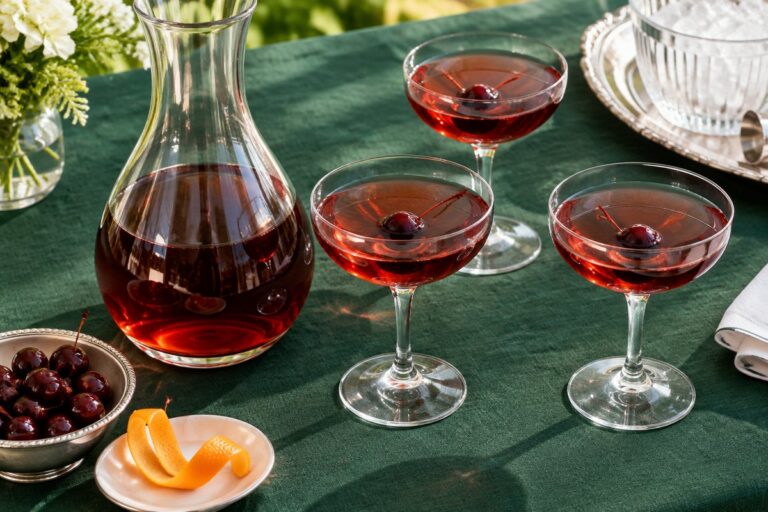
Serving twelve without a shaker
For a party you need four things: a large pitcher, a long spoon, a fine strainer, and a bottle or carafe to hold the finished batch in the fridge. None of them is special equipment, and none of it is difficult.
Stir the batch in the pitcher with ice until the pitcher is cold, strain it into the chilled bottle, and put the bottle back in the fridge. Then set the pitcher aside rather than leaving the drink in it. When guests arrive, pour from the bottle into chilled glasses and add a cherry to each, and the last pour is still cold.
The pace matters more than the technique. Twelve drinks made one at a time is a lot of measuring, stirring and straining while your guests watch, and a batched bottle is twelve pours. Choose the bottle.
Getting it cold without watering it down
A Manhattan is a cold drink served without ice, which means every bit of chilling has to happen before it reaches the glass. Two things get you there: cold glassware and enough ice in the mixing vessel. Put the glasses in the freezer while you set up, or fill them with ice water and tip the water out at the last second.
Use more ice than looks necessary, and use the biggest cubes you have. Small cubes melt faster, which is one reason a bar keeps a tray of two-inch cubes: the same chilling with less water in the drink. Fill the glass, stir until it is cold to the touch, and stop there.
Stir rather than shake. Shaking a Manhattan works, in the sense that you end up with a cold drink, but it aerates it and leaves it cloudy, and a Manhattan should be clear enough to see the cherry through. Stirring also gives you more control: you can stop when the dilution tastes right rather than when your arm gives out.
The glass, the cherry and the orange peel
Chill the glass. The drink is at its best cold and undiluted, and a warm glass works against both. A coupe is the right shape: a rounded bowl holds the drink and looks right on a table.
For the garnish, a brandied cherry is the classic and the one Miguel recommends, and two is not a crime. A strip of orange peel, expressed over the top so the oils land on the surface, suits a drier pour. Do not shake it: shaking a clear drink clouds it, which is the one thing a stirred drink should not be.
Extra tips that make a difference
- Use ingredients you would drink on their own. Cheap whiskey or tired vermouth will ruin the drink, and there is nowhere in a three-ingredient cocktail to hide.
- Experiment with the ratio. Some people like a drier Manhattan with more whiskey and less vermouth, and some like it sweeter. Whichever camp you are in, the ratio is yours to set at home.
- Use good ice. Bigger cubes melt more slowly, which keeps the drink cold without watering it down, and the large cubes sold for Old Fashioneds fit a mixing glass.
- Play with the bitters. Angostura is the standard, and Peychaud’s is worth trying if you want a different layer of flavour. Neither is a mistake.
- Play with the sweetness, too. Some people add a little cherry liqueur or a splash of grenadine. That is a sweeter drink than a Manhattan usually is, and there is nothing wrong with wanting it.
When it does not taste right
Almost every Manhattan problem is a ratio problem, and the fix is the same: adjust one ingredient at a time and taste as you go.
- Too sweet. Add a quarter ounce more whiskey, or cut the vermouth slightly on the next one. If it is still sweet after that, your vermouth is doing more work than the whiskey, which usually means the bottle is a heavy one.
- Too strong. Add vermouth, or a teaspoon of water if you want the whiskey to stay in front. The water is what the ice would have given you anyway.
- Too warm. Chill the glass, chill the vermouth, and stir for longer than you think.
- Cloudy. You shook it, or you poured the ice into the glass with the drink.
- Flat and sweet at the same time. Not enough bitters. Four dashes is a legitimate number.
What to put out with them
A Manhattan is a big-flavoured drink and it does not need much beside it. Salted nuts, a bowl of good olives, a hard cheese cut into pieces, and a little dark chocolate cover the whole table and take ten minutes to put out. Anything strongly smoky or pickled will fight the vermouth, and anything sweet will make the drink taste drier than it is.
Keep the food where people can reach it without standing over the drinks, and put the cherries in a small bowl with a spoon rather than letting guests fish them out of the jar. Small things, but they are the difference between a drinks table that works and one that needs a host standing next to it all evening.
Frequently asked questions
Can you make a Manhattan ahead of time?
Yes, and it is the best way to serve them at a party. Stir the batch with ice, strain it into a bottle, and keep the bottle in the fridge for a few hours. Pour into chilled glasses when guests arrive. What you should not do is leave the drink sitting on ice, which keeps diluting it.
Rye or bourbon?
Both work. Rye is the spicier and drier of the two, bourbon is the sweeter and rounder one, and either makes a proper Manhattan. The IBA spec calls for rye, and Miguel’s own recipe says either will do.
What if I have no bitters?
Make it anyway, then buy bitters for the next one. A Manhattan without bitters is whiskey and vermouth, which is a pleasant drink but a flatter one: the bitters are what keep the sweetness from taking over. Angostura is the standard bottle.
How many drinks does one bottle make?
At 60 ml of whiskey and 30 ml of vermouth per drink, a 750 ml bottle of whiskey makes twelve drinks, and a 375 ml bottle of sweet vermouth covers those twelve with 15 ml left. That is sixty millilitres of whiskey per serving, twelve times over, with a splash left in the bottle.
Watch it made
If you would rather watch the pour than read it, this is the version worth four minutes: a shaker, plenty of ice, a proper stir, and a cherry at the end.
That is it: how to make the ideal Manhattan cocktail. Get good ingredients, experiment until the ratio is yours, and enjoy. I leave you with the video recipe, for your drinking pleasure.
Sources
Every source below was read in November 2026.
- International Bartenders Association, “Manhattan”: 50 ml rye whiskey, 20 ml sweet red vermouth, 1 dash Angostura bitters, stirred and strained, garnished with a cocktail cherry.
- Carpano, Antica Formula: the vermouth Miguel mentions by name.
- Preppy Kitchen, How to Make a Manhattan Cocktail: the video embedded above.
This article is for general information and entertainment, not financial advice.
Updated November 2026 by Richie with the help of modern digital tools.


Leave a Reply