If you are hosting a holiday dinner and wondering how much ham per person to buy, the answer depends on something the per-person rules ignore: the label on the ham. Two hams of the same weight can feed different numbers of people, because one of them carries more added water than the other.
There is a second reason the question is slippery, and it is not a disagreement between the sources. The USDA publishes buying estimates, and the popular host rule lands at the top of both of them, then adds a pound or two for leftovers. The rules do not conflict. One is a range, and the other is where the range ends.
What follows is the range, the shopping rule, the label words that change the count, and a decoder that starts from the ham already in your cart.
In this article
What the USDA numbers actually measure
The USDA’s Food Safety and Inspection Service publishes two planning figures for ham, and both are buying estimates. The section they sit in is headed “Quantity to Buy,” and it opens by telling shoppers to “estimate the size needed.” The figures are “1/4-1/3 lb. per serving of boneless ham” and “1/3-1/2 lb. of meat per serving of bone-in ham.” The bone-in number is the larger of the two, which makes sense once you notice that a bone-in ham is the heavier package for the same amount of meat.
Food52, the recipe and food publication, publishes its own pair of numbers: about half a pound per person for a bone-in ham and a third of a pound for boneless. Read those against the federal figures and the numbers land on the same ceilings. Half a pound is the top of the bone-in range, and a third of a pound is the top of the boneless one, so the publication is not contradicting the government. It is landing on the generous end of it, then telling hosts to add an extra pound or two when they want leftovers. Both sets of figures are buying estimates, and the bone is part of the package either way, which is what the next section is about.
So the useful question is not which number is right. It is what moves you from the bottom of the range to the top. Four things do: appetite, seconds, leftovers and the label. A table of light eaters with three side dishes can live at the floor. A table where the ham is the event, with sandwiches promised for Monday, belongs at the ceiling plus Food52’s extra pound or two.
How many people a ham feeds
Food52 publishes a table for the guest counts people actually host, and it is the most useful shopping list in either source because it is already in purchase weight. Here it is. Food52 does not print its working, but each row runs from about the per-person rule to roughly a pound above it, which matches the extra pound or two they suggest when you want leftovers.
| Guests | Bone-in ham to buy | Boneless ham to buy |
|---|---|---|
| 4 | 2 to 3 lb | 1.5 to 2 lb |
| 6 | 3 to 4 lb | 2 to 3 lb |
| 8 | 4 to 5 lb | 2.75 to 3.5 lb |
| 10 | 5 to 6 lb | 3 to 4 lb |
| 12 | 6 to 7 lb | 4 to 5 lb |
For a bigger table, Food52’s pattern continues at about half a pound per person for bone-in ham. Fifteen people is about seven and a half pounds, and twenty is about ten. If that pushes you past about ten pounds, you are into a whole ham, which changes the warming time more than the shopping.
Why the bone changes the number
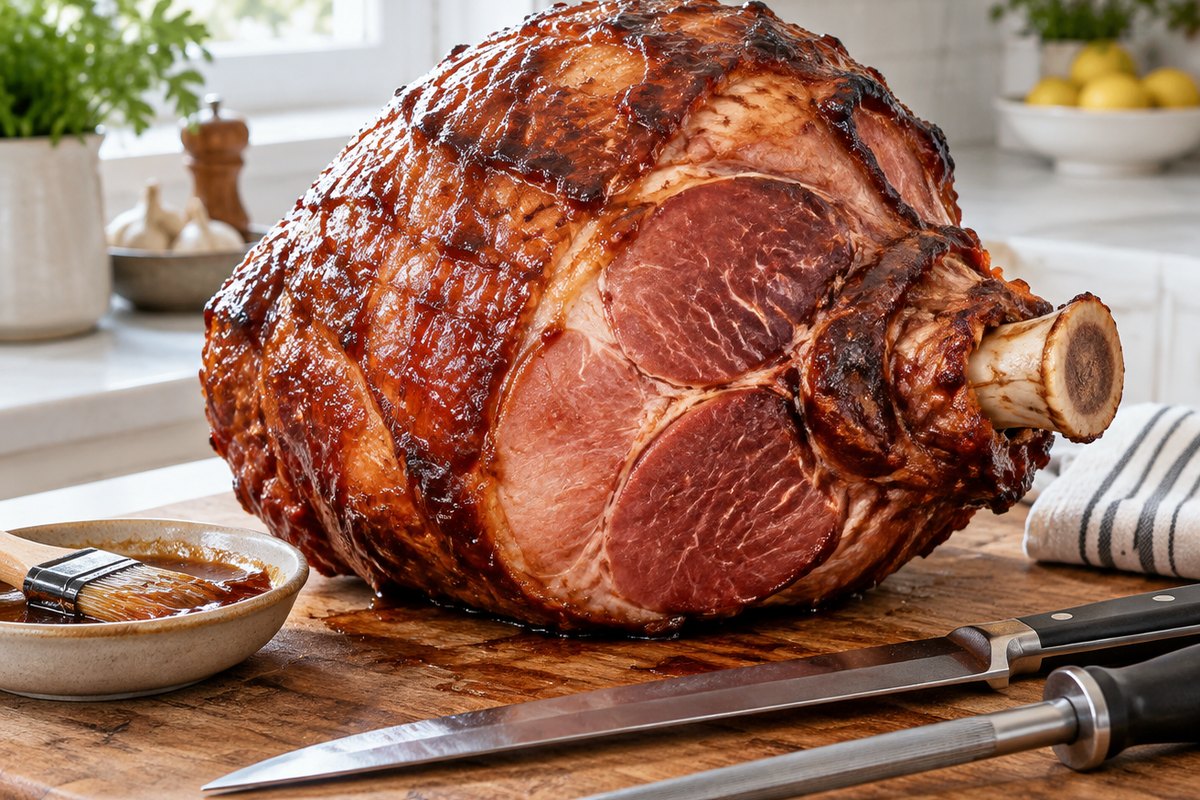
A seven-pound bone-in ham is not seven pounds of meat. The bone, the fat cap and the trim all count toward the weight you pay for, which is why you buy more pounds per person when the bone stays in, and why Food52’s bone-in rule is higher than its boneless one. Neither source publishes a bone yield, so the exact meat weight of your particular ham stays unknown until you carve. Plan with the purchase figures, then carve and see.
The label words that change the count
Now the part that changes the arithmetic. The USDA grades ham labels by protein content in the lean portion, and the lower the floor, the more of the package can be something other than meat. These are protein floors, not a ranking of added water:
- Ham: at least 20.5 percent protein in the lean portion.
- Ham With Natural Juices: at least 18.5 percent protein.
- Ham – Water Added: at least 17.0 percent protein, with about 10 percent added solution.
- Ham and Water Products: the label states the percentage of added ingredients, and the product carries more than the water-added grade.
Two of those grades come with a published solution number: the water-added label carries about 10 percent, and a Ham and Water Products label prints its own figure. A plain “Ham” may still contain added water, which the USDA permits, and the ingredients statement on the package is where a shopper can see it. The arithmetic that matters is the one for the label in your hand: a ten-pound water-added ham has about nine pounds of non-solution weight. For a host counting half a pound of ham per person, not half a pound of package, that is the difference between feeding twenty people and feeding eighteen from the same size package.
The second label question decides how you cook it. A ham marked “fully cooked” is ready to eat from the package and only needs warming. A “cook-before-eating” or fresh ham must reach 145 F with a three-minute rest before anyone eats it. The USDA requires hams that are not ready to eat but look as if they are to say so on the front of the package, along with cooking directions. So look for “fully cooked,” or for a cooking instruction.
Decode the ham in your cart
This is the reverse of the usual calculator. Instead of starting with a guest list, start with the ham you are holding: enter its weight, what the label says and the cut. The decoder subtracts the added solution where the label states a percentage, turns what is left into servings at the published rates, and shows the USDA’s buying range as a cross-check.
Ham decoder: how many people will this ham feed?
Enter the weight, the label wording and the cut, and it prints people fed, non-solution weight and sandwich count. Tap or click to open.
The decoder uses the USDA’s 10 percent added solution for the water-added grade and the percent printed on a Ham and Water Products label. For Ham and Ham With Natural Juices it counts no added solution, because those grades publish a protein floor and not a percentage; check the ingredients statement if that matters to you. Servings use Food52’s rates, half a pound per person for bone-in and a third of a pound for boneless. Neither source measures the bone, so on a bone-in ham every figure here is an upper bound.
Warming a cooked ham without drying it out
A supermarket ham says on its label whether it is fully cooked. When it is, the oven job is warming rather than roasting, and that changes the target: you are bringing the center to a safe serving temperature without driving more moisture out of meat that is already done.
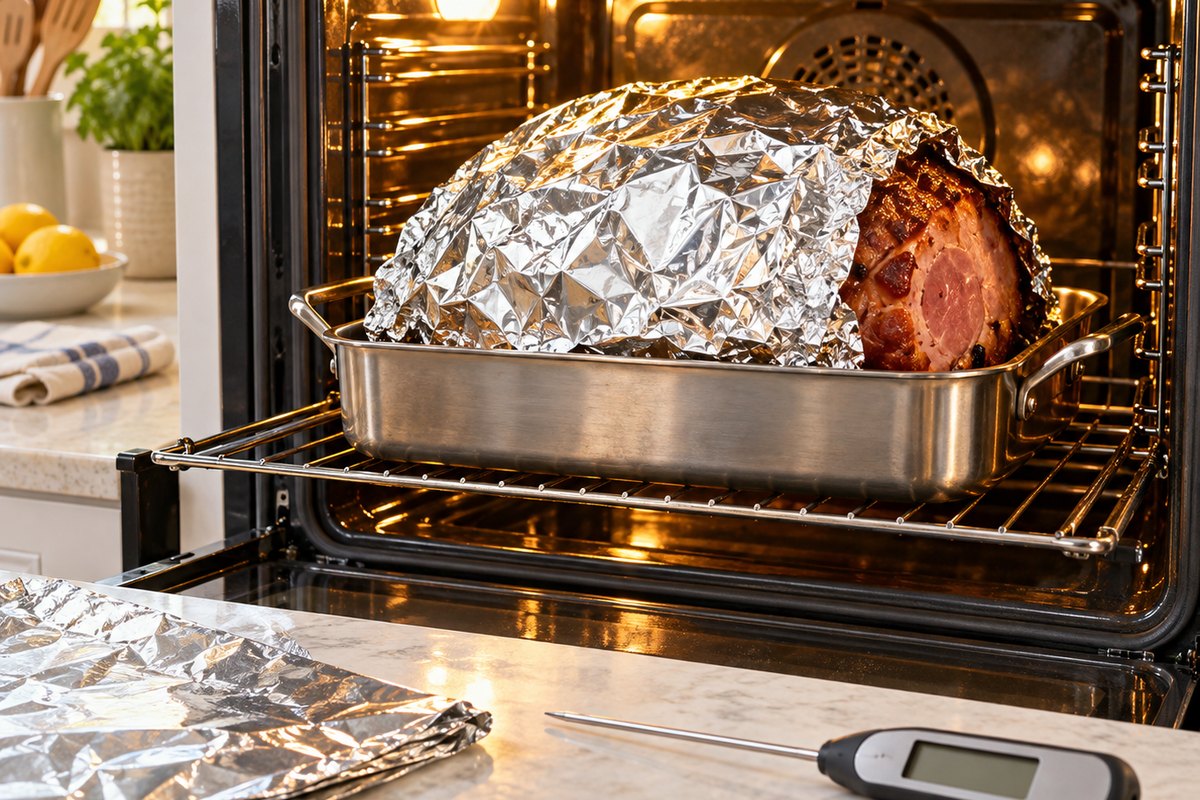
Three numbers cover it, and the questions below use the same three. Set the oven no lower than 325 F. For a spiral-cut ham, cover it with heavy foil and plan about 10 minutes per pound; the USDA’s timetable gives a wider 10 to 18 minutes per pound for a 7 to 9 pound spiral, so start at the shorter figure and let a thermometer finish the job. Pull it at 140 F if it was packaged fully cooked in a USDA-inspected plant, or 165 F if it was repackaged in a store or you are reheating leftovers.
Other cuts follow the federal timetable’s bands, quoted with the page they come from. The USDA’s ham guide lists 18 to 24 minutes per pound for a 5 to 7 lb cooked bone-in half and 15 to 18 for a 10 to 14 lb whole; its holiday-meats guide lists 27 to 33 minutes per pound for a 3 to 4 lb fully cooked boneless ham. Those are wide because shape and packaging change how fast heat reaches the center.
Glaze late, and keep the foil on first
If you are glazing, brush it on near the end, after the foil comes off, and give it just enough time to set. The USDA’s spiral method keeps the ham under heavy foil while it heats, so the uncovered stretch at the end is where the glaze goes. Warm first, glaze last, rest before carving.
For cook-before-eating or fresh ham, everything changes: that is raw meat, and it must reach 145 F with a three-minute rest. The 140 F reheat target above applies only to a ham the plant already cooked.
Carving, holding and the two-hour clock
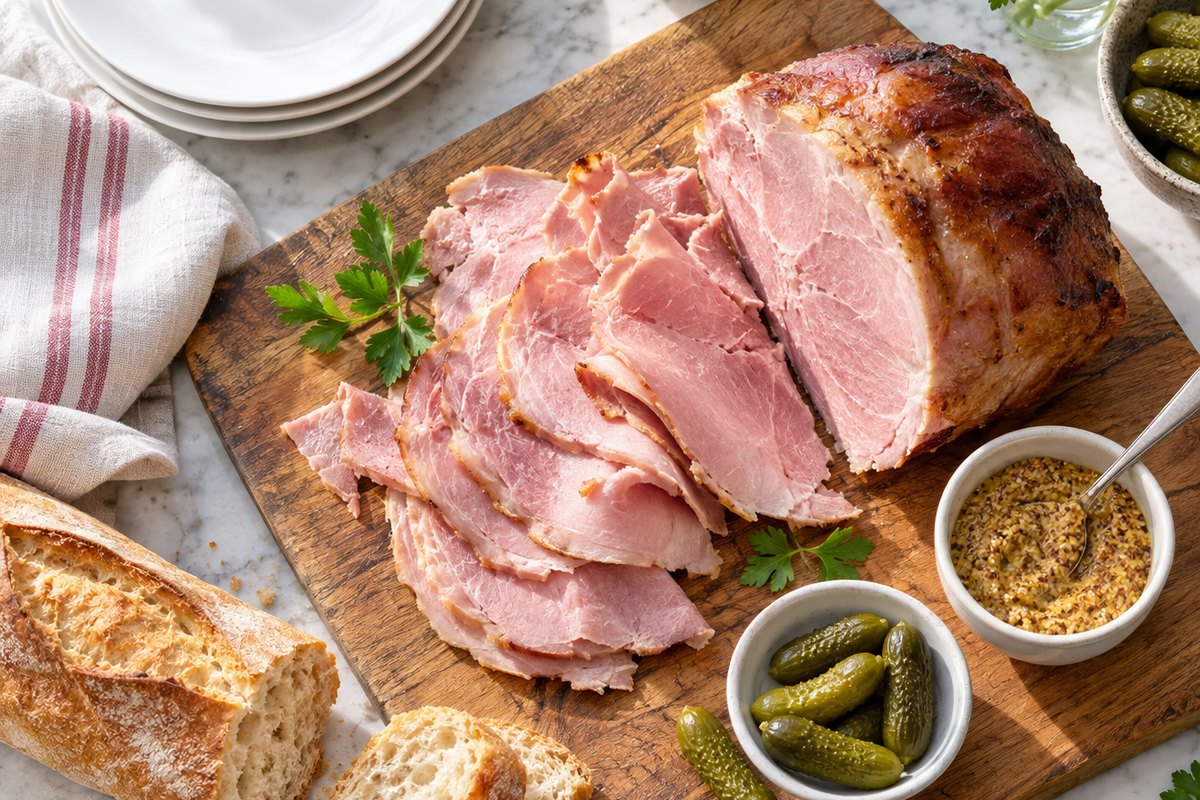
A spiral-cut ham is most of the way carved already: separate the slices with a fork and a thin knife, then cut around the bone when the easy slices are gone. The short video below, from Omaha Steaks, shows where the knife goes along the bone.
Once it is carved, the clock starts. The USDA’s guidance is blunt: never leave food out of refrigeration for more than two hours, and no more than one hour if the room is above 90 F. If the ham is going to sit out through a long dinner, keep it hot at 140 F or above in a warming tray or slow cooker rather than letting it drift down through the range where bacteria multiply fastest.
One more note specific to the spiral cut: the USDA says a spiral-cut ham is safe to eat cold and is best served cold, because warming a pre-sliced ham can dry the meat and melt the glaze off. If you want yours warm, that is fine, and the method above is how. Just do not treat a fully cooked spiral ham like a raw roast.
Leftovers: the math and the clock
Leftover ham is half the reason to buy the bigger one, and it is also where food safety gets decided. Cool it quickly in shallow containers, refrigerate within two hours of serving, and reheat to 165 F. A spiral-cut ham or leftovers from a ham you cooked keep three to five days in the refrigerator and one to two months in the freezer, according to the USDA’s storage chart.
For sandwich planning, one piece of arithmetic that is ours rather than a source’s: a pound of cooked ham makes about five three-ounce sandwiches. Count what is left on the board after carving, and that number tells you whether you have a week of lunches or a very good reason to invite people over the next day.
Frequently asked questions
How much ham per person for Christmas dinner?
Plan on about half a pound of bone-in ham per person, or a third of a pound if it is boneless. That is Food52’s purchase rule, and it sits at the top of the USDA’s buying range for the same cut, which is where a holiday table with seconds tends to land.
How many pounds of ham for 10 people?
For ten people, Food52’s table calls for 5 to 6 pounds of bone-in ham or 3 to 4 pounds boneless. The top of each range includes the extra pound or two the publication recommends for leftovers.
Is bone-in or boneless ham better?
Bone-in ham carries more flavor and gives you a bone for soup, but part of what you buy is bone you cannot slice, which is why the purchase rule for bone-in ham is higher. Boneless ham is easier to carve and portion. Neither is a bad buy; they are sized differently, and that is the part that trips people up.
How long does it take to warm a spiral ham?
Plan about 10 minutes per pound at 325 F, covered with foil, for a spiral-cut ham packaged fully cooked at a USDA-inspected plant. The USDA’s timetable gives a wider 10 to 18 minutes per pound for a 7 to 9 pound spiral. Pull it at 140 F, or 165 F if it was repackaged or you are reheating leftovers.
Do water-added hams feed fewer people?
Yes. The water-added grade carries about 10 percent added solution, according to the USDA, so a ten-pound ham of that grade has roughly nine pounds of non-solution weight, and the bone comes out of that. A Ham and Water Products label states its own percentage, which the decoder above uses.
Can you eat spiral ham cold?
Yes. The USDA says spiral-cut cooked hams are safe to eat cold and are best served cold, because warming pre-sliced ham can dry it out. If you prefer it warm, cover it with foil and heat gently at 325 F to 140 F, or 165 F if the ham was repackaged in a store or these are leftovers.
Where this leaves your shopping list
Pick the cut first, take Food52’s purchase number for it, then read the label for added solution and let the decoder adjust. Buy the closest size the store sells, and let the label also tell you whether you are warming a cooked ham or cooking a raw one. The ham is forgiving. The shopping is the part that rewards a minute of arithmetic, and now you have it.
If you are still sorting out the rest of the meal, our guide to how many cookies a cookie exchange needs uses the same label-and-math approach, and what to bring to a dinner party covers the other half of the planning. For the bird version of this question, see how much turkey per person.
Sources
All sources below were read in November 2026. The sandwich count and the decoder’s arithmetic are ours, not a source’s.
- USDA Food Safety and Inspection Service, Hams and Food Safety (updated January 15, 2025): meat-per-serving ranges, label grades, reheating temperatures, timetable and storage chart.
- USDA Food Safety and Inspection Service, Roasting Those “Other” Holiday Meats (updated December 5, 2024): the 325 F oven floor, the 3 to 4 lb boneless timing and cook-before-eating guidance.
- USDA Food Safety and Inspection Service, “Danger Zone” (40 F – 140 F) (updated June 28, 2023): the two-hour rule, holding temperature and leftover cooling.
- Food52, How Much Ham Per Person? (updated March 2022): purchase weights per person, the guest-count table and the extra pound or two for leftovers.
Researched and written by Richie with the help of modern digital tools. Images: AI-generated illustration.

Leave a Reply