Buying a Thanksgiving turkey starts with one number: how much turkey to buy, in pounds, for the people coming to dinner. Everything else moves out from that figure, from the thaw date to the roasting time to what is left on Friday, which is why the wrong number is so expensive to fix.
The rules are simple enough to quote and easy to misapply. The U.S. Department of Agriculture’s Food Safety and Inspection Service, the federal agency that runs the meat and poultry hotline, says to allow 1 pound of turkey per person, and most hosts have heard some version of that. But the rule counts the whole bird as it sits in the store, bone and all, and it says nothing about leftovers. Change that assumption and the pound count moves, which is where oversized birds come from.
So this page sizes the bird the way a host actually shops. One weight per guest, with its scope stated next to it. Worked examples for the crowd sizes people search for, from six at the table to twenty. The ceiling that splits one bird into two. And a folded calculator that turns your guest list into pounds and a thaw date. The safety numbers appear in the text and again inside the tool, so you can check them without scrolling.
In this article
| People at the table | Whole bird, no leftovers (1 pound each) | Whole bird, leftovers (2 pounds each) | What the 15-pound ceiling does |
|---|---|---|---|
| 4 | 4 pounds | 8 pounds | One bird either way |
| 6 | 6 pounds | 12 pounds | One bird either way |
| 8 | 8 pounds | 16 pounds | One bird; two when you want leftovers |
| 10 | 10 pounds | 20 pounds | One bird; two when you want leftovers |
| 12 | 12 pounds | 24 pounds | One bird; two when you want leftovers |
| 16 | 16 pounds | 32 pounds | Two birds; three with leftovers |
| 20 | 20 pounds | 40 pounds | Two birds; three with leftovers |
Every cell in that table is desk arithmetic on the per-person rules, all of it whole-bird weight as it sits at the store: 1 pound each in the middle column, and the 2 pound leftovers rate of Bon Appetit’s test kitchen in the right. Past 15 pounds that rate turns into more than one bird, which is what the last column names. And the table is arithmetic, not shelf reality: the USDA roasting chart starts at an 8 pound bird, so the 4 and 6 pound answers fall below every timed row. At the small end the test kitchen’s own number for four to six people with leftovers is 11 to 13 pounds, so read the 8 pound cell as the chart floor: when your arithmetic lands under 8 pounds with no leftovers, buy the 8 pound bird the chart starts at, and when it lands there with leftovers at a table of four to six, buy in that 11 to 13 pound range instead.
Three numbers, three different questions
Start with the fact that the guidance you have already seen is not one rule. There are three, and each answers a different question.
The first is the federal one. In its public Q&A, the Food Safety and Inspection Service answers the question “What size of turkey should I buy?” with a single line: “Whether you are buying a fresh or frozen turkey, allow 1 pound of turkey per person.” That 1 pound is bird weight at purchase, bone and skin included. The agency says nothing about leftovers, so this page treats 1 pound as the dinner-sized number.
The second is the general rule from Bon Appetit, the cooking magazine: “The general rule is 1 to 1 1/2 pounds of turkey per person.” Same whole bone-in bird, same purchase weight, but a wider aim, and the range exists because a whole bone-in bird carries parts nobody eats. If your crowd is known to go back for seconds, the top of that range is the honest end of it.
The third is the leftovers rule, and it is the biggest of the three: 2 pounds of whole bird per person. It comes from Bon Appetit, which reports that recipe developer Jessie YuChen, a former staffer, recommends scaling up “to 2 pounds per person to guarantee extra turkey for leftovers” for smaller gatherings. Past the 15 pound ceiling that rate turns into two birds, or a bird and a second main. This one buys turkey for the fridge as well as the table.
One decision, three questions: what feeds the table, what feeds it with slack, and what also stocks the fridge for the weekend.
Why a pound of bird is not a pound of meat
The confusion comes from treating the two as the same thing. They are not. Bon Appetit is blunt about it: “Buying a pound of turkey per person doesn’t mean it’ll yield an equivalent amount of meat.” A turkey is not a bag of protein with a wrapper. It has a skeleton.
The math shows up as soon as you buy a breast. Bon Appetit puts it this way: “most of the breast is 40 to 50-percent bone and cartilage,” which is why the same page says you will “realistically get around half a pound of edible meat per guest” at 1 to 1 1/2 pounds of breast per person. Roughly half is bone. That is the shortcut to remember for a breast: the pounds at the store are about twice the meat that reaches the plate.
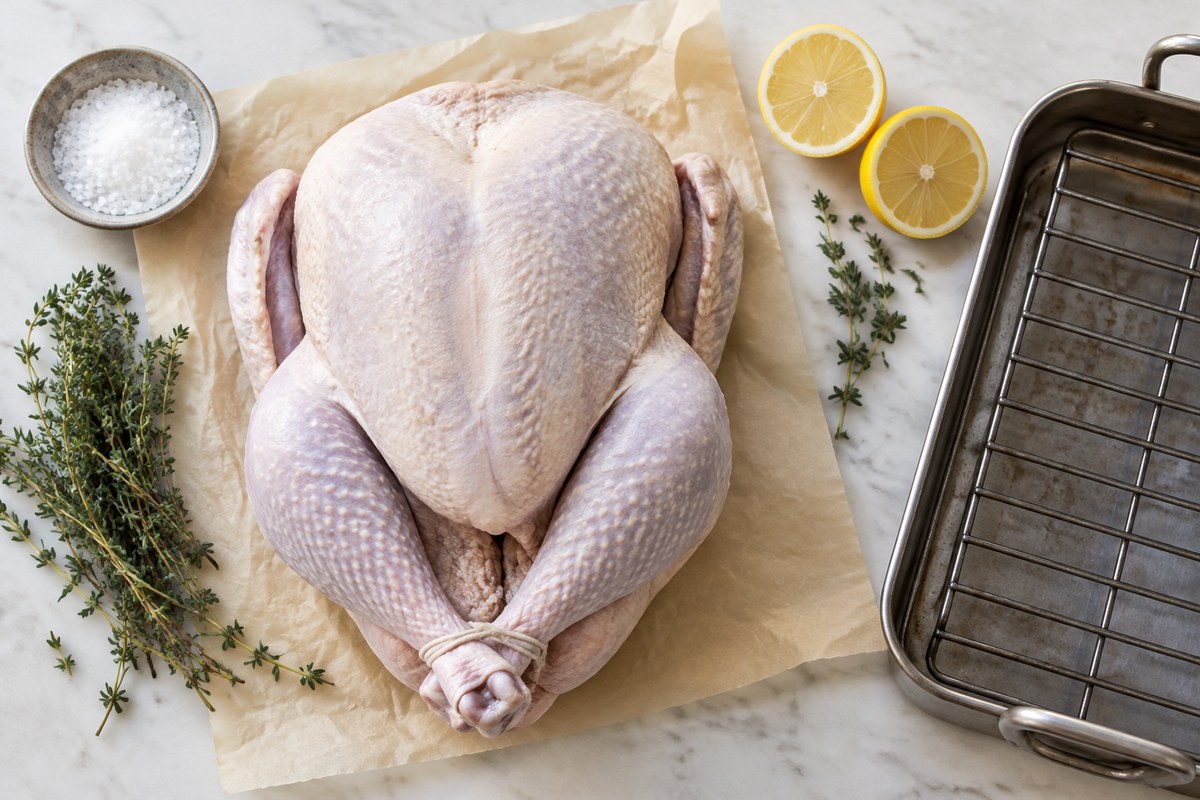
The same idea shows up in the individual cuts. The Food Safety and Inspection Service’s cooking chart lists a whole bone-in breast at 4 to 6 pounds or 6 to 8 pounds, a single breast half at 2 to 3 pounds, and drumsticks and thighs at 3/4 to 1 pound each. Those are raw weights for the cuts as they leave the butcher counter.
How much turkey for 6, 10 and 20 people
Here is the whole calculation. For six at the table with no leftovers: 6 people x 1 pound = 6 pounds of bird, except that 6 pounds is under the 8 pound floor of the USDA roasting chart, so buy the smallest bird the USDA chart covers, 8 pounds, or a bone-in breast. For leftovers on Friday: 6 x 2 = 12 pounds. And here is the room to breathe: YuChen’s range for a small gathering is 11 to 13 pounds for four to six people.
For ten at the table: 10 x 1 = 10 pounds for dinner alone, 10 x 1 1/2 = 15 pounds at the top of the general range, which leaves some to spare, and 10 x 2 = 20 pounds to guarantee leftovers. That last figure crosses into the band where one bird stops cooking evenly.
Twenty at the table is a different kind of meal: 20 x 1 = 20 pounds with nothing to spare, 20 x 1 1/2 = 30 pounds, and 20 x 2 = 40 pounds to guarantee leftovers. That last rate is Bon Appetit’s advice for smaller gatherings, so at this size it is arithmetic to steer by rather than a promise to buy in one piece.
With 20 people, Bon Appetit’s rule for crowds comes first: “Aim for 1 to 1 1/2 total pounds of protein per person, including your supplementary main.” Spread the work across two moderate birds, or a bird and a second protein. The turkey becomes one of the plates instead of the entire meal.
The 15-pound ceiling, and the two-bird plan
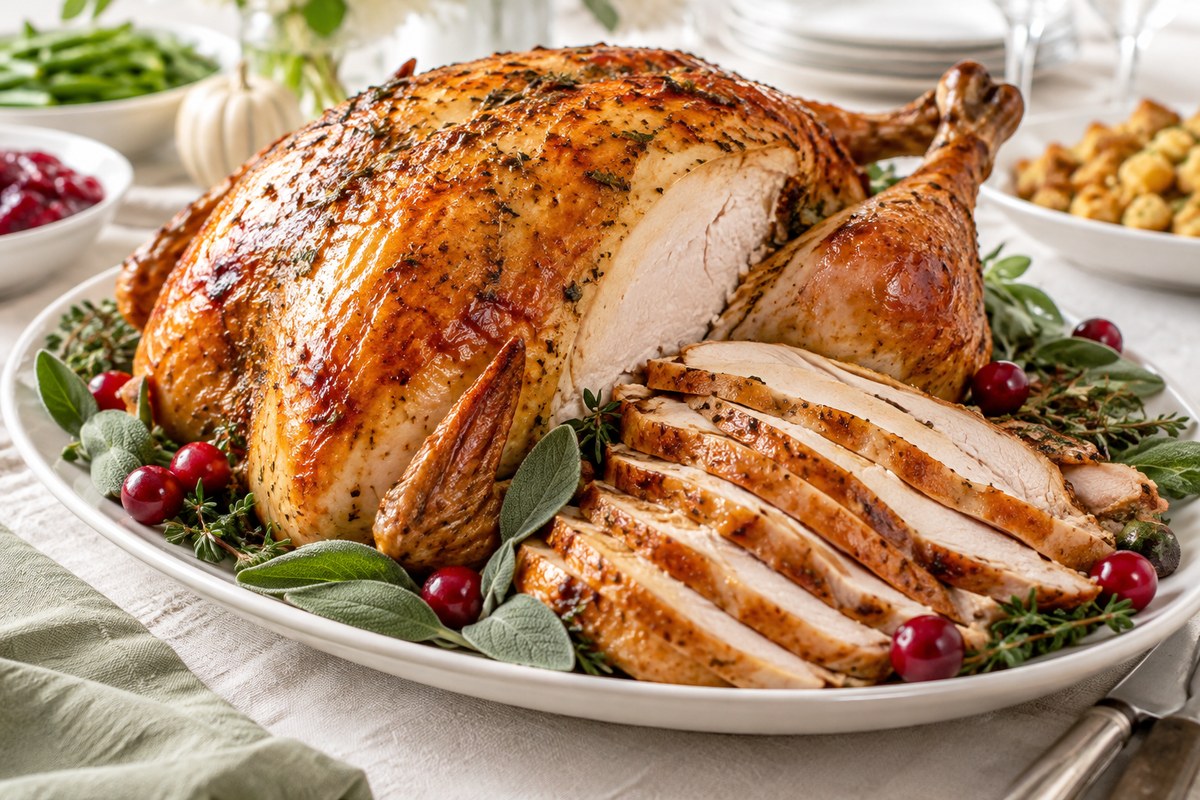
There is one structural limit in this whole calculation, and it is the reason people end up with two birds. Amiel Stanek, a contributing editor at Bon Appetit, is direct about it: “you’re going to get the best results from a 15-pound turkey, max.” Not a safety limit. A cooking one, because past that weight the bird roasts unevenly.
The answer is two moderate birds side by side instead of one giant one, and it works better than most hosts expect. Bon Appetit’s advice is to buy two or more moderately sized birds and roast them side by side, or to roast one a day or two early and reheat it on Thanksgiving Day. Two birds also give the table two of everything, so the white-meat seekers and the dark-meat loyalists both get what they came for.
If you are buying breast instead
A breast is a different cut from a whole bird. A bone-in breast is 40 to 50 percent bone and cartilage, so the whole reasoning above holds: a part of the weight goes to the bone, and the meat that reaches the plate is less than the number on the label.
The practical figure is Bon Appetit’s: “Plan on 1 to 1 1/2 pounds of turkey breast per person.” Take the bone out and that becomes around half a pound of edible meat per guest. On a good day it is half a pound of meat.
USDA lists whole bone-in breasts at 4 to 6 pounds or 6 to 8 pounds, and breast halves at 2 to 3 pounds. Roast a 4 to 6 pound breast for about 1 hour and 30 minutes to 2 hours and 15 minutes at 325 degrees Fahrenheit, and a 6 to 8 pounder for 2 hours and 15 minutes to 3 hours and 15 minutes.
A boneless breast skips the bone arithmetic entirely. So the practical rule is smaller: allow about 1/2 pound per person for a dinner with nothing left over, 3/4 of a pound for a round of extras, and a full pound for a crowd that plans on sandwiches Friday. That math is this desk’s, derived from the cooked-meat figure above, not a published rule: the USDA chart lists whole birds and bone-in breasts, and prints no time for boneless.
The calculator
Give the calculator your guest list and it returns pounds to buy, the bird split when you cross the 15-pound ceiling, a thaw date, and the oven basics. The note underneath gives the working, so you can check it against the arithmetic above.
The bird-size calculator
Guests in, pounds out, and a thaw date for the calendar. Tap or click to open.
Reading your guest list…
How this is built: kids 12 and under count as half an adult, light eaters multiply the number by 0.9 and big eaters by 1.15, and the result rounds up to a whole pound. The pounds themselves come from the published rules: 1 pound per person for a whole bird (USDA), 1.5 pounds for a round of leftovers (the top of Bon Appetit’s general range) and 2 pounds for a lot (Bon Appetit’s figure, which it gives for smaller gatherings), and about half a pound of boneless meat per person. The 15-pound split follows the test kitchen’s advice that bigger birds cook unevenly.
From the number to the thaw date
The pound count has to cover two things: the grocery list and the calendar. Turn the weight into a start date. The Food Safety and Inspection Service is generous with timing: let the bird thaw in the refrigerator, "allow approximately 24 hours for each 4 to 5 pounds in a refrigerator set at 40 F or below."
The agency publishes the same thing as bands, which is what to clip to the refrigerator: a 4 to 12 pound bird takes 1 to 3 days, 12 to 16 pound birds take 3 to 4 days, 16 to 20 pound birds take 4 to 5 days, and 20 to 24 pound birds take 5 to 6 days. Then "a thawed turkey can remain in the refrigerator for 1 or 2 days before cooking," so the timeline has slack.
If you are running late, the agency has a second path. Cold water: submerge the wrapped, leak-proof bird in cold tap water, 30 minutes per pound, changing the water every 30 minutes. A 20 pound bird runs about 10 hours this way, and the agency's band for a 20 to 24 pound bird runs 10 to 12. The safety rule, stated once here: the refrigerator stays at 40 F or below, meat sits at room temperature for no more than 2 hours, and the bird never thaws on the counter, no matter how frozen it looks. Cook immediately after a cold water thaw.
In the store and in the pan
The whole bird goes from the store to the refrigerator or freezer right away: the Food Safety and Inspection Service's storage table allows 1 to 2 days in the refrigerator for fresh whole turkey from purchase, and 12 months in the freezer at best quality. A frozen turkey is safe indefinitely; 12 months is the quality limit.
And read the wrapper on the way out. Basted and self-basted birds carry an added solution. The USDA allows "the maximum added weight of approximately 3% solution before processing is included in the net weight on the label." That solution is folded into the net weight on the label, so the pound count you buy already includes it.
Now the pan. Set the oven no lower than 325 F. Place the bird breast-side up on a flat rack in a shallow pan 2 to 2 1/2 inches deep: deep enough to catch the juices, shallow enough to roast rather than steam.
The bird is done when a thermometer reads 165 F in the innermost part of the thigh, the wing, and the thickest part of the breast. The clock at 325 F: a 14 to 18 pound bird takes about 3 hours and 45 minutes to 4 hours and 15 minutes when unstuffed.
Then "let the bird stand 20 minutes before removing the stuffing and carving." The agency's reason is quality: the juices set, and the bird carves more easily. For the timing of every pot on the stove with it, see the Thanksgiving dinner timeline.
What to do with the turkey that is left
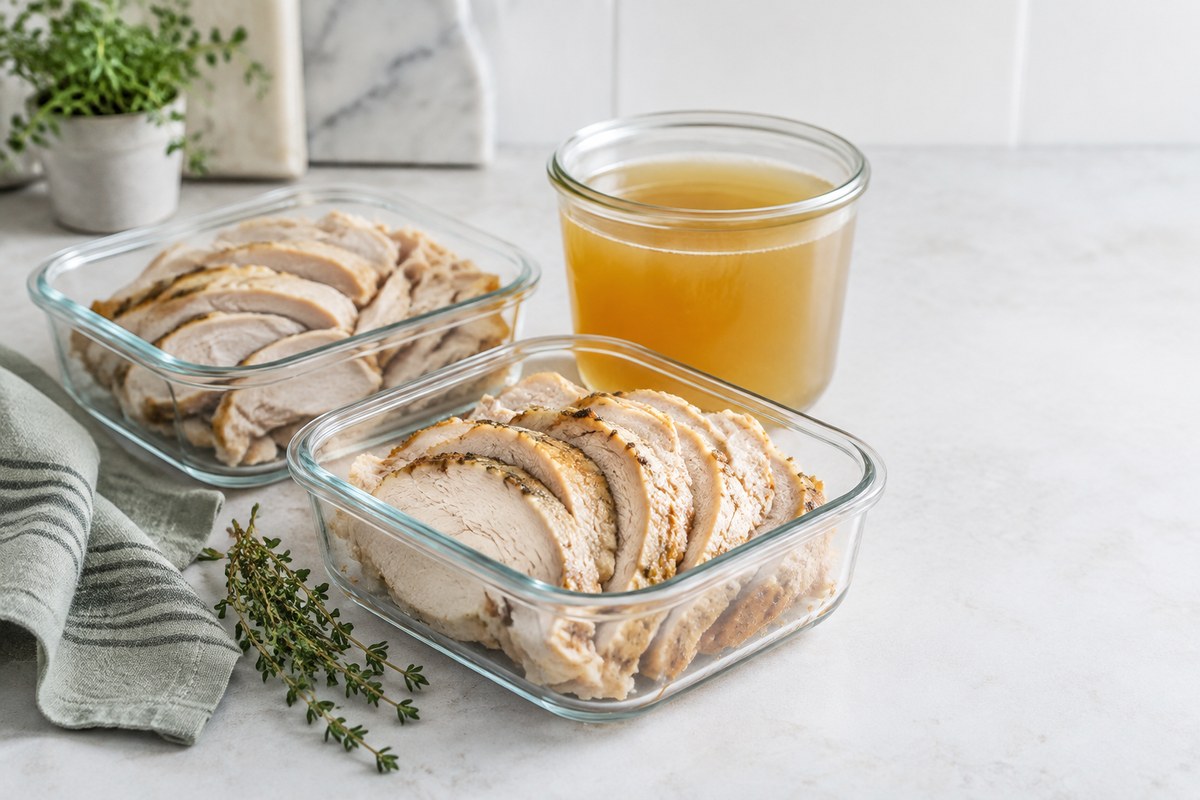
The turkey you carved is the part of the purchase most worth not wasting, and the clock is short. The Food Safety and Inspection Service puts cooked turkey at 3 to 4 days in the refrigerator and 4 months in the freezer, and the same for broth and gravy: 3 to 4 days cold, 2 to 3 months frozen.
Pack the bird in serving-size containers before dessert, and using it up stops being a chore. Turning those containers into meals is what the guide to Thanksgiving leftovers is for.
This article is for general information and entertainment, not financial advice.
Frequently asked questions
How much turkey per person?
Allow 1 pound of whole bird per person, the figure the USDA's Food Safety and Inspection Service gives; it does not mention leftovers. The general rule at Bon Appetit is 1 to 1 1/2 pounds per person. For guaranteed leftovers, the magazine's figure is 2 pounds per person, which it gives for a smaller gathering.
How much turkey do I need for 10 people?
Ten pounds buys enough for dinner without leftovers, 15 pounds at the top of the general range, which leaves some to spare, and 20 pounds to guarantee leftovers. Past 15 pounds one bird cooks unevenly, so 20 pounds is two birds of 10 pounds each. The table at the top of this page lays out 4 through 20 people the same way.
Does the one-pound rule include the bones?
It counts the whole bird, bone included. Bon Appetit puts a bone-in turkey breast at 40 to 50 percent bone and cartilage, so 1 to 1 1/2 pounds of breast per person gives about half a pound of edible meat.
How much turkey breast per person?
For bone-in breast, plan 1 to 1 1/2 pounds per person, which is Bon Appetit's guidance. From there, boneless breast is a lighter lift: about 1/2 pound per person for no leftovers, 3/4 of a pound for extras, and a full pound when a crowd wants plenty, which is this desk's arithmetic from the half pound of edible meat figure.
Is a 20-pound turkey too big?
A 20 pound bird sits past the 15-pound ceiling Bon Appetit works to. That ceiling is where Amiel Stanek, the magazine's contributing editor, says a bird stops roasting evenly. Roast two moderate birds side by side instead, each one with its own rack and pan.
How long does a 20-pound turkey take to thaw?
Count 5 to 6 days in the refrigerator at 40 F or below for a 20 to 24 pound bird. In cold water, a 20 pounder takes about 10 hours at 30 minutes per pound, and FSIS's band for a 20 to 24 pound bird runs 10 to 12 hours, with the water changed every 30 minutes.
The whole decision is one weight and a date. Buy once and the thaw, the pan and the roasting time all follow. If the bird is one dish among many at a table full of friends, the group version of this dinner has its own arithmetic: the Friendsgiving potluck planner.
Sources
All sources below were read in October 2026.
- U.S. Department of Agriculture, Food Safety and Inspection Service: Public Q&A, "What size of turkey should I buy?". The 1 pound per person figure, updated February 4, 2025.
- U.S. Department of Agriculture, Food Safety and Inspection Service: Turkey from Farm to Table. The storage table, part weights, and the added-solution note on basted birds, updated July 2, 2024.
- U.S. Department of Agriculture, Food Safety and Inspection Service: Turkey Basics: Safe Thawing. The refrigerator and cold-water thawing times, updated October 24, 2023.
- U.S. Department of Agriculture, Food Safety and Inspection Service: Turkey Basics: Safe Cooking. The oven temperature, roasting times and 165 F doneness check, updated October 22, 2019.
- Bon Appetit: How Much Turkey Per Person Is Ideal for Thanksgiving?. The general rule of 1 to 1 1/2 pounds, the 2 pound leftovers figure, and the 15-pound ceiling.
Researched and written by Richie with the help of modern digital tools. Images: AI-generated.

Leave a Reply