Twenty-four pockets to fill, and a limit in mind for what the month should cost before the 24th arrives. That is the December this page is built for. The advent calendar ideas here come back to one object: a box or cloth panel with 24 small pockets, one opened on each of the last 24 days before Christmas. This year the person whose job it is to fill them is you. By junk, I mean the plastic trinket used up in under a minute, the filler that runs on a button battery, or anything that cannot be given to the child whose pocket it is in.
At first the shelves make it look like a product question, with boxes and bags already stuffed and priced. It is a budget question in a product costume, because the shelf mixes calendars with different numbers of doors, so a shelf price does not compare two calendars. In other words, a calendar with 12 doors and a calendar with 24 doors serve different countdowns. So this page comes down to three things: what goes in the pockets, what each pocket costs divided by the doors it fills, and which fillers clear the safety rules the US Consumer Product Safety Commission sets out. 1 December 2026 is 15 days after 16 November 2026, and Advent begins Sunday 29 November, so a plan built this week is waiting when the first door opens.
In this article
The short version
| Question | Short answer |
|---|---|
| What does one pocket cost? | The listed price divided by the number of doors. Of the calendars we priced with a stated day count, the spread runs 58 cents to $24.79 a day. |
| Which number decides the month? | Your daily figure. At $1 a day one child’s 24 pockets come to $24. |
| What goes in a pocket? | Something small enough to fit the pocket, used after the 26th or eaten on the day, and safe for the youngest hand reaching in. |
| Where is the safety line? | The US Consumer Product Safety Commission toys page: age labels for choking hazards, small parts away from children under 3, deflated balloons away from children under 8. |
What a shop-bought calendar really costs, per day
For the record, the prices below come from NBC News Select’s roundup of 2026 advent calendars, published 12 November 2026 and read here on 16 November 2026. Prices move; these are the listed prices on 16 November 2026, and the per-day figures are our own arithmetic. Three pieces of work go into this page beyond the shelf price: the per-day arithmetic run on each calendar’s own day count, the 12-versus-24 reconciliation, and the Commission’s age rules placed next to the fillers.
Retailers print the shelf price, because the shelf price is what the card charges. The number that decides the December is the shelf price divided by the number of doors, and the roundup we priced from does not print it. Set that daily figure before a single shelf gets a look. Then every calendar, filler and craft becomes one simple comparison against your own number. So the month has 24 openings. At $1 a pocket one child’s December costs $24 before any wrapping, at $2 a pocket it costs $48, and a second child doubles every number in that sentence.
Even so, the season’s scale is fixed by the forecasters before December starts. The National Retail Federation, the industry’s trade group for American retail, forecasts November and December retail sales of $1.013 trillion, 4.2% over 2025.
Why the shelf price cannot compare two calendars
But the mix of door counts is the problem the shelf hides. NBC News Select’s roundup lists 51+ calendars, and our table is a subset of that list. It frames the product in one sentence: “Traditionally, Advent calendars count down the days until Christmas.” The page names 12-day items alongside 24-day ones, and the item line is what counts. Frisco’s cat calendar holds 12 toys, Voluspa’s candle calendar runs 12 days, Yankee Candle sells a “12 Days of Christmas” calendar, and Papier sells a 12-day version “for the first time this year”. A 12-day calendar is not automatically cheaper per day, and our arithmetic below shows exactly that.
| Calendar | Price (retailer) | Days stated by source | Our cost per day |
|---|---|---|---|
| Lindt Holiday Chocolate Teddy Bear, 24 pieces | $13.97 (Amazon, Walmart; $18.99 at Lindt) | 24 | $0.58 |
| Godiva 2026 Holiday Chocolate, 24 pieces | $43.50 (Amazon, list $58.00) | 24 | $1.81 |
| Squishmallows 24-Day Micromallows, 24 plush 2.5 inches tall | $48.99 (Amazon, list $69.99) | 24 | $2.04 |
| Bonne Maman 2026 Limited Edition, 24 mini jars | $55.99 (Amazon, Bonne Maman, MoMA) | 24 | $2.33 |
| Sugarfina 24 Tastes of Christmas, four pieces a drawer | $60.00 (Amazon, Saks, Sugarfina) | 24 (four pieces a day) | $2.50 |
| Compartés Enchanted Castle, 24 chocolates (“There’s 24 chocolates inside”) | $120.00 (Compartés) | 24 | $5.00 |
| Papier 24-Day Advent Calendar | $195.00 (Papier) | 24 | $8.13 |
| Lego Star Wars 75456, 293 pieces; Lego says ages 6 and up | $31.49 (Target, list $44.99) | not stated | not stated |
| Magna-Tiles MicroMags, 34 pieces | $38.99 (Amazon) | not stated | not stated |
| Sockerbit, Swedish candy calendar | $100.00 (Nordstrom) | not stated | not stated |
The shelf price, divided by the doors
The per-day figures are our arithmetic on those listed prices. By contrast, three rows keep their price and lose the per-day cell on purpose: Lego, Magna-Tiles and Sockerbit are listed with piece counts or no count at all, never a door count. The quoted piece counts, 293 and 34, are not day counts, so a per-day figure there would be invented rather than divided.
The three statements that say what the month costs
For a start, seven 24-day calendars with a stated day count divide to 0.58, 1.81, 2.04, 2.33, 2.50, 5.00 and 8.13 dollars a day. That median is $2.33 a day, the middle value of the seven, sitting between $2.04 and $2.50. The Baobab Collection Voyage Extraordinaire, $595.00 over 24 days, divides to $24.79 a day, which makes it the priciest of the fourteen calendars priced on this page.
The shorter calendars are a group of their own and are not folded into that median. Frisco’s cat calendar holds 12 toys rather than 12 doors, at $19.99 on sale at Chewy against a $24.99 list, and divides to $1.67 a day. The Yankee Candle 12 Days of Christmas, 12 mini candles at $69.99, divides to $5.83 a day. The Voluspa 12-Day Alpine, 12 days at $185.00, divides to $15.42 a day. They straddle the 24-day median on both sides, which is the finding: a shorter calendar is not automatically cheaper per day. Also, twelve doors cut the countdown rather than the cost, and the Frisco calendar fills cat pockets rather than a child’s.
Fillers by age, and the three questions that separate a filler from junk
In practice, a pocket holds twenty cents of nonsense exactly as well as a dollar of something kept, and when it is closed they look identical. Three questions separate them, and the advent calendar ideas below answer all three for every band. Does it have a life after the 26th, a bookmark or card worth keeping into January rather than an object nobody wanted? Does it need a small battery to work? Is it right for the age of the child whose pocket it is in? Each filler below clears two gates: it fits the pocket, and it suits the age of the hand opening it.
Under 3
Every filler here is large and single-piece, because small parts have no place in this band, and the food is soft or dissolvable rather than round, sticky or chewy. Think a clementine in tissue paper, a sealed snack pouch, one large sticker sheet, a fat crayon with a big sheet of paper, a fat bath crayon, a mini board book, a paper crown to color. A card promising a playground trip works too. No beads, no balloons, no magnets, nothing with cells. The mini board book is the pocket-sized alternative to a small toy.
Ages 3 to 4
This band can hold a small wooden animal figure or a chocolate biscuit in a paper napkin. The chunky things sit beside them: stickers, animal crackers in a paper sleeve, a fat crayon and scrap paper, a comb in a bright color. Small parts appear here with one line of supervision: an adult in the room when the pocket opens.
Ages 5 to 8
This band loves a job as much as a gift. Cocoa mix in a paper envelope, a clementine in tissue paper, a square of origami paper, a blank card and a stamp, a small notepad, and a candy cane in a paper sleeve all travel well in a pocket. Then experience cards for a movie night or a walk to see the lights do the rest. Balloons stay out of the calendar. For a movie night card, our guide to Christmas movies by youngest age tells you which film suits which child.
Ages 9 to 12
Older children want to make things and to be trusted with the making. Microwave popcorn, a bookmark and a gel pen, a mini crossword on a card, a set of page flags, a pocket notebook and a card good for choosing the family movie all fill the days without filling a landfill. The shelf-bought version of this band is the Lego Star Wars calendar, 293 pieces, which Lego says is for ages 6 and up. At $31.49 against a $44.99 list at Target it has no stated door count, so it sits in the table above without a per-day figure.
Teens
A teen reads a countdown calendar as attention rather than as candy, so the pockets carry small competence. A sachet of spiced cider mix arrives with none of the fuss of a coffee-shop queue. Then a cable organizer fixes the tangle in a school bag every morning of the term. A pocket sewing kit handles the button that always pops in December, and a chocolate truffle paces the run toward the last door. Meanwhile, the experience cards do the heaviest work: one good for choosing the family movie, one good for a day off from chores, one good for a home-cooked breakfast.
Adults
For grown-ups the pockets hold small luxuries that would look silly bought on their own, all of them consumable or quietly useful. A sachet of loose-leaf tea is a good evening without opening a tin. A salted caramel outlasts a chocolate on pleasure per wrapper. One pocket notebook catches the December lists, and a printable crossword keeps one evening quiet on purpose. If the calendar sits beside a home bar, our mason jar cocktail kits carry the same idea through as a gift.

Four ways to build the calendar itself
Usually the shell is the cheap part of a countdown calendar, which is why it deserves choosing first. Four kinds of shell cover almost every home.
The envelope grid
For the first build, 24 kraft coin envelopes, around 3 by 5 inches, taped in a four-by-six grid on the back of a closet door will carry the whole flat world of fillers: stickers, cards, sachets, folded notes. Then number them with a marker, and the grid is done in one evening. The envelope is the pocket, so nothing inside has to be wrapped twice.
The cloth wall panel
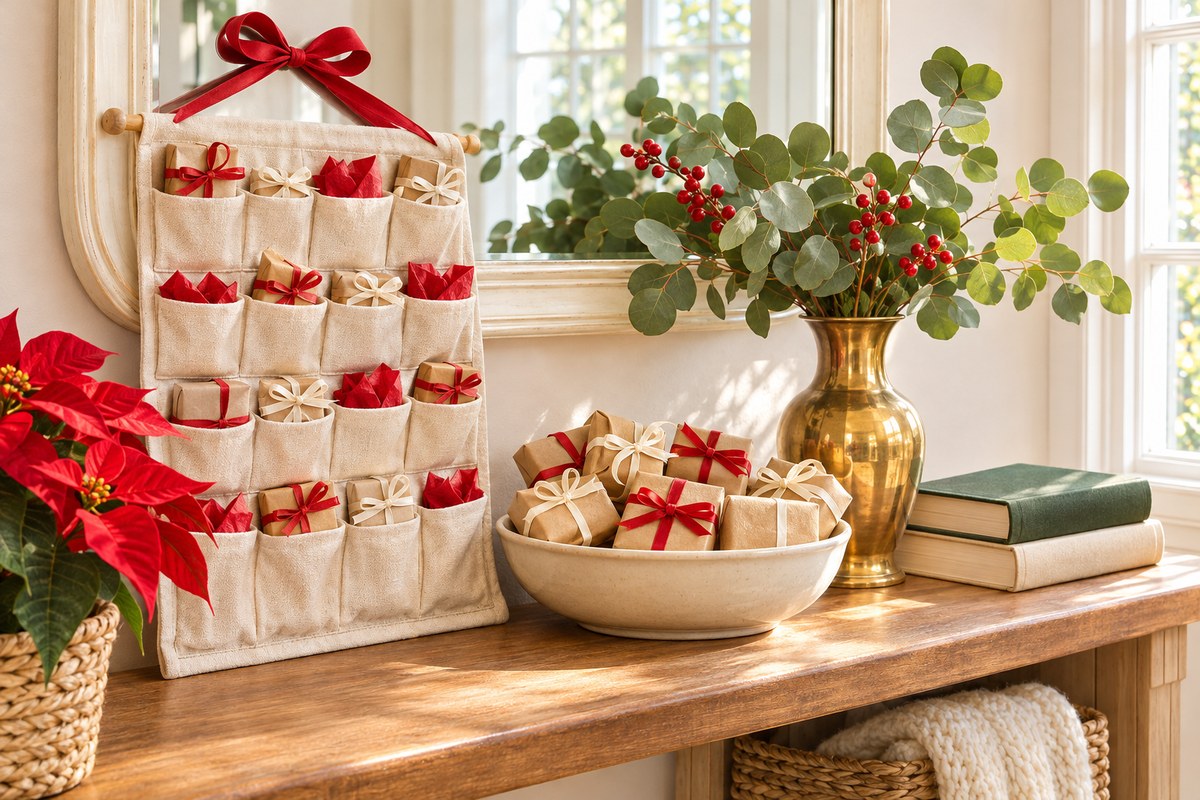
A cloth panel with 24 sewn or glued pockets is the version that lives out in the open, cream and deep green fabric with brass hooks. The pockets want to be deep enough for a small bag standing upright. More than anything, this is the calendar worth making once and refilling every year.
The box with dividers
The third build is a box with paper-towel-roll dividers. Wrap the box first, stand the tubes inside it, and fill them last, which is the order that keeps the dividers upright. The video below is worth watching before you cut anything.
The shell you already own
The fourth is the shell you already own: last year’s calendar, a hung shoe organizer, or a muffin tin with numbered paper lids. A shell with 24 compartments is a shell with 24 compartments. None of the four builds needs a run to a specialist shop, and the box build closes up on a shelf when the month is done. A calendar made as a host gift lands beside our guide to what to bring to a dinner party without adding another object to a crowded kitchen.
The safety rules that matter in December
A countdown calendar is a small pile of unopened objects handed to a child each morning. That is close to the exact situation the US Consumer Product Safety Commission writes its toy guidance for, and the agency polices product hazards for a living. Its toys page carries age guidance, helmet advice and other tips, and four of its rules decide what belongs in a young child’s pockets.
First: “Toys must have age labels if the toy is a choking hazard for children under 3-years-old.” Second: “Keep small balls and toys with small parts away from children younger than age 3 and keep deflated balloons away from children younger than age 8.” The age labels belong on the packaging of anything bought; the small-parts and balloon directions set where the object itself goes.
Third: two of the hazards this page highlights are button batteries and water beads, and both have guides linked from the toys page. On water beads specifically, CPSC approved a federal safety standard for water bead toys in August 2025. A young child’s calendar therefore keeps both of those hazards out of its pockets entirely.
Fourth: “Once gifts are open, discard immediately plastic wrappings and other packaging on toys before they become dangerous playthings.” The sequence matters as much as the rule: the wrapping comes off when the gift is opened, not before. Once a bought treat is out of its pocket, the wrapper goes in the bin the same minute. A wrapper you add yourself is home packaging, not a manufacturer’s wrapping, and the same habit applies.
A 24-day plan at your own budget
Method first, because the method is the reusable part. One daily amount, multiplied by the number of pockets, spent in a rotation that never opens the same kind of thing twice in a row: consumable, make-and-do, experience card, useful small thing, treat. The five categories do the pacing, the daily figure does the arithmetic, and the last pocket is always the treat. The rotation is five days long against a 24-day month, so the categories land unevenly in a way that reads as variety.
Here is the arithmetic at three daily amounts. At $0.50 a day, 24 pockets come to $12.00 for one child, which is one example. For $1.00 a day, 24 pockets come to $24.00: that is the plan this page promises, the $1-a-day December. At $2.00 a day, 24 pockets come to $48.00, another example. And two children at $1.00 a day cost 24 x $1.00 x 2, which is $48.00 for the household.
December pocket planner
Builds a day-by-day pocket plan from your age band, recipient count and daily amount. Tap or click to open.
The planner’s own habit is worth stealing for the mid-month sag: keep two pockets of slack, so a filler that fails to arrive can be swapped without touching the rest of the month. Put the treat on the 24th and the experience cards where the month drags. A card promising a walk to see the lights belongs in the third week, and our guide to how many lights a Christmas tree needs is the reading for the night the family decides.
In the end, twenty-four pockets buy a whole month of small mornings. The daily figure shapes the rest of the plan, and it is yours to name before the shelf names it for you.
Frequently asked questions
Is a 12-day calendar worth it?
In exchange, a 12-day calendar gives up 12 openings and pays for the door count in the shelf price. The three shorter calendars we priced run $1.67, $5.83 and $15.42 a day in our arithmetic, around a 24-day median of $2.33 a day. Whether that trade is worth making depends on the countdown you want, and the advent calendar ideas above cover what goes in the pockets either way.
Can I buy a filled calendar instead of making one?
Yes. In fact, the prices above are exactly those. The Lindt teddy calendar at $13.97 divides to 58 cents a day in our arithmetic, and the seven 24-day calendars with a stated day count have a median of $2.33 a day. The builders in the section above only decide where the pockets live. A filled calendar also answers the day-count question for you, if the box states its doors.
What do I do with the plastic inside?
The US Consumer Product Safety Commission says to discard plastic wrappings and other packaging on toys once gifts are open, before they become dangerous playthings. The rule covers the plastic that arrives on a bought toy; a wrapper you add yourself is home packaging, not a manufacturer’s wrapping, and the same habit applies.
What if the child is under 3?
For the under-3 band, the plan prints only large, one-piece fillers like a mini board book or a fat bath crayon. Toys that are a choking hazard for children under 3 must carry an age label, and small balls and toys with small parts belong away from children younger than age 3. The planner’s under-3 branch cannot print small parts, balloons, water beads or button-battery items, and says so when it runs.
What does 24 days cost for two children?
At $1.00 a day, two children cost 24 x $1.00 x 2, which is $48.00 for the household. At $2.00 a day the same two children come to $96.00 in our arithmetic. The daily figure, not the calendar, is what the shelf cannot tell you.
Sources
All sources below were read in November 2026.
- NBC News Select: The 51+ Best Advent Calendars of 2026 to Buy Before They Sell Out, published 12 November 2026: the calendar prices, contents and retail listings quoted above, and the one framing sentence.
- National Retail Federation: Winter Holiday Data and Trends: the November and December sales forecast quoted in the cost section.
- US Consumer Product Safety Commission: Toys safety page: age labels for choking hazards, the small-parts and balloon guidance, the packaging advice, the two highlighted hazards and the August 2025 water bead safety standard.
This article is for general information and entertainment, not financial advice.
Researched and written by Richie with the help of modern digital tools. Images: AI-generated.

Leave a Reply