The answer to how many lights for a Christmas tree is not one number. Published guidance runs from about 33 lights per foot of tree to 200, and the difference is taste wearing the costume of a standard.
The low figure is arithmetic on the opening summary of Christmas Lights Etc, a lighting retailer: a 6-foot tree takes roughly 200 mini lights. The high one, by contrast, is the bright band other retailers print. Both, then, are incandescent conventions counted per vertical foot of tree height, and no government or university page the desk checked publishes a lights-per-foot rule.
So the number is a choice, and the shopping is where a guess costs something: a tree taller than the room cannot stand up, and a bulb count invented at the till means a second trip for another box or a drawer of sets that never leave the plastic. This page, therefore, does the arithmetic in the order the purchase happens. A ceiling becomes a tree height, the tree height becomes a bulb count, the bulb count becomes sets and separate plug runs, and the one wiring limit with a government number behind it is stated once, plainly.
In this article
At a glance: lights by tree height
Incandescent mini lights by tree height. Soft is 100 lights per foot and Full is 200, the two figures 1000Bulbs prints, and Bright’s 150 is the floor of King of Christmas’s 150-to-200 range.
| Tree height | Soft (100 per ft) | Bright (150 per ft) | Full (200 per ft) |
|---|---|---|---|
| 4 ft | 400 | 600 | 800 |
| 6 ft | 600 | 900 | 1,200 |
| 7 ft | 700 | 1,050 | 1,400 |
| 8 ft | 800 | 1,200 | 1,600 |
| 9 ft | 900 | 1,350 | 1,800 |
| 10 ft | 1,000 | 1,500 | 2,000 |
| 12 ft | 1,200 | 1,800 | 2,400 |
Each cell is the bulb count for that height and band. For LED mini lights, 1000Bulbs guidance runs about half of each cell.
The lights-per-foot rule is a preference, not a standard
Three of the big lighting retailers publish a lights-per-foot rule, and they agree on the floor of about 100 lights per foot, then split above it. Christmas Lights Etc opens by saying a 6-foot tree takes roughly 200 mini lights, a 10-foot tree about 400 and a 12-foot tree around 600. Further down the same page it tells you to “plan for a minimum of 100 lights per vertical foot when wrapping indoor Christmas trees”. One page, two answers: the opening summary computes to about 33 lights a foot, and the detailed rule says 100 as a floor.
What 1000Bulbs and King of Christmas print
1000Bulbs, another lighting retailer, splits the question by taste. “If you’re leaning more toward a conservative lighting approach, then use 100 mini lights per vertical foot,” it says, and for a brighter look, “try using 200 mini lights per vertical foot”, with 600 mini lights named as the count for a 6-foot tree. King of Christmas, an artificial-tree retailer, says it in decorator language: a “soft, cozy glow” at 100 lights per foot, a “bright, layered look” at 150 to 200. Its own words are “per foot”; the worked examples beside them show it means the height of the tree, 750 lights for a 7.5-foot tree and 1,000 for a 10-foot one.
These are all retailer conventions for incandescent mini lights, counted per foot of tree height. The spread survives because the count moves with how bright the bulbs are, how full the tree is, and how deep into the branches you weave. Meanwhile, LED guidance compresses the same question from two directions: 1000Bulbs halves the number to 50 lights per vertical foot, its stated reason being that LED mini bulbs are brighter, while King of Christmas keeps the count and promises the same brightness with fewer strands. Both conventions live in the planner as one switch.
For all that, choose a band, then work on the tree in front of you: a sparser tree gets more from weaving deeper than from opening another box. The bands are rulers for taste. The tree is the last word.
How tall a Christmas tree fits under your ceiling
The tree height, first, is a subtraction: ceiling height, minus the stand, minus whatever room the topper needs. King of Christmas prints the rule outright. Choose a tree “approximately one to two feet shorter than your ceiling”, it says, which “accounts for the height of a tree stand (typically 6-12 inches) and leaves room for a tree topper without the tip brushing the ceiling”. Its chart lands at 6 to 7 feet for an 8-foot ceiling, or 6 to 6.5 feet with a topper.
Treetime, another artificial-tree retailer, answers the same room differently: “For an 8-foot ceiling, a 7 to 7.5-foot tree is usually the most comfortable fit, especially if you want room for a topper.”
Why the two stores disagree
That leaves a half-foot of daylight between two stores, and the cause is not arithmetic. One allows one to two feet of room and names a 6-to-12-inch stand; the other allows closer to a foot, calls it breathing room, and warns that a tall topper wants a shorter tree or a low-profile one. Both assume an ordinary stand and topper instead of yours. So measure the room: take the ceiling in inches, subtract the stand you own, subtract the topper you want. What remains is the tallest tree that can stand there.
Then round down to the size a store actually stocks. Both retailers above work in half-foot steps, so a maximum of 6 feet 11 inches becomes the 6.5-foot size; the 7-foot size needs the topper allowance cut by the difference. The planner’s ceiling helper does the subtraction and feeds its answer into the tree height, where a tree you already own goes straight in.
The tree and light planner
The planner keeps the whole chain in one place: the tree on hand or on order in, look and light type chosen, bulb count and sets out.
The tree and light planner
Enter the tree you have or plan to buy, pick a look, and get the bulb count and the sets to buy. Tap or click to open.
Not sure what fits? Measure the room, and this works out the tallest tree that fits and the size to ask for.
About 600 bulbs: 6 sets of 100
Soft band, 100 lights per foot of tree height, the conservative figure two lighting retailers print
That is 2 plug runs at CPSC guidance of no more than three sets of incandescent lights per run.
CPSC’s guidance is no more than three sets of incandescent lights on one extension cord. Where a label allows more, that is the maker’s limit for its own product, not a government allowance.
This is this desk’s arithmetic from the lighting and safety sources cited in the article, not a manufacturer’s specification. Round up when you buy.
What to do with the number it gives you
Take the bulb count to the shelf, then divide by the bulbs in the box you are actually buying, which is where the next section starts.
How many sets of lights to buy, and how many plug runs
In practice, sets are the bulb count divided by the bulbs in the box: about 600 bulbs is 6 sets of 100, or 12 sets of 50. A 100-bulb set is not one length, either. Novelty Lights, a light supplier, listed one commercial-grade set at 22.5 feet with 2.5-inch bulb spacing, 34 feet at 4-inch and 50 feet at 6-inch. That product is marked no longer available, so it is cited as a specification example only. Buy by the bulb count printed on the box, not by the length of wire printed beside it.
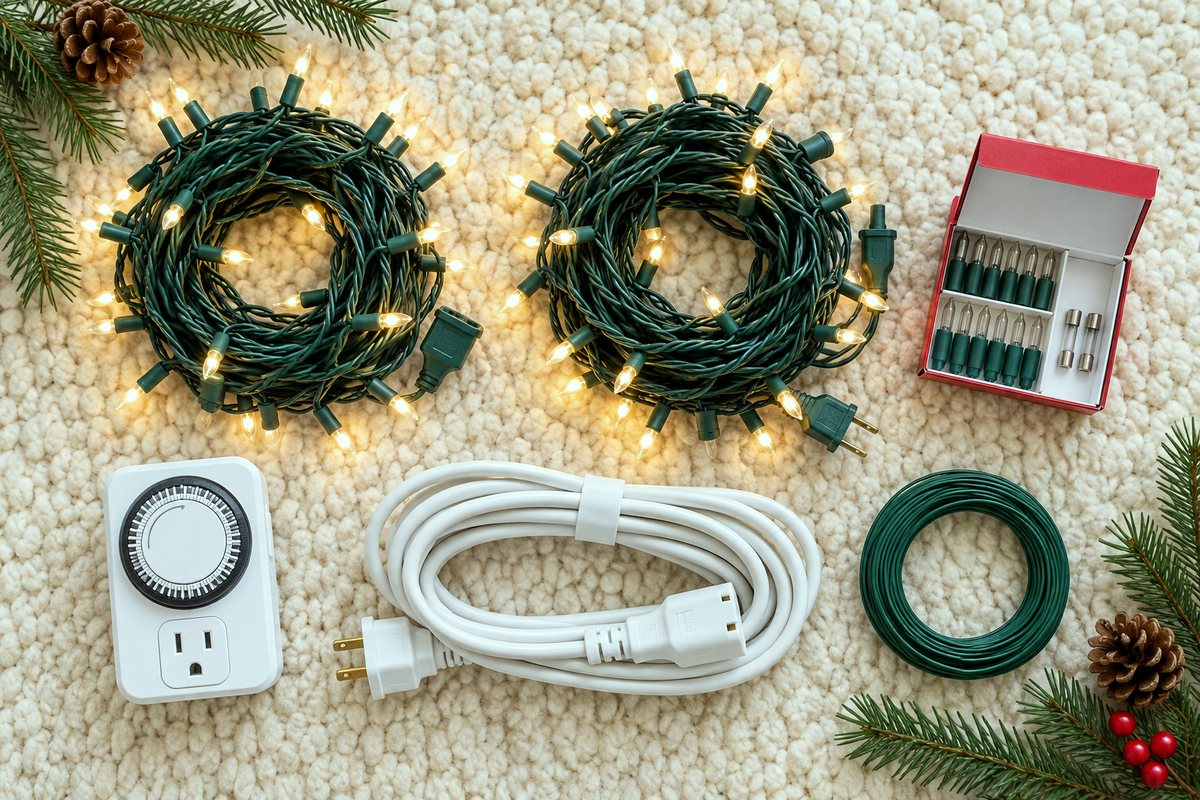
Among all of that, one limit is not a preference. The U.S. Consumer Product Safety Commission, the federal product-safety agency, prints it plainly in its holiday guidance: "Never string together more than three sets of incandescent lights and never overload electrical outlets." A CPSC release from 2002 scoped the same number "per single extension cord". Either way, three sets make a run: 6 sets of 100 is 2 plug runs, and the same 600 bulbs in 12 sets of 50 is 4.
Why the label and the government disagree
Set labels commonly allow more than three joined at once. Christmas Lights Etc says that depending on grade you can "typically connect between 5-10 strands of incandescent mini lights together on one run", and LiteSource, another light supplier, lists five sets of 100-light strands end to end in a capacity table footnoted "Based on current UL-Rated specifications. Subject to change. Always Read the Tag". For LED sets, however, the claims run far higher: Christmas Lights Etc quotes about 44 sets of its 5mm LED mini lights or 45 strings of its T5 LED lights on one run.
Those are the makers' figures for particular products. NFPA and the U.S. Fire Administration both print the same instruction for the label: read the manufacturer's instructions for the number of strands to connect. A label rated for five sets or ten is the manufacturer's limit for that product, not a government allowance. The number this page prints is the CPSC's three, and the page stops there.
How to hang the lights so the count looks bigger
How the strand goes on, meanwhile, changes how much of it you see, and the retailer method has three moves. Start at the top and work down, with the female end at the topper. Wrap branches "from the tree interior out", as Christmas Lights Etc puts it, rather than circling the outside edge, which is what evens the light across the tree. And choose 4-inch bulb spacing for indoor trees, "to allow for maximum lighting with minimal wire", keeping 6- and 8-inch spacing for branches you wrap tightly.
Christopher Hiedeman, a decorator who films tree lighting, puts a real count beside the method. The description of his video says of the balsam fir he lights: "We used about 850 light count on this 7.8 ft tree. 150 of those are twinkle lights that were mixed in (after the regular lights) to give the tree a sparkling look!" The same description names where the taste lives: closer to the branch edge for a subtler look using fewer lights, further into the tree for more.
How to light a tree without setting the room on fire
The National Fire Protection Association, the fire-safety nonprofit whose figures fill this section, reports that between 2020 and 2024 American fire departments answered an average of 143 home fires a year that started with Christmas trees. Over the same years, the NFPA attributes an estimated 7 civilian deaths, 13 civilian injuries and $15 million in property damage to those fires.
Meanwhile, the causes cluster around wiring and dryness. Electrical distribution or lighting equipment was involved in two in five, 40 percent, of home Christmas tree fires. Nearly one in four, 24 percent, were started by lamps or bulbs. And 35 percent of Christmas tree fires were in January, long after the wrapping paper.
Water, and the difference it makes
Water is the plainest of the defenses. Penn State Extension, the university's agriculture and gardening service, says a stand's basin should hold a quart of water per inch of stem diameter, at least a gallon for most trees, and that a cut tree "will absorb a surprising amount of water, particularly during the first week, so replenish the water daily". Its page adds that keeping a tree in water outperforms spraying flame retardants, some of which damage needles and speed up moisture loss.
The federal fire researchers at NIST, the National Institute of Standards and Technology, tested the difference directly: the Christmas tree whose stand "was kept filled with water" before testing "did not ignite when exposed to the same ignition source" as the tree that was left dry. Their page also instructs cutting 5 cm, about 2 inches, from the base of the trunk just before the tree goes into the stand, so it can draw.
Distance, and the lights themselves
Distance finishes the list. The U.S. Fire Administration asks for the tree to stand "at least 3 feet away from heat sources like fireplaces, radiators, space heaters, candles or heat vents", and the NFPA's own line is that a heat source too close to the tree causes nearly one in four of the fires. Penn State Extension adds the small habit the rest implies: newer LED lights run cooler than older types, and lights go off when nobody is with the tree.
Frequently asked questions
How many lights do I need for a 6-foot Christmas tree?
About 600 incandescent mini lights for the Soft band, 900 for Bright, and 1,200 for Full. Those bands are retailer conventions: 100 lights per foot is the soft figure 1000Bulbs and King of Christmas both print, 150 is the bottom of King of Christmas's bright range, and 200 is 1000Bulbs's brightest figure. LED mini lights run about half of each count, per 1000Bulbs guidance.
How many lights for a 9-foot Christmas tree?
A 9-foot tree takes 900 incandescent mini lights at Soft, 1,350 at Bright, and 1,800 at Full, counted per foot of tree height the way the retailers count it. LED guidance runs about half of those numbers. The table near the top of this page carries the same arithmetic at the heights it lists, from 4 to 12 feet.
How many sets is that, and how many plug runs?
Divide the bulb count by the bulbs in the set: 600 bulbs is 6 sets of 100, or 12 sets of 50. For incandescent sets the CPSC says never to string more than three together, which makes 6 sets 2 plug runs and 12 sets 4. A label that allows more is the maker's limit for that product, not a government allowance. Both NFPA and the U.S. Fire Administration say to read the manufacturer's instructions, and this page prints the CPSC's three.
Do LED trees need fewer lights?
By one retailer's convention, about half as many. 1000Bulbs counts 50 lights per vertical foot for LED mini lights because LED bulbs are brighter, while King of Christmas keeps the count and says LED delivers the same brightness with fewer strands. Both are retailer guidance; the planner on this page uses the halved convention and names it in its output.
What size tree fits an 8-foot ceiling?
Subtract your stand and your topper allowance from the ceiling: 8 feet is 96 inches, less a stand and the room the topper wants. King of Christmas lands at 6 to 7 feet, or 6 to 6.5 feet with a topper, while Treetime calls 7 to 7.5 feet the comfortable fit. Whichever rule you follow, round the answer down to the half-foot sizes stores stock.
Can I connect more than three strands of lights?
The CPSC says never to string more than three sets of incandescent lights together, and that is the number this page prints. Many labels are rated for more: Christmas Lights Etc says 5 to 10 strands of incandescent mini lights on one run depending on grade, and LiteSource lists five sets of 100-light strands end to end by UL ratings. Those are makers' limits for particular products, not a government allowance, and this page does not take a reader past the CPSC's three.
The room decides the tree, your taste decides the band, and the government's three decides the wiring. The numbers scatter because they are three decisions stacked in one question. When the lights are up and the evening finally settles, the film for whoever is still on the couch is our Christmas movies ranked by youngest age in the room, and when the tree is up, the season's other small arithmetic happens at the host's door: What to Bring to a Dinner Party.
Sources
Fire, wiring and safety sources
- National Fire Protection Association (NFPA): Winter holidays. The 143-fire average for 2020 to 2024 and the 40, 24 and 35 percent shares. One page frames the same relationship in more than one way: elsewhere it says "Nearly half of home Christmas tree fires are caused by electrical problems", and the U.S. Fire Administration's page says "almost one-third". This article uses the 40 percent line, which names what was involved.
- U.S. Consumer Product Safety Commission (CPSC): Holiday Safety. The three-set ceiling for incandescent lights.
- U.S. Fire Administration (USFA): Holiday Fire Safety. The three-foot distance from heat sources, and the instruction to read the manufacturer's instructions on connecting strands.
- Penn State Extension: Tips for Selection and Care of Cut Christmas Trees. Stand capacity and daily water; updated September 26, 2025.
- NIST Fire Research Division: Holiday Fire Safety. The watered-versus-dry tree experiments and the 2-inch trunk cut; updated September 3, 2025.
- LiteSource: Christmas light specifications. The five sets of 100-light strands end to end, and the "Based on current UL-Rated specifications. Subject to change. Always Read the Tag" footnote.
- U.S. Consumer Product Safety Commission: CPSC urges consumers to decorate safely for the holidays. An earlier holiday release that scoped the three-set limit per single extension cord.
Lighting and sizing sources
- 1000Bulbs: Christmas lights per foot of tree. 100 and 200 mini lights per vertical foot for incandescent, 50 for LED; updated October 21, 2024.
- Christmas Lights Etc: the retailer calculator. The 100-per-vertical-foot minimum, the 4-inch spacing, the interior-out hanging method, and the 5-to-10 strand range; updated August 13, 2026.
- King of Christmas: What Size Christmas Tree Works for an 8, 9, 10 and 12' Ceiling. The one-to-two-feet rule and the 100 and 150-to-200 lights per foot bands.
- Treetime: Artificial Christmas Tree Buyer's Guide. The 7- to 7.5-foot answer for an 8-foot ceiling.
- Christopher Hiedeman on YouTube: How To Put Lights On A Christmas Tree. The description's own count of about 850 lights on a 7.8-foot tree.
- Novelty Lights: 100-light mini light set specification. The 22.5 ft, 34 ft and 50 ft lengths at 2.5, 4 and 6 inch spacing. The page is marked no longer available; it is cited as a specification example only.
Researched and written by Richie with the help of modern digital tools. Images: AI-generated.
Leave a Reply