Most cut Christmas trees do not fail because the room was warm or the ornaments were heavy. They fail at the base: the water ran low, or the level fell below the trunk while the basin still looked full, and nobody checked until the needles were falling. A cut tree is not a plant in a pot. It is a cutting with no roots, drinking through a thin band of living wood just under the bark, and it drinks far more than most people expect in its first week indoors.
This guide covers the one variable that decides whether your tree lasts to New Year, plus the handful of habits that actually help and the popular tricks that do nothing at all. The short version: a trunk takes about a quart of water a day for every inch of its diameter, so a common four-inch trunk wants a gallon a day. What that means for your stand and your calendar is the part worth doing carefully.
In this article
How much water a Christmas tree needs
| Question | Short answer |
|---|---|
| Water per day | About 1 quart for every inch of trunk diameter |
| Stand size | 1 quart of usable water per inch of trunk, and at least 1 gallon for most trees |
| How often to check | Daily, first thing, so the level never falls below the base |
| Additives | None. Research finds no benefit from sugar, aspirin, bleach, soda, vodka or commercial mixes |
| How long it lasts | At least five weeks with good care, according to Illinois Extension |
The quart-per-inch rule
Washington State University’s Gary Chastagner, a plant pathologist who has spent decades researching Christmas trees, puts the water rule simply: for each inch of stem diameter, the tree will need a quart of water per day. A four-inch trunk therefore wants at least a gallon a day. That is a general rule for a well-watered tree in a heated room, not a measurement of your particular tree, and it is the number the rest of this page builds on.
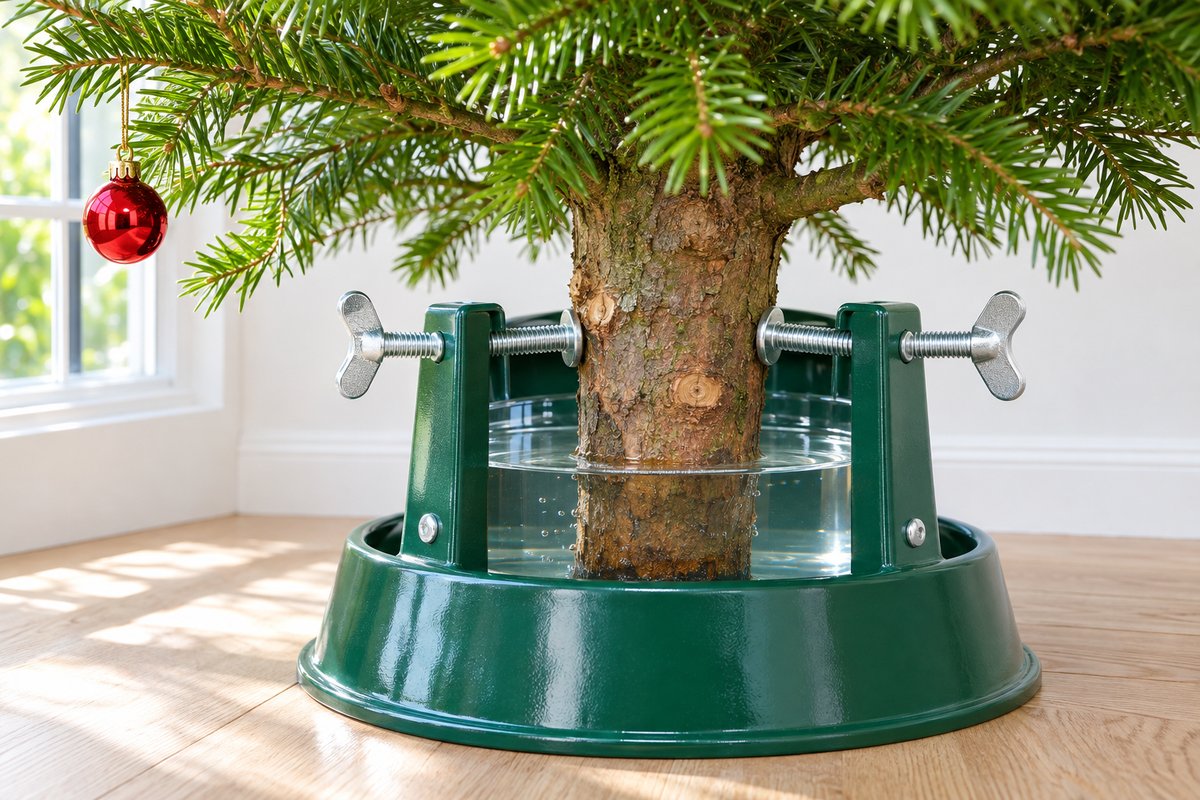
It is also a number the standard stand hides. Penn State Extension says a stand’s basin should hold a quart of water for every inch of stem diameter, and at least a gallon for most trees. Oregon State University Extension makes the same point with a bigger example: a tree with a six-inch stem needs a stand that holds a gallon and a half, and “very few stands have the capacity for today’s large trees.” A stand sold as one gallon is therefore fine for a four-inch trunk and too small for a six-inch one.
Size the stand before you fill it
Two details make the arithmetic honest. First, measure the cut end of the trunk, not the widest branch. Second, use the water the stand actually holds with the tree in it. The capacity on the box is the empty basin, and the trunk and the stand’s own hardware take up room, so a labelled gallon is always more than the gallon you can use.
If the stand holds less than a day’s water for your trunk, you have two fixes: refill it more than once a day, or buy a bigger stand. The second is a one-time purchase and better than the daily scramble.
Christmas tree water planner
Enter your trunk and stand to see the daily draw, the refills and the gallons to have on hand. Tap or click to open.
The quart-per-inch rule comes from Washington State University and Penn State Extension. A real tree’s uptake varies with room temperature, species and how fresh the cut is. Water can sit in a stand while the trunk base is above it, so check the level itself, not the look of the basin.
A quick table for common trunks
| Trunk | Quarts a day | Gallons a week | Smallest stand |
|---|---|---|---|
| 2 in | 2 | 3.5 | 0.5 gal |
| 3 in | 3 | 5.25 | 0.75 gal |
| 4 in | 4 | 7 | 1 gal |
| 5 in | 5 | 8.75 | 1.25 gal |
| 6 in | 6 | 10.5 | 1.5 gal |
Why your tree is drying out
When a tree drops its needles in ten days, the cause is usually one of three things, and they are worth checking in this order.
Water in the stand, base in the air
Penn State Extension warns about a specific trap: with many stands, water can still be visible in the basin while the base of the tree is no longer under it. A tree cannot drink through air. Check the water level with a finger or a dipstick against the trunk, not by glancing at the basin from across the room.
Heat, sun and the vent you forgot
Penn State’s guidance is blunt: keep the tree away from fireplaces, heaters, heat vents and direct sunlight. Lowering the room temperature slows the drying and cuts the water the tree uses each day. A tree beside a forced-air vent will outdrink the same tree in a cooler corner, and the difference shows up in the stand.
What happens when the stand runs dry
Here is the good news. Oregon State University Extension says that if you refill the stand within 24 hours of it going dry, most trees, including Douglas-fir, noble, Nordmann and Fraser, should re-hydrate just fine. Grand fir is the exception: Oregon State says 12 hours may be the limit. So a tree that ran dry overnight is usually recoverable.
The bad version is a base left dry for days. Illinois Extension explains why: resin forms over the cut end, the tree can no longer absorb water, and it dries out quickly. If the base has sealed, a fresh cut is the fix, which means taking the tree out of the stand. That is a job worth avoiding with a daily check.
The first 48 hours
The first two days set the tone for the whole display, because a cut tree takes up a surprising amount of water in its first week indoors. Oregon State puts it plainly: trees are very thirsty the first few days inside a heated home. Get the water right early and the rest is maintenance.
The cut: a quarter inch is enough, and why sources differ
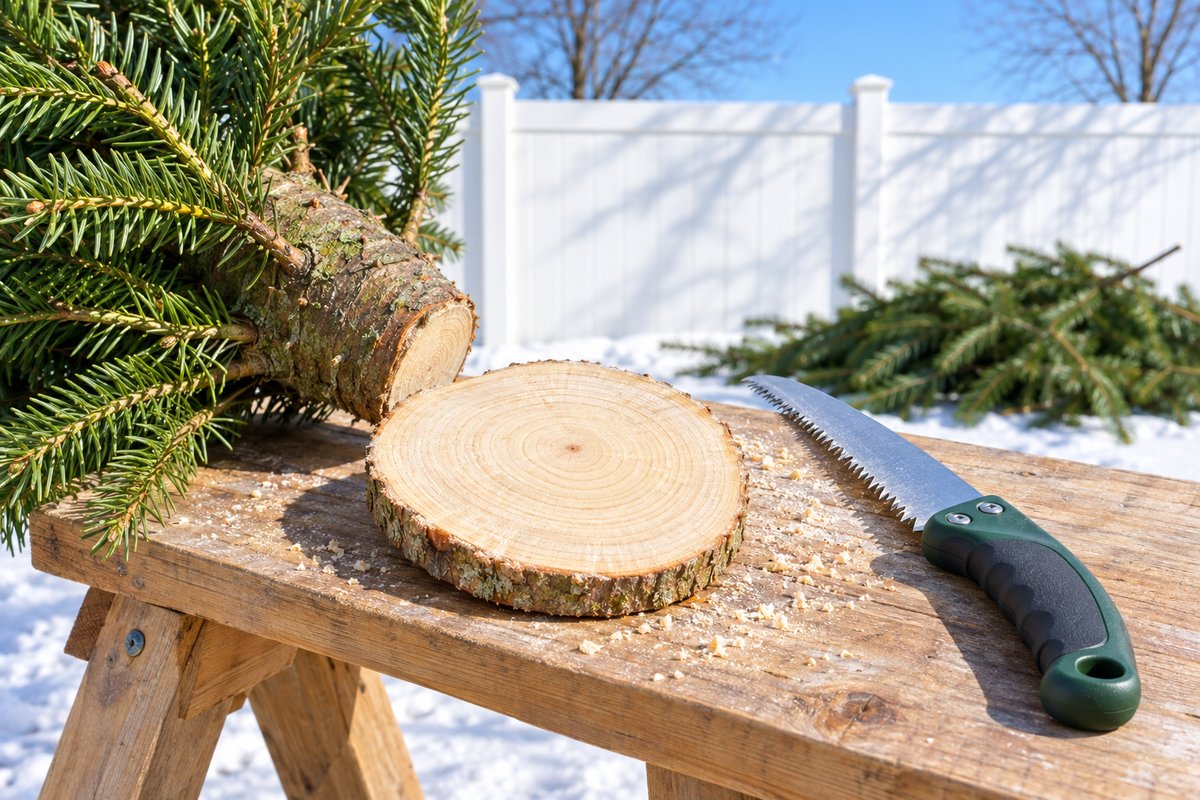
You will see three different cut depths recommended, and they come from three different jobs. Penn State Extension says cutting a disk about a quarter inch thick off the base is all that is necessary for water uptake. Oregon State agrees that a quarter-inch slice is plenty. Illinois Extension’s version says one inch. And the National Institute of Standards and Technology, describing fire-test preparation, repeats the NFPA’s advice to cut about two inches (5 cm) from the base.
None of these is wrong. A quarter inch exposes fresh wood, and the deeper cuts simply remove more of the dried end. What all of them agree on is the shape of the cut: straight across, perpendicular to the trunk. Penn State says cutting at an angle or into a V-shape makes it harder to hold the tree and reduces the water available to it. Oregon State explains why: water moves up through microscopic tubes just beneath the bark, so a straight cut exposes the most of the wood that actually conducts. Drilling holes or fitting IV-style tubes does not help, and whittling the sides to fit a stand removes the very layers that carry water.
The recut rule depends on time as well. Penn State says a tree cut within the past 12 hours does not need another cut, and one cut longer ago should be recut. Oregon State says to recut if more than 24 hours has passed. Either way, the principle is the same: a fresh surface goes into the water.
Water now, decorate later
Put the tree in water as soon as the cut is made, then decorate at your leisure. A tree standing dry in a garage for two days is losing the advantage of that fresh cut. If you are not ready to decorate, keep the trunk in a bucket of water rather than on its side.
If you are not decorating yet
Penn State suggests storing a tree you are not ready to display with its trunk in water, in a cool, shaded, protected spot such as an unheated garage. Illinois Extension adds the obvious caveat: out of the wind and out of freezing temperatures. Cold slows water loss. A tree left on a sunny porch does the opposite.
Additives that do not work
Every December, someone’s uncle swears by sugar, aspirin or a splash of bleach. The research does not support any of it. Washington State’s Chastagner says research has found that commercial additives, sugar, 7-Up, bleach and other home remedies provide no benefit, and that water alone is the single most important thing. Penn State’s list is longer: floral preservatives, commercial tree preservatives, molasses, sugar, bleach, soft drinks, aspirin, honey and other concoctions. Clean water is all that is needed.
What the research tested
The tested list covers the popular myths. Oregon State names vodka, 7-Up, bleach, aspirin and sugar as things people add, and says clean, cold water is all that is needed, with some additives actually causing a tree to shed needles or dry out faster. The pattern is consistent across three university sources, which is why this page does not hedge: skip the additives.
Water temperature is in the same category. Penn State says the temperature of the water used to fill the stand is not important and does not affect uptake. Illinois Extension’s instructions suggest a bucket of warm water when a tree first comes home, while Penn State’s finding is about the stand, where the water’s temperature does not affect uptake. Once the tree is in the stand, temperature is not the lever.
Products that sound scientific
Three product categories promise more than they deliver. Water-holding gels are not beneficial and can reduce the amount of water in the stand that is available to the tree, according to Penn State. Anti-transpirant sprays, marketed to block evaporation from the foliage, do not have a significant effect on moisture loss from a cut tree displayed indoors. And flame-retardant sprays are no substitute for water: Penn State says proper watering is far more effective, and some flame retardants damage needles and increase moisture loss.
The five-minute daily routine
Once the tree is up, the routine is one check and one top-up. Do it first thing in the morning, when the house is quiet and the tree has had a night to drink. Check the level against the trunk, add water to the same mark each time, and stop worrying about it until tomorrow.
The first week is the demanding one. Penn State says a cut tree absorbs a surprising amount of water, particularly in the first week, so replenish daily. After that, most trees settle into a lower draw, though the stand still needs checking every day.
The funnel-and-tubing trick
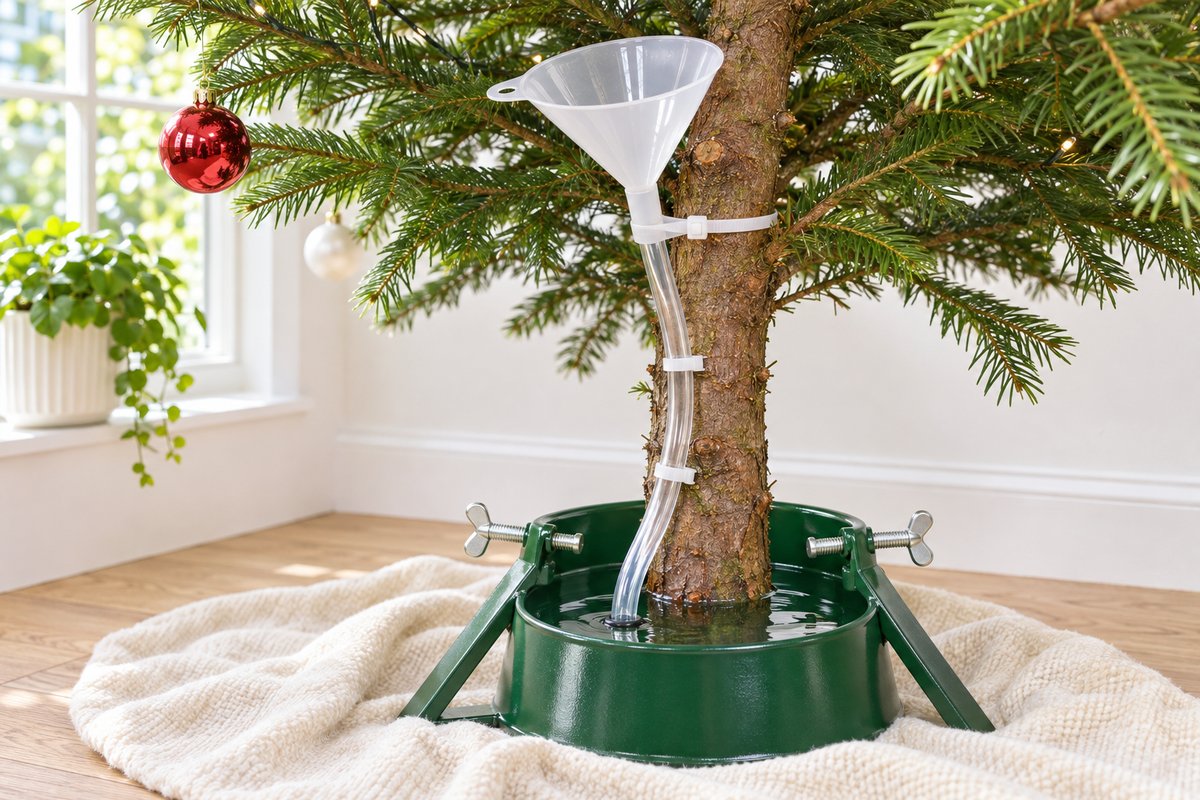
Watering a decorated tree is awkward, and awkward jobs get skipped. Illinois Extension has a fix that costs a few dollars: a funnel and three or four feet of vinyl tubing, with the tube slipped over the funnel’s outlet and run down the trunk into the stand. Fasten it out of the way, and you can top up without crawling under the branches or moving the tree skirt. The best watering routine is the one you will actually do on a busy morning.
Pets, weekends away and the water you did not see go
Oregon State makes a point that explains a lot of mystery water loss: your pets may be helping themselves to the stand. A cat that treats the basin as a bowl can leave the stand dry by morning. If the level drops faster than the size of the tree suggests, watch the stand for a day before you assume a leak.
For a weekend away, fill the stand to the top before you leave and check it the moment you are home. If the base went dry for less than a day, Oregon State’s rehydration window says most trees recover. If it went dry for longer, the fresh-cut question comes back.
When to take the tree down
A well-cared-for cut tree can last a long time. Illinois Extension says many fresh cut trees, properly cared for, will last at least five weeks before drying out. That is a floor, not a promise, and the tree will tell you when its time is up.
The needle tests
Penn State’s test is the one to use: run your fingers across the needles. If they break easily or fall off in your hand, the tree is dry and should come down. At the lot, the same logic runs in reverse: look for flexible needles that stay attached when you tug, and expect a few brown needles from the inside, which every evergreen sheds.
Why water is the fire defense
A dry tree is a fire hazard, and water is the plainest defense against it. The National Institute of Standards and Technology ran the comparison directly: a Christmas tree kept in a water-filled stand did not ignite when exposed to the same ignition source as a dry tree. NIST puts it at an estimated 210 home fires involving Christmas trees a year, with annual averages of 6 civilian deaths, 16 injuries and $16.2 million in property damage. The U.S. Consumer Product Safety Commission’s 65-second clip shows a dry tree and a watered one under the same flame, and it is worth the minute.
Two habits finish the safety job. Keep the tree at least three feet from heat sources, as the NFPA guidance NIST passes along says, and turn the lights off when nobody is in the room. Penn State notes that newer LED lights generate less heat than older types, which helps, and the lights still go off when the tree is unattended.
Picking a tree that will last
The best care cannot rescue a tree that was already dry at the lot, so the choice matters. Species is part of it. Penn State notes good needle retention in Douglas-fir, Fraser and balsam fir, and in white and Scotch pine. Colorado blue spruce holds its needles well but only if it never runs out of water even once, and its needles are very sharp, which is worth knowing in a house with small children.
The lot tests are quick. Tug a few needles: flexible needles that stay attached are the sign of a fresh tree, and needles that pull out easily or look dull suggest one past its prime. Tap the butt on the ground, as Washington State suggests: a few brown interior needles are normal, but green needles falling in number mean the tree is already drying.
One last link in the chain: the lights you put on the tree add heat, and the number you need is a separate question. Our guide to how many lights a Christmas tree needs does that arithmetic. And if the tree is one part of a bigger December, the advent calendar ideas that skip the junk are a good next stop.
Frequently asked questions
What do I do if my Christmas tree stand ran out of water?
Refill it. Oregon State University Extension says most trees re-hydrate if the stand is refilled within 24 hours of going dry, though grand fir may have only about 12 hours. If the base has been dry for days and resin has sealed the cut, the tree needs a fresh cut to drink again.
Does hot water help a Christmas tree?
No. Penn State Extension says the temperature of the water does not affect uptake. Room-temperature water from the tap is fine.
Should I add sugar or aspirin to the water?
No. Washington State University names commercial additives, sugar, 7-Up and bleach among the home remedies research has found no benefit from, and Penn State’s longer list adds aspirin, honey, molasses and soft drinks. Plain water is the recommendation.
How often should I refill the stand?
Check it every day and top it up so the level stays above the base. In the first week a tree can drink about a quart a day for every inch of trunk diameter, so a four-inch trunk may take a gallon a day.
Can I leave a Christmas tree for a long weekend?
Fill the stand to the top before you go, and check it as soon as you are back. If the base went dry for less than a day, most trees recover after a refill.
How long does a cut Christmas tree last?
Illinois Extension says many fresh cut trees, properly cared for, last at least five weeks before drying out. Water, a cool spot away from heat and a stand that holds enough are the variables that decide it.
Sources
All sources below were read in November 2026.
- Washington State University Insider: WSU researcher on how to keep Christmas tree fresh (Gary Chastagner, 2012).
- Oregon State University Newsroom: Treat your Christmas tree to vodka? Only if you want to waste it (Chal Landgren, 2018).
- Penn State Extension: Tips for Selection and Care of Cut Christmas Trees (updated 2025).
- Illinois Extension: Caring For Live Christmas Trees.
- National Institute of Standards and Technology: Watering your Christmas Tree Reduces Fire Hazard.
- U.S. Consumer Product Safety Commission on YouTube: Dry Christmas Tree vs Well Watered Christmas Tree.
Researched and written by Richie with the help of modern digital tools. Images: AI-generated.

Leave a Reply