A loaf of sliced bread is one of the cheapest fresh foods in most kitchens and among the fastest to turn on you. Leave it on the counter and the slices go dry at the edges long before the date on the bag. Push it further and you find green in the middle of a loaf that still looks fine from the outside. So you freeze bread, which is the right move, and then you meet the frozen brick.
Freezing is the obvious fix, with one catch that sends people straight back to the bread aisle. Pull a frozen loaf out and the slices are welded into a single block, so you either saw at it with a knife or thaw the whole thing, which defeats the point of freezing it in the first place.
Here is the method, why it works, how long a loaf actually keeps, and a planner that turns the USDA’s storage windows into a date on your own loaf.
Why frozen bread sticks together
Bread goes stale for two reasons, and only one of them is about drying out. The other is the starch. Flour starch gelatinizes in the oven, then slowly re-forms into a crystalline structure as the loaf cools. Serious Eats calls this return to the crystal state “retrogradation” and “recrystallization”, and points out the part that surprises people: bread sealed against every bit of moisture loss still hardens, because the starch is doing it, not the air.
Temperature decides how fast that happens. Warm is slow. Frozen stops it. In between, around refrigerator temperature, it speeds up. A 2021 study in the journal Foods held its pan wheat bread at 8.2 degrees Celsius, a fridge temperature, against about 21 to 22 degrees for the room-temperature arms. The refrigerated loaves firmed faster: 0.37 newtons per day against 0.26 for the same bread in a plastic bag at room temperature. The USDA FoodKeeper entry for whole wheat bread says the same thing flatly: “Refrigeration not recommended – bread will quickly dry out and become stale.”
So the freezer is the right shelf. The sticking is a separate problem. Every cut face of a slice carries moisture. Press a second slice against it, drop the temperature, and that moisture freezes across the gap as a thin bridge of ice. Do that to a whole loaf at once and you get one solid brick, the effect King Arthur’s page describes when it says breaking single slices from a frozen loaf “isn’t particularly effective at anything other than making your hands cold”. The fix is to break the contact before the cold arrives, one slice at a time.
How long bread keeps on each shelf
The numbers below come from FoodKeeper, the storage database the USDA Food Safety and Inspection Service publishes and FoodSafety.gov points readers to. Read the two paragraphs under the table before the days, because they change how you use them.
| Bread | Pantry | Refrigerator | Freezer at 0 F |
|---|---|---|---|
| Commercial bread products | 14 to 18 days | 2 to 3 weeks after opening | 3 to 5 months |
| Whole wheat, homemade or commercially baked and pre-sliced | 3 to 5 days | Not recommended | 3 months |
| Breadcrumbs, commercial | 6 months | Not listed | Not listed |
Two things about that table matter more than the exact days. The first is that these are quality windows, not safety limits. The FoodSafety.gov cold storage chart says food held “continuously at 0 F (-18 C) or below can be kept indefinitely”, and the inspection service puts it even more plainly: “Food stored constantly at 0 F will always be safe. Only the quality suffers with lengthy freezer storage.” Even so, a loaf at month seven is not a hazard. It is just tired.
The second is that published advice genuinely disagrees. King Arthur Baking says most bread freezes well for “as long as three months”. Cornell Cooperative Extension, reprinting Iowa State’s advice, says to use it “within 6 months”. Kansas State gives 6 to 8 months for yeast bread and rolls, and FoodKeeper says 3 to 5 months for commercial bread and 3 for whole wheat. In practice, treat 3 months as the point where a loaf is at its best, 6 months as the outer edge, and anything beyond that as safe but not worth saving for a sandwich.
Before you freeze bread, four things to have ready
None of this requires a vacuum sealer, and none of it takes more than a couple of minutes at the counter.
- A freezer at 0 F or below. Kansas State’s extension sheet opens with that number, and Iowa State makes the same point: keep the freezer at zero or colder, it says, to “freeze food fast and stay frozen solid”.
- A bag you can press flat, plus something to wrap the loaf in. A freezer-grade bag is the minimum. A layer under it is what buys the extra months.
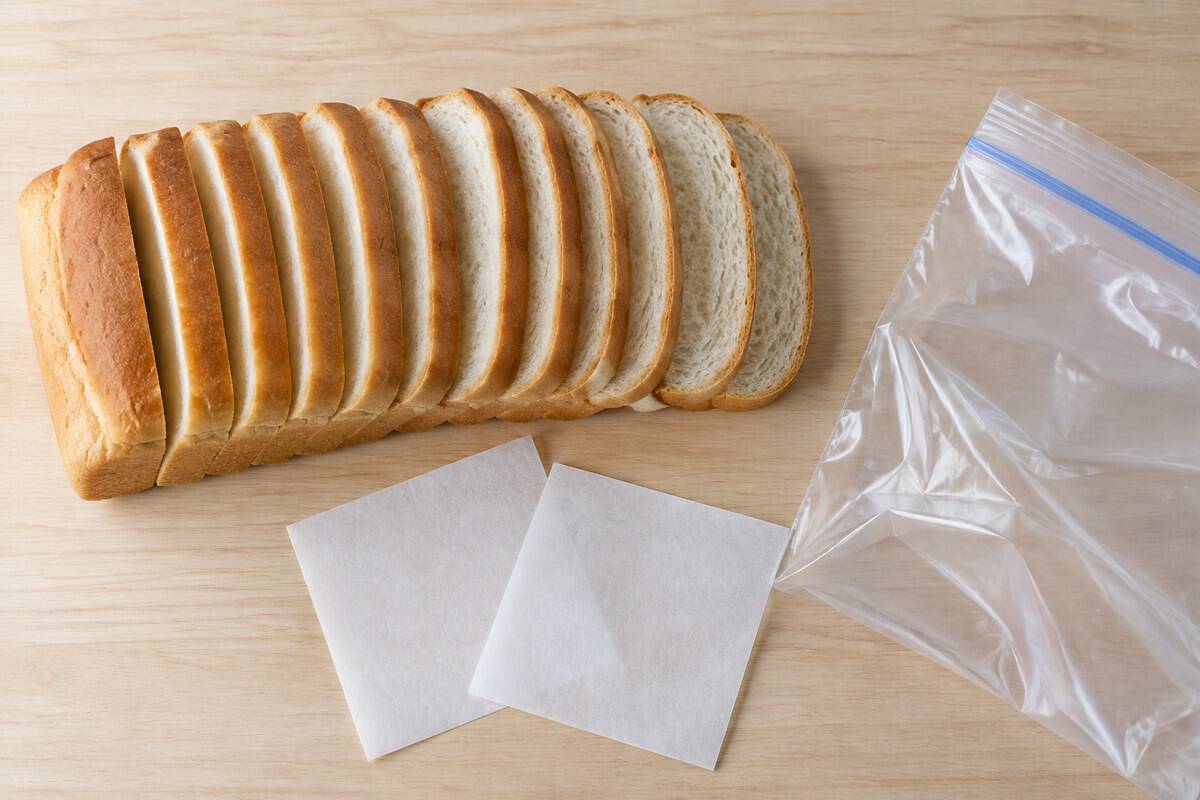
- Parchment, if you would rather not work the slices apart by hand. King Arthur Baking suggests separating slices “with small squares of parchment paper”, which does the same job as the hand method with less mess.
- A marker. The date on the bag is the only thing standing between you and a freezer full of anonymous loaves.
One rule matters most for bread you baked yourself. Let it cool completely before it goes anywhere near the freezer. King Arthur’s Baker’s Hotline is blunt about the reason: wrap a loaf while it is still warm and “steam will be trapped and turned into condensation, prompting potential mold and bacteria growth on your bread.”
How to freeze bread: the method in six steps
The method was born out of frustration rather than a test kitchen: too many loaves frozen into one solid block. It has held up.
Step one: buy or make pre-sliced bread
Any bread is fine, so long as it is pre-sliced. Moist or dry does not matter. I really like the Alpine Valley Organic from Costco, which I used to have shipped to my door through Google Express. Any pre-sliced loaf from the warehouse does the same job, and so does whatever loaf you brought home, sliced at the bakery counter.
Step two: separate every slice
This is the innovation, and it is almost embarrassingly simple. Put your hand into the bag, and use your fingers to work each slice free of the one behind it, all the way down the loaf. Go sequentially. Do not skip, and do not leave the last two or three welded together, because those are the ones that will defeat you in February.
The two “butts”, the thin end pieces, are worth pulling out and eating while you work. They are thin enough that they stick hardest to the slice beside them, and they never separate cleanly once frozen.
If you would rather keep your hands out of the bag, King Arthur’s alternative is to divide the slices into groups of two or four, however many you use at a time, and slip a square of parchment between the groups. That is slightly slower and slightly tidier, and it solves the same problem.
Step three: get it into the freezer immediately
Immediately is the operative word. Close the bag the moment the last slice is free and put it in the freezer. Do not wait more than a minute. Leave the loaf on the counter while you finish unloading groceries and the cut faces settle back against each other, the surface moisture comes back, and the whole exercise is undone.
Step four: take out only what you need
When you want bread, pull the loaf out and separate the slices you are about to use. Done right, they come apart with a light pull instead of a knife, which is the whole payoff.
Step five: put the rest back right away
Same rule as step three, in reverse. A few minutes on the counter and the edges of the remaining slices begin to soften, and soft edges stick when they refreeze. Take what you need, close the bag, and put it back.
Step six: toast it
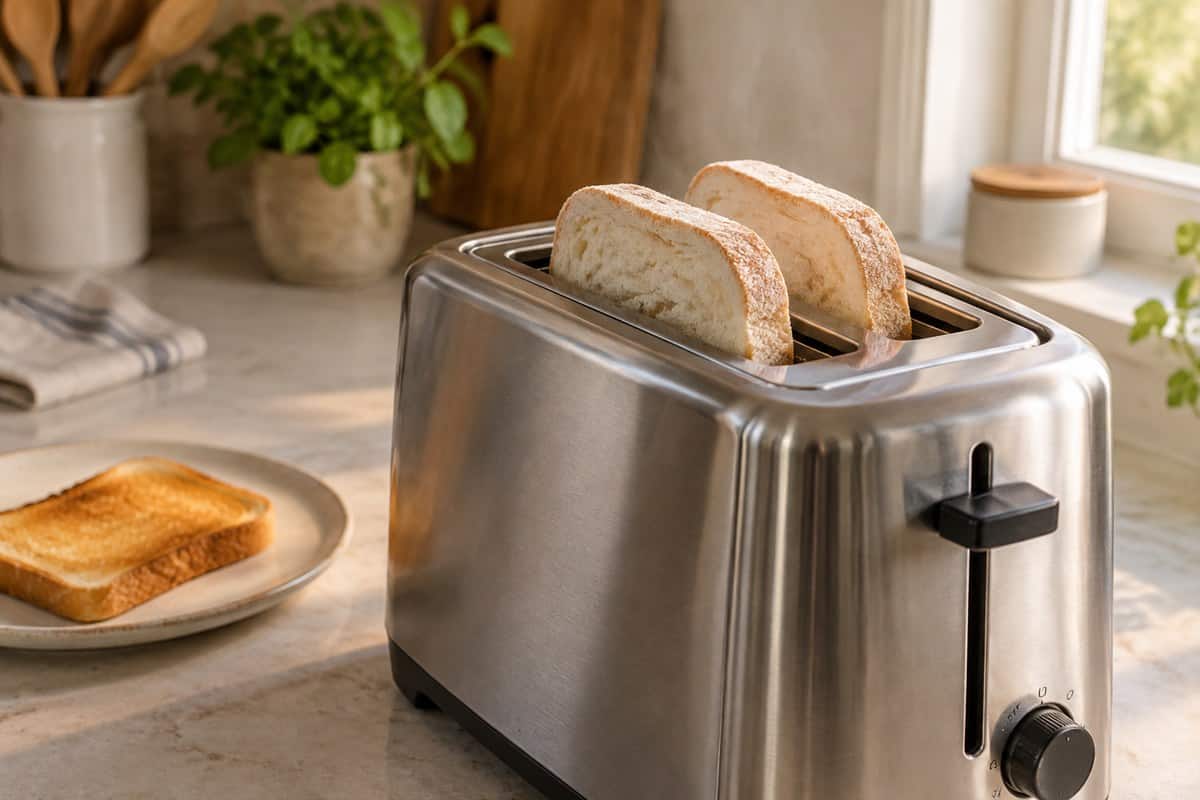
Toasting is the best way to bring a frozen slice back, and it is the only method that skips thawing altogether. King Arthur says slices “can be popped directly into the toaster from the freezer”, and that a slice left on the counter thaws in under half an hour if you want it soft. Set the toaster a notch or two higher than you would for room-temperature bread. The result is close enough to fresh that nobody at the table will ask.
Packaging decides how the loaf tastes in three months
Air is the enemy here, and the damage has a name. Freezer burn is what happens when the water at the surface of a frozen food turns straight into vapor without passing through liquid, a process Iowa State calls sublimation. The surface dries, goes grayish-brown and leathery, and the texture does not come back.
The reassuring part is that it is a quality problem, not a safety one. The inspection service says freezer burn “does not make food unsafe, merely dry in spots”, and Iowa State puts it just as flatly: “Freezer burn affects food’s quality but not its safety.” Cut the dried patches off, or use that loaf for toast and croutons where nobody will notice.
How to keep the air off a loaf
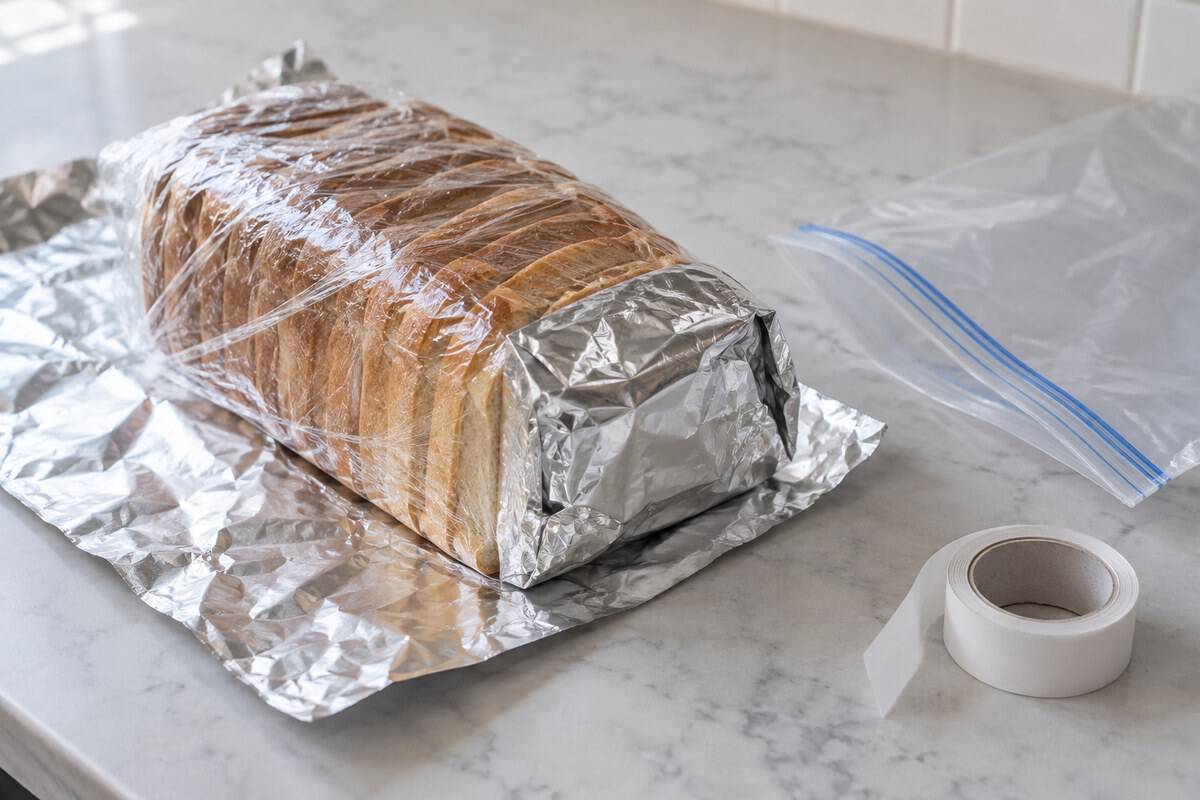
To slow it down, press the air out of the bag before you seal it. Iowa State’s tip is to push a straw into the corner of a zip bag and pull the air out before the final close. Cornell’s version is simply to suck the extra air out through a straw before sealing. A second layer does the rest. King Arthur’s bakers use “multiple airtight layers”, plastic wrap and then a bread bag, or foil first and then an airtight container. Cornell’s version is plastic first, then foil, then a freezer bag. Either way, the loaf that gets two layers outlasts the one that gets a twist tie.
This is also where the savings hide. A loaf that goes green is money in the bin, and food waste rarely shows up in a weekly grocery budget, because nobody plans for it. Two minutes with a freezer bag on shopping day is the cheapest fix in the kitchen.
A planner for your own loaf
The dates in the table are ranges, so here is the arithmetic done for your loaf. Pick the bread and the shelf, enter the date you bought it or froze it, and the planner gives you the window in calendar dates.
Bread storage planner: when the loaf passes its best
Pick the bread, the shelf and the date. Tap or click to open.
Windows come from the USDA FoodKeeper records for commercial bread products and whole wheat bread. Freezer dates are quality, not safety: a loaf past its window is still safe, just past its best.
How to thaw and revive a slice
Toasting is the default, and it is fast enough that most loaves never need anything else. For sandwich bread you want soft rather than crisp, leave the slices in their wrapper on the counter for about half an hour, which is King Arthur’s figure for single slices.
A whole loaf, or a single slice
A whole loaf takes longer. King Arthur says to move the wrapped loaf to room temperature “for three hours or so”, and Cornell says about three hours. Kansas State says two to three hours and tells you to loosen the wrapping. King Arthur and Cornell both keep the loaf wrapped, and Cornell gives the reason: unwrap it while it is still cold and “condensation will form on the exterior compromising the texture”.
In a hurry, and reviving a stale loaf
For a crust worth hearing, King Arthur gives artisan loaves such as baguettes a quick refresh in a 350 F oven, tenting with foil to prevent over-browning. Cornell’s version for a whole defrosted loaf is 300 to 350 F for 10 minutes, and Kansas State reheats a foil-wrapped loaf at 350 F for 15 to 20 minutes. A hotter oven is quicker, and a baguette takes it well.
The microwave will do in a hurry if you are defrosting “a single roll or a couple of slices”. King Arthur wraps each piece in a damp paper towel and gives it about 30 seconds, 45 for a roll, and warns that a whole loaf in there dries out and turns hard. Use it for a sandwich emergency, not for the loaf.
And if you find a loaf that went stale before you froze it, it is not necessarily lost. Cornell’s revival is to flick a little water on the crust, wrap it in foil, and heat it at 300 F for 5 to 10 minutes. Serious Eats explains why that works: reheating can reverse the crystallization that made the bread hard, provided not much moisture was lost along the way.
When to throw bread out
Mold on bread is the one place where the frugal answer is the wrong one. The rule that lets you cut a one-inch margin around mold on hard cheese does not extend to bread. The inspection service’s mold table files “bread and baked goods” under Discard, with the reason spelled out: “Porous foods can be contaminated below the surface.” The green you can see is the spores; the root threads underneath run further than they look. Do not sniff it to check, either. The same page warns that sniffing a moldy item can cause respiratory trouble.
Two edge cases are worth knowing. Freezer burn is not spoilage, so a dry patch means trim or toast, not bin. And a thawed loaf can go back in the freezer safely if it thawed in the refrigerator, though the texture will have suffered. That is the inspection service’s general rule for perishable food, not a bread rule, and the refrigerator thaw is the part that makes the refreeze safe.
One habit prevents most of this. Freeze the loaf while it is still fresh, on the day you buy it if you can, rather than waiting for the first sign of spoilage. That is the whole argument: the freezer preserves quality, it does not restore it. The same logic, applied to a fridge full of turkey and mashed potatoes, is in what to do with Thanksgiving leftovers.
How do you freeze your bread? If you have a trick that beats this one, I want to hear it.
A one-minute video on why the fridge ruins bread
America’s Test Kitchen makes the case against the refrigerator in under a minute, and the title says it plainly: this is why you shouldn’t refrigerate your bread. The storage windows in this post come from the sources listed at the end.
Frequently asked questions
Why do my frozen slices stick together?
The cut faces of two slices touch, moisture on those faces freezes across the gap, and the slices fuse. Separating them by hand before the loaf goes in stops it. So does parchment between groups of slices, and so does getting the loaf into the freezer within a minute.
How long does bread last in the freezer?
FoodKeeper gives 3 to 5 months for commercial bread and 3 months for whole wheat. King Arthur Baking uses 3 months, Cornell and Iowa State say 6, and Kansas State says 6 to 8 for yeast bread. These are quality windows. At 0 F the bread stays safe indefinitely, and the only thing you lose is flavor and texture.
Can you freeze bread in the bag it came in?
You can, and many people do for short storage. For the months the freezer allows, add a layer: a freezer bag over the original wrapper, or plastic wrap and then foil, which is Cornell’s method. Press the air out before sealing, and write the date on the outside.
Should you refrigerate bread?
No. The refrigerator sits in the cold-but-above-freezing range where starch recrystallizes fastest, so it stales bread faster than the counter does. FoodKeeper marks refrigeration of whole wheat bread “not recommended”. Choose the pantry for a few days or the freezer for longer.
Can you freeze bread twice?
Yes, if it thawed in the refrigerator. The inspection service’s rule is written for food generally, not for bread: once food is thawed in the refrigerator it is safe to refreeze without cooking, with some loss of quality. What hurts is repeated thawing at room temperature, which dries the slice each time.
How do you thaw frozen bread without a toaster?
Leave the slices wrapped on the counter for about half an hour, or put a whole loaf out for three hours still wrapped, which is Cornell’s and King Arthur’s method. For a crust, King Arthur gives baguettes a few minutes at 350 F with foil tented over the top. A microwave works for one roll or a couple of slices in about 30 seconds under a damp paper towel, but it will dry out a whole loaf.
Sources
All sources below were read in October 2026. Storage windows are quoted from the sources’ own figures; the planner’s calendar dates are arithmetic done here from those windows.
- USDA Food Safety and Inspection Service. FoodKeeper data and its data.gov record. Commercial bread products, whole wheat bread and breadcrumbs storage rows, and the “Refrigeration not recommended” note.
- FoodSafety.gov. Cold Food Storage Chart, reviewed September 19, 2023. Freezer storage at 0 F or below, and the note that such food can be kept indefinitely.
- Serious Eats. Daniel Gritzer, Does Refrigeration Really Ruin Bread?, updated February 28, 2023. Retrogradation and recrystallization, why the fridge is worse than the counter, and why reheating revives a stale loaf.
- Alpers T. et al., Impact of Storing Condition on Staling and Microbial Spoilage Behavior of Bread, Foods 2021, 10(1):76. Fridge storage at 8.2 C against room temperature, and measured firming rates.
- King Arthur Baking. Annabelle Shippee, How can I freeze my bread? (And defrost it, too!), December 20, 2023. Cooling before freezing, parchment between slices, multiple airtight layers, thawing times and the microwave method.
- Cornell Cooperative Extension, Herkimer County. Tips for Storing Bread, May 2020, reprinting Iowa State University Extension advice. The straw air-removal trick, plastic then foil, the 6-month window, the 300 to 350 F refresh and the stale-loaf revival.
- Kansas State University Research and Extension. Freezing Baked Goods (PDF). The 0 F freezer rule, pressing air out, thawing times, the foil reheat and the 6 to 8 month window.
- USDA FSIS. Freezing and Food Safety, updated August 9, 2024. Freezer burn, packaging, refreezing thawed food, and the point that 0 F storage stays safe.
- USDA FSIS. Molds on Food: Are They Dangerous? The table row discarding moldy bread and baked goods, and the warning about sniffing mold.
- Iowa State University Extension and Outreach, AnswerLine. Freezer Burn and Food Safety, 2024. Sublimation, why freezer burn is a quality problem, and the packaging habits that prevent it.
- America’s Test Kitchen, YouTube. This is Why You Shouldn’t Refrigerate Your Bread (0:57). The refrigerator’s effect on bread, in under a minute.
Updated October 2026 by Richie with the help of modern digital tools.


Ah! That bread looks so yummy and I now feel very hungry ;). Sounds like an excellent idea… I’ll try it out.
Awesome! Yeah, I love that Costco bread, it’s actually tasty and whole grain at the same time. There’s also a Trader Joe’s bread that’s just as good, though I forget the name…
Your method does not work for home baked bread which is sliced.