You are in the seafood aisle with a bag of frozen shrimp in one hand and a guest count in the other. The bag says 31/35. The guide you pulled up says a third of a pound a person. Neither number tells you whether twelve people will get a decent plate, and that is not because one of them is wrong. The two numbers are measuring different things.
Shrimp is sold by count, the number of shrimp in a pound, and almost every published per-person figure is a weight of something specific: the bag as sold, shells and all; peeled shrimp; or cooked, peeled shrimp. Some guides say which weight they mean; several do not. A quarter pound and a pound then look like a disagreement when they are usually the same dinner described at two points in the shrimp’s life.
This page puts the published figures side by side with the basis each one uses, turns the count on your bag into pieces you can count on a platter, and gives you a sizer that runs the arithmetic for your own party. The figures come from Tasting Table, Food Republic, The Takeout, The Kitchn, Fresh Seafood, Cook the Story and the FDA. Where the arithmetic is ours, the page says so.
In this article
At a glance: how much shrimp per person
The short answer for a party is a third of a pound of shrimp per person as an appetizer when dinner follows, half a pound for a main course, and a third of a pound for a shrimp boil where corn, potatoes and sausage share the plate. Each of those is a weight of a particular kind of shrimp, so the table names the basis before it names the number.
| Occasion | Buy per person | Basis | Shrimp per person at 16/20 (16 to 20 a pound) |
|---|---|---|---|
| Cocktail or appetizer, dinner follows | 1/4 to 1/3 lb | Weight as sold on the bag | 4 to 7 |
| Main course, peeled shrimp | 1/2 lb | As sold; The Takeout specifies cooked, peeled | 8 to 10 |
| Main course, shell-on shrimp | 3/4 to 1 lb | Headless, in the shell | 12 to 20 |
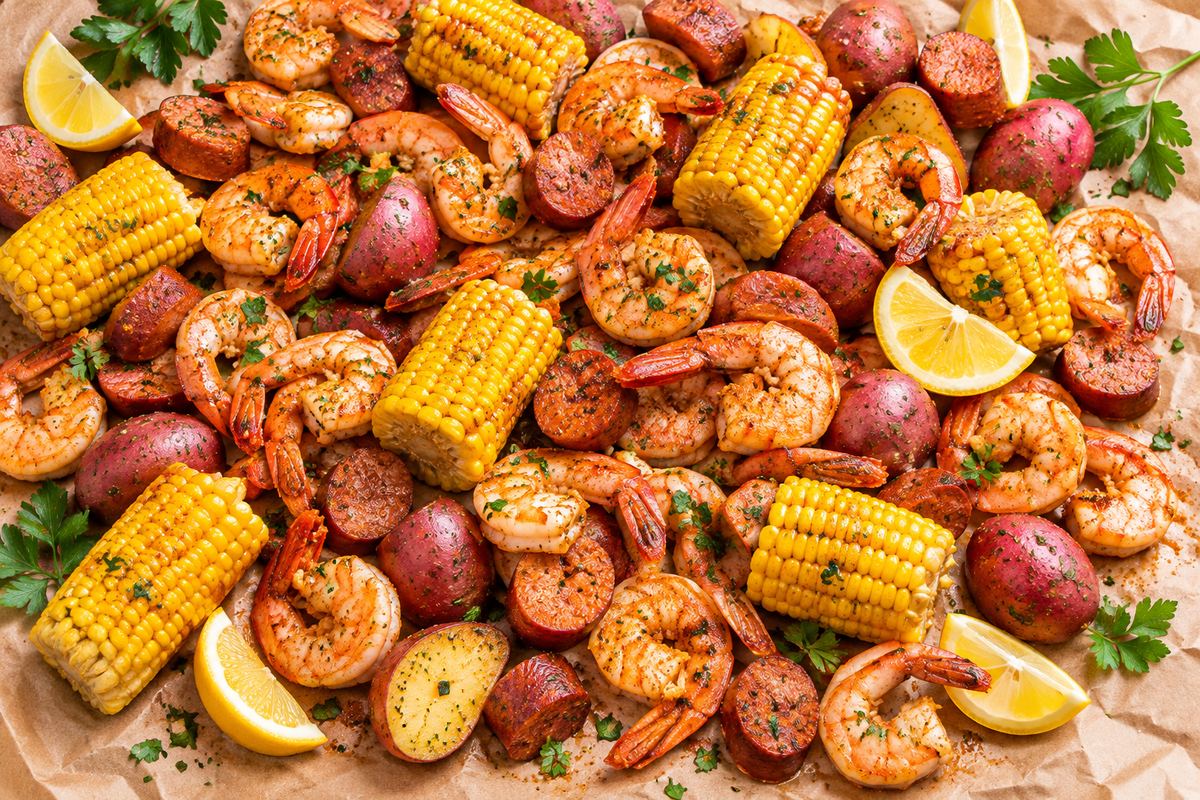
| Shrimp boil with corn and potatoes | 1/3 lb | Peeled or easy-peel, the form Cook the Story’s recipe uses | 5 to 7 |
Read the third column the way you read a price per unit, and every table below becomes a shopping list.
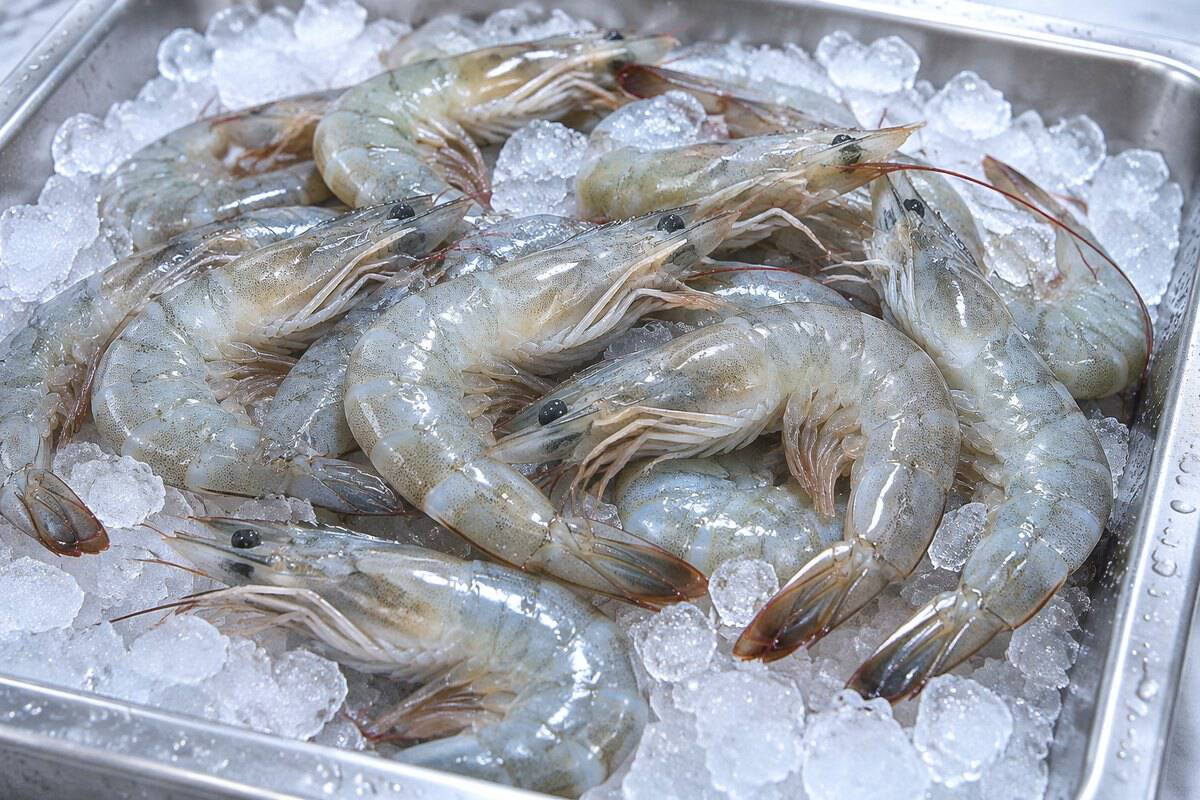
Why the published figures run from a quarter pound to a pound
The appetizer figures are a third apart, not a disagreement
Put the appetizer numbers beside each other and the spread is small. Food Republic says a quarter pound per person for an appetizer. Tasting Table says about a third of a pound, in its own words “three to five large shrimp.” That is 33 percent apart, and both behave like weights of shrimp as sold, shells on, though neither page says so.
The piece counts the sources print show why. Food Republic works from a bag of 25 to 30 shrimp per pound: a quarter pound is “about six shrimp pieces per guest,” a sensible appetizer portion. Tasting Table’s three to five large shrimp in a third of a pound works out to roughly 9 to 15 shrimp per pound, which is a bigger shrimp than the word “large” suggests. The Kitchn ties the two together without saying so: its shrimp cocktail serves eight from two pounds of 16/20 shell-on shrimp, a quarter pound and four to five shrimp a person, and its instruction is to “plan for 3 to 5 shrimp per person.”
The main-course figures are mostly shells
The main-course numbers look further apart and are not. Food Republic and Tasting Table both land on half a pound per person, without saying whether that means the bag as sold or the shrimp on the plate. Food Republic’s own piece count hints at the answer: from a 25 to 30 count bag it calls for “about a dozen shrimp for each plate,” which comes to just under half a pound of shrimp as sold. The Takeout says the basis out loud: half a pound of cooked, peeled shrimp for an entree, or one pound per person for raw, unpeeled shrimp. Those are the same dinner, weighed before and after the shells come off.
What Food Republic and Tasting Table omit is the sentence that would settle it. A weight of shrimp means very little until you know whether it is the bag as sold, the peeled shrimp, or the cooked peeled shrimp on the plate. Once the basis is named, the numbers stop arguing.
What the number on the bag means
The count is the number of shrimp per pound of the product as sold, printed as a range. A bag marked 16/20 holds 16 to 20 shrimp in every pound, so a two-pound bag holds 32 to 40. A higher number means smaller shrimp: Tasting Table sends 51/60 into pasta and 61/70 into shrimp salad, and often reaches for 10/12 on a cocktail platter. The letter U means under, so U/12 is under 12 shrimp per pound.
The names on the bag are not a reliable substitute. Food Republic notes that “there are no true labeling standards,” so a colossal shrimp at one store can be a jumbo at the next. Fresh Seafood publishes its own rough scale, 8 to 10 per pound for jumbo, 10 to 25 for large, 26 to 40 for medium and 41 to 60 for small, and warns that the names are “not universally defined or regulated.”
Peeling changes the count, because the shells were part of the weight. Tasting Table puts it plainly: a 16/20 shrimp “can end up looking more like a 21/25 after it’s peeled.” The count on a peeled bag and the count on a shell-on bag are both honest, and they are not counting the same pound.
The shells are why the weight looks wrong
Here is the conversion that makes the rest of the page make sense. Fresh Seafood’s rule of thumb is that two pounds of headless shrimp in their shells yield about a pound and a quarter when peeled. That is a yield of about 62.5 percent, which is our arithmetic on the supplier’s two figures, and the supplier labels its own numbers approximate. Buy a pound of shell-on shrimp and you are buying roughly ten ounces of shrimp and six ounces of shell.
A peer-reviewed study of five shrimp species, published in the journal Foods in 2021, puts whole-shrimp meat yield between 37 and 56 percent depending on the species, with the head and shell making up the rest. It measures five species in a laboratory rather than a retail bag, so read it as a second source on direction, not a shopping number: the more of the animal you buy, the smaller the share that reaches the plate.
Heads change the math again. Fresh Seafood says it takes about three pounds of fresh heads-on coldwater shrimp to produce one pound of cooked, peeled shrimp. Cooking removes water on top of what the shells took, which is why The Takeout’s pair, one pound raw unpeeled against half a pound cooked peeled, sits between the two.
The yield ladder, from bag to plate
So the ladder runs like this. If your target is a third of a pound of peeled shrimp on each plate, buy about half a pound of headless shell-on shrimp. That half pound is our arithmetic from the 62.5 percent yield, not a figure from a source. To put half a pound of cooked, peeled shrimp on each plate, buy about a pound of raw, shell-on shrimp, which is The Takeout’s own comparison. Buying shrimp with the heads on, the supplier’s rule of thumb is three pounds for every pound of cooked, peeled shrimp you want to serve.
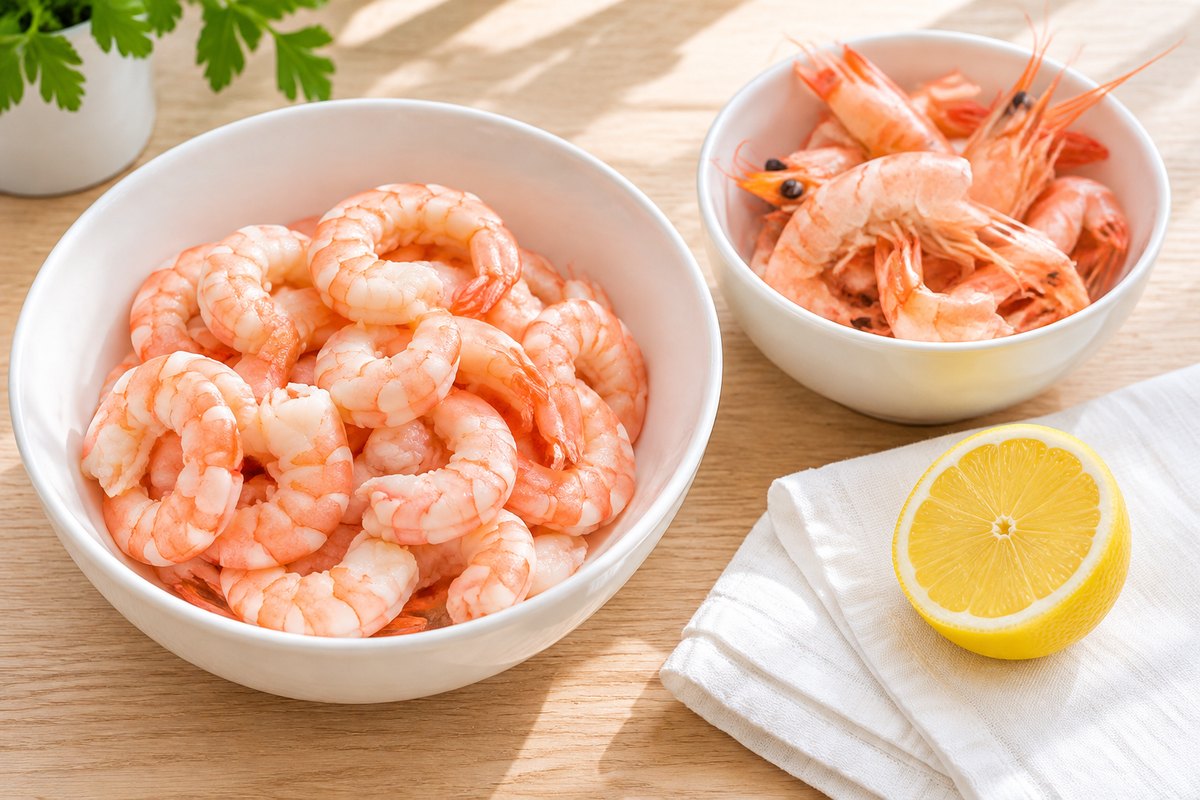
None of that makes shell-on shrimp a worse buy. It makes it a different unit: the shells protect the meat, they flavor a stock, and the price is lower for a reason that has nothing to do with quality. The mistake is comparing a shell-on price with a peeled price as if they were the same pound.
A raw peeled bag loses a little more weight when it cooks, and the sources read for this page give no single figure for that loss. If your bag is raw and peeled and you are matching a cooked-weight figure, buy the top of the range rather than the bottom.
Pieces per person, by count
If you would rather count shrimp than weigh them, this is the table to use. It multiplies the per-person weight by the count on the bag, and every figure is our arithmetic on the count you select, so a bag at a different count gives a different piece count for the same weight.
| Count on the bag | Pieces per person at 1/3 lb | Pieces per person at 1/2 lb |
|---|---|---|
| U/12 | 3 to 4 | 4 to 6 |
| U/15 | 4 to 5 | 6 to 8 |
| 8/10 | 3 | 4 to 5 |
| 10/12 | 3 to 4 | 5 to 6 |
| 16/20 | 5 to 7 | 8 to 10 |
| 21/25 | 7 to 8 | 11 to 13 |
| 26/30 | 9 to 10 | 13 to 15 |
| 31/35 | 10 to 12 | 16 to 18 |
| 41/50 | 14 to 17 | 21 to 25 |
| 51/60 | 17 to 20 | 26 to 30 |
| 61/70 | 20 to 23 | 31 to 35 |
The lesson in the rows is that a third of a pound is not one number of shrimp. It is three jumbo shrimp or twenty small ones. A host who counts pieces and a host who weighs bags can both be right about the same party, as long as they are looking at the same count.
The shrimp sizer
The sizer below does the whole calculation for your party: guests, serving style, what you are buying and the count on the bag. It returns the pounds to ask for first, because pounds buy shrimp, then pieces per person and the number of two-pound bags. If your bag prints no count, it returns the weight and says so rather than inventing a piece count. For the rest of the table, the appetizer counts for a whole spread sit beside these.
Shrimp sizer
Your guest count, your serving style and the count on the bag, turned into pounds, pieces and bags. Tap or click to open.
The count is the number of shrimp per pound printed on the bag, for example 16/20. A cocktail is a weight as sold, so the form you buy changes the meat on the plate, not the pounds in the cart. The main course has a published pair with a stated basis: half a pound cooked and peeled against one pound raw and unpeeled, both from The Takeout. Cook the Story’s boil figure is for shrimp that are “either shell off or easy-peel”, so a fully shell-on bag needs about half a pound a person to land the same third of a pound of meat. Peeling leaves about 62 percent of a headless pound, which is our arithmetic on the supplier’s rule of thumb.
Shrimp for 10, 20, 30 and 50 guests
Multiply the per-person figure by the head count and you have the shopping list. The grid uses a third of a pound for a cocktail hour, half a pound of peeled shrimp for a main, and three quarters to a pound of shell-on shrimp for a main. Every cell is rounded up to the nearest quarter pound, the same step the sizer above uses.
| Guests | Cocktail, 1/3 lb as sold | Main, 1/2 lb peeled | Main, 3/4 to 1 lb shell-on |
|---|---|---|---|
| 10 | 3.5 lb | 5 lb | 7.5 to 10 lb |
| 20 | 6.75 lb | 10 lb | 15 to 20 lb |
| 30 | 10 lb | 15 lb | 22.5 to 30 lb |
| 50 | 16.75 lb | 25 lb | 37.5 to 50 lb |
Shrimp cocktail for a party
A shrimp cocktail platter is the classic December use for all of this, and it has the clearest piece count of any shrimp dish: three to five shrimp per person. The Kitchn and Tasting Table agree on that range, and it holds whether the shrimp are jumbo or merely large, because size changes the weight, not the number of pieces a guest takes.
What changes with size is how the platter reads and what it costs. Tasting Table's classic cocktail platter often uses jumbo 10/12 shrimp, which is the tray that looks like an occasion and holds its shape after poaching. Smaller shrimp give more pieces for the same weight, good on a buffet where people graze and less impressive on a plate where five shrimp are meant to look like five shrimp. For twelve guests at three to five pieces each, that is 36 to 60 shrimp, somewhere between two and four pounds of 16/20. The sizer rounds twelve guests up to four pounds, which is 64 to 80 shrimp.
The clock the platter is on
The platter has a clock. The FDA's seafood guidance says never to leave seafood out of the refrigerator for more than two hours, or more than one hour when the room is above 90 degrees Fahrenheit, and to serve cold seafood on ice if it will stay out longer than two hours. A platter over a bowl of ice buys you the evening; a platter on a bare table does not.
Thaw it overnight, and read the guest list
Thaw shrimp in the refrigerator overnight, or sealed in a plastic bag and held under cold water. The FDA allows a microwave defrost only if the shrimp go straight into the pan. Cook them to 145 degrees Fahrenheit, or until the flesh is firm, pearly and opaque, which takes a couple of minutes in simmering water and less in a hot pan. Two guest-list notes come with the platter: shellfish is one of the common food allergens, so a small sign or a word from the host is worth the trouble, and the FDA tells pregnant women, young children, older adults and people with weakened immune systems to avoid raw or undercooked shellfish, which makes a poached-and-chilled platter the safer centerpiece for a mixed crowd.
The video below is the technique we would send a friend. America's Test Kitchen covers how to shop for shrimp and how to poach them for cocktail in one short video, and the poaching method is what keeps a cold platter tender.
Price per edible pound: what the cheaper bag actually costs
The comparison that decides a shrimp purchase, to this desk's mind, is not the price on the bag. It is the price per pound of shrimp you can eat, and the yield ladder gives you the multiplier. Whatever your store charges for headless shell-on shrimp, divide by 0.625 to get the price per peeled pound, because a shell-on bag costs about 1.6 times its sticker per edible pound. For heads-on shrimp, multiply by about three to compare with cooked, peeled shrimp.
Run it with your own shelf prices and the answer can flip. A shell-on bag at eight dollars a pound is twelve dollars and eighty cents per edible pound. A peeled bag at twelve dollars a pound is twelve dollars per edible pound, so the peeled bag wins even though its sticker is higher. The same arithmetic answers the holiday-main question if you are weighing how much ham per person for the same table, where the bone does the same job the shell does here.
A shrimp price moves with the season, the count and the store, so a number printed here would be stale by the time you shopped. Your shelf price answers it, and the multipliers above are what you apply to it.
This article is for general information and entertainment, not financial advice.
A worked example: twelve guests, two ways
Twelve guests, a cocktail hour before dinner, and a bag of peeled 16/20 shrimp. A third of a pound a person is four pounds, which is 64 to 80 shrimp, five to seven a person, and two two-pound bags. A shell-on 16/20 bag is the same four pounds for the same party, because the cocktail figure is a weight as sold.
Now make shrimp the main course for the same twelve, with shell-on 16/20 shrimp. A pound a person is twelve pounds, 16 to 20 shrimp a person and about 216 shrimp in all, which is six two-pound bags. Buy peeled shrimp instead and the figure drops to six pounds and eight to ten shrimp a person. Both are the same dinner, and both are correct for the bag in your hand.
For the rest of the table, the host's list for a dinner party covers what to carry through the door, and the punch numbers cover the bowl.
Frequently asked questions
How many shrimp are in a shrimp cocktail serving?
Three to five shrimp per person, according to The Kitchn and Tasting Table. At a 16/20 count that is about a quarter pound as sold, and on jumbo 10/12 it is the classic cocktail plate.
How much shrimp should I buy for 20 people?
For a cocktail hour with dinner to follow, 6.75 pounds as sold. For a main course, 10 pounds of peeled shrimp or 15 to 20 pounds of shell-on shrimp. Those are the per-person figures multiplied by 20 and rounded up to the nearest quarter pound.
Is shell-on shrimp cheaper than peeled shrimp?
Not necessarily. Per edible pound, a shell-on bag only wins if the price gap is wide enough: divide the shell-on price by 0.625 to compare it with a peeled price, because about 62.5 percent of headless shell-on weight is shrimp after peeling. The peeled bag has to cost about 60 percent more to be an even trade.
How many pounds of shrimp for a boil?
A third of a pound per person when corn, potatoes and sausage share the plate, and Cook the Story rounds that up to the nearest half pound for shopping: two pounds for six people, three and a half for ten. Its recipe uses shrimp that are "either shell off or easy-peel", so a fully shell-on bag needs about half a pound a person. If shrimp is the only thing on the table, use the main-course figure instead.
What does 31/35 mean on a bag of shrimp?
It is the count per pound in the state the shrimp are sold: 31 to 35 shrimp in every pound of that bag, so a two-pound bag holds 62 to 70. The higher the pair, the smaller the shrimp.
Can I buy shrimp the day before a party?
Yes, with refrigeration. Keep seafood at 40 degrees Fahrenheit or below if you will use it within two days, and freeze it otherwise. Cooked shrimp should stay cold until serving and should not sit out more than two hours, or one hour above 90 degrees Fahrenheit.
Researched and written by Richie with the help of modern digital tools. Images: AI-generated illustrations.
Sources
All sources below were read in November 2026.
- Tasting Table. How Many Shrimp Should You Buy For A Dinner Party? (Martha Brennan, 2025-10-04).
- Food Republic. How Many Shrimp Per Person Should You Serve At A Dinner Party? (Bobby Huen, 2013-09-25).
- The Takeout. About How Much Shrimp Should You Cook Per Guest At A Dinner Party? (Cara J Suppa, 2025-01-23).
- The Kitchn. Shrimp Cocktail (Rachel Perlmutter, published 2023-12-20).
- Fresh Seafood. Seafood Sizes, Weights, Measures (supplier reference page; all figures labelled approximate).
- Liu, Z., and others. Comparison of the Proximate Composition and Nutritional Profile of Byproducts and Edible Parts of Five Species of Shrimp, Foods 10(11):2603, 2021.
- Cook the Story. Easy Shrimp Boil Recipe (Christine Pittman, updated 2025-07-28).
- U.S. Food and Drug Administration. Selecting and Serving Fresh and Frozen Seafood Safely.
- America's Test Kitchen. The Best Way to Cook Shrimp, Techniquely with Lan Lam (YouTube).

Leave a Reply