Navigation apps will route you through a rough neighborhood to save a minute, and they almost never warn you. I don’t know if this has happened to you, but it has happened to me: I get in the car during rush hour, type the address into my phone, and trust the app to find the fast way around the jam. Twenty minutes later I understand why the road is so empty: I am in the middle of a rough, high-crime neighborhood, counting the seconds until I am out of it.
That is not a malfunction. Navigation apps are built to find the quickest legal route, and the quickest route sometimes runs through streets you would never choose on purpose. The app has no idea whether a block feels safe at 6 p.m. It knows traffic, distance, turn restrictions, and little else. If you want to avoid sketchy neighborhoods, you have to supply the judgment the app does not have.
The good news is that a few minutes of preparation can keep you out of that situation, and a few calm decisions can get you through it if you are already there. This guide covers what the apps actually do about high-risk areas, how to avoid sketchy neighborhoods with a three-minute route check, and the settings that help more than people think.
| App | What its own help pages promise |
|---|---|
| Waze | High-risk area alerts in Israel and limited areas of Rio de Janeiro, plus toll, ferry and freeway avoidance; ETA from driver speeds. |
| Google Maps | Toll and highway options, alternative routes, route dragging, and Street View previews. No crime or safety routing setting. |
| Apple Maps | Toll and highway options, plus Leave at and Arrive by times. Its help pages list no safety setting. |
Why your GPS keeps choosing the rough way
Every navigation app is solving the same problem: get you from one point to another in the least time. Google Maps says plainly that its transport options are ranked on objective factors including duration, distance, and price, and that the most important factors are usually your mode preference and trip duration. Safety is not on that list.
Waze adds a second ingredient. Its arrival estimate is based on the average speed that Wazers are driving on a given route, adjusted for traffic and for irregular events such as crashes. Waze also asks drivers to report what they see, from potholes and broken traffic lights to cars on the shoulder, and those reports go onto the map for everyone. When the highway seizes up, all of that data can point to a clever shortcut through a residential grid. The shortcut is real. So is the reason those streets are quiet.
This is where Waze and Google Maps part company in practice. Waze is more willing to leave the main road to save a minute. In my experience, Google Maps tends to stick to highways and major avenues even when that is slightly slower. Apple Maps behaves more like Google Maps in the limited use I have given it. No app promises to keep you out of a rough area everywhere, because outside one narrow feature in two countries, none of them is measuring safety at all.
What the apps actually do about high-risk areas
Waze does have a high-risk area feature, and its scope is much narrower than most drivers assume. Waze’s own help page says the alerts are available only in Israel and limited areas of Rio de Janeiro, Brazil. In those places you get a warning before you start navigating into a high-risk area and another if you enter one, and Waze avoids those areas by default.
Outside those places, there is no such layer. Waze has never warned me anywhere in the United States, and that matches the documentation rather than contradicting it.
Google Maps has no crime-avoidance setting at all. Its route options cover tolls and highways, not safety. Google has removed a specific route after a serious incident. A 2025 opinion piece in Android Authority by Megan Ellis describes a 2024 lawsuit from a couple who said Maps sent them from the Cape Town airport through a dangerous area, and notes that Google later removed the suggested route after other attacks. That is a reaction to one notorious route, not a safety system.
Apple Maps is in the same place. Its help pages list toll and highway options and a Leave at or Arrive by time, and nothing about safety. A third-party app called RedZone Map once promised to route drivers around rough areas. Android Authority described it in 2016 as combining crime data with user reports to steer drivers clear of dangerous neighborhoods. Ten years later its website did not respond to a check in October 2026, so it is not a service to plan around.
Be equally skeptical of any app that claims to show crime block by block. A crime map is a record of reports, not a forecast of your drive, and it is only as complete as the reporting behind it. A red patch is not a prediction.
The three-minute route check to avoid sketchy neighborhoods
You do not need a special app. You need to look at the shape of the route before you put the car in gear. This is the check worth running, and it takes about three minutes.
1. Look at the whole route, not just the arrival time
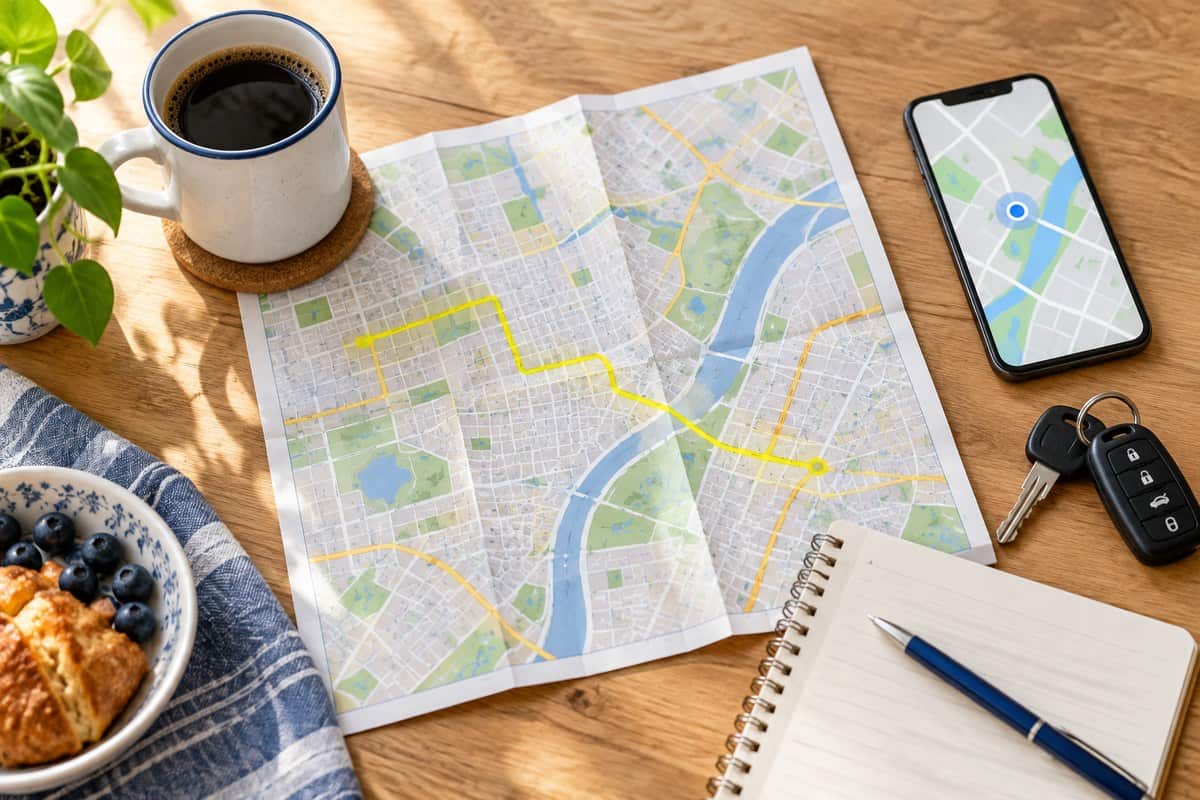
Open the directions and pinch out until you can see the entire line. A route that hugs two highways and one major avenue is easier to read, and easier to escape, than a thin squiggle through twenty side streets. If the line leaves the main roads for a long stretch in an unfamiliar city, that is your signal to look closer.
2. Compare the alternatives by shape, then by minutes
Google Maps shows multiple routes with the best one in blue. Tap or click another line to see its time. Waze has a View routes screen before you start, and Apple Maps lists the driving options with their times. Compare where each one goes, not only how long it takes.
Then do a little arithmetic, because the minutes are usually smaller than they feel. Six extra minutes on a twenty-minute trip is thirty percent more time, which is a real cost. Six extra minutes on an hour-long trip is ten percent, which is often a bargain. A workable rule of thumb: in daylight and in a city you know, take the main-road route when the detour costs less than a quarter of the trip. At night in a city you do not know, the extra minutes should bother you much less.
3. Preview the last mile in Street View
Most of the anxiety in an unfamiliar area comes from not knowing what the next corner looks like. Google Maps lets you open the steps of a route and preview each one in Street View where imagery exists. Check the final turn into your hotel, the parking entrance, and the street you will walk from the car. It is the cheapest reconnaissance available.
4. Set the time you will actually drive
A route at 2 p.m. and the same route at 10 p.m. are different trips. Google Maps and Apple Maps both let you set a departure or arrival time, and the estimate changes with predicted traffic. If the app is planning your evening drive with midday traffic, its shortcut may look better than it will be after dark.
The settings worth changing, and the one that can backfire
Waze hides its route preferences in Settings, then Navigation. Turn on Avoid toll roads, Avoid ferries, or Avoid freeways as you prefer. You can also set them for a single trip: search for the destination, tap View routes, then Avoid for tolls and ferries. Freeways need one more tap, on View all navigation settings. Waze warns that it may still suggest a toll road, ferry, or freeway when the setting is on, depending on the routes available, so treat the toggle as a strong preference rather than a promise.
Google Maps puts the same choices under Options when you get directions, with checkboxes for tolls and highways. Apple Maps puts them under Options below the directions, next to Leave at and Arrive by. Waze applies changes to future drives, so check the settings before a long trip rather than discovering them at the toll booth.
Here is the part that can backfire. Avoiding freeways sounds safer, and sometimes it is: you stay on roads with more traffic, more lights, and more places to turn around. But on a long trip at night, avoiding the freeway can push you onto a chain of unfamiliar surface streets through exactly the kind of area you were trying to avoid. The freeway is usually the more predictable place to be. Use the avoid-highways setting when you know the alternate roads, not as a blanket safety switch.
The four rules I still use
The tools have improved. The rules I use have not changed much, and they still settle most of these decisions before I touch the screen. If it is not rush hour, Waze is generally fine. If I know the city and know where the rough stretches are, I use Waze and choose the better route myself. If I do not know the city, I lean on Google Maps. And for a trip that matters, I map the route the day before, so the choice is already made before I am tired.
None of that is a guarantee. It is a set of habits that keeps the app in the passenger seat instead of the driver’s seat.
If you are already in it: the calm-driver rules
Sometimes the turn is behind you before you realize where you are. What you do next matters more than how you got there.
Keep moving, and stay on the widest, best-lit road you can see. A moving car on a main avenue is a much better place to be than a stopped car on a side street while you study the phone. Do not slam on the brakes to reprogram the route. Wait for a safe place to pull over, ideally a lit gas station or a busy lot, and reroute there.
Keep the doors locked and the windows up, and leave space at the light so you are not boxed in. If someone approaches the car, do not roll down the window to explain yourself or to be polite. A wave and a shake of the head is enough. If you think you are being followed, drive to the nearest police station or open business rather than home, and call the police from the car if you can do it safely.
Two boring preparations do more than any app. Fuel up before dark, so you are never hunting for a station in an unfamiliar area with the gauge on empty. And park where you can see the car from the door, under a light, rather than in the cheapest unlit spot three blocks away. On a road trip, tell someone your route and your expected arrival time. That is the habit that turns a bad turn into a story instead of a problem. If you are packing for a longer trip, our seven-day carry-on checklist covers the bag while this guide covers the drive.
What “sketchy” actually means, and why the map cannot tell you
The word in the title is doing a lot of work, and it deserves an honest look. A neighborhood can feel threatening for reasons that have nothing to do with danger: shuttered storefronts, poor lighting, unfamiliar languages on the signs, or simply the fact that you do not recognize anything. Those cues are real to the driver. They are not crime statistics.
Crime is local. The block you are on can feel different from the one after it, and the pattern can change with the hour. The people standing on the corner are not evidence of anything. If the goal is to get home safely, the useful signals are simpler and less judgmental: Is this a main road? Is it lit? Are there open businesses? Do I know where I am going? A route that fails those tests is worth changing, no matter what the neighborhood looks like.
That distinction matters for another reason. Treating every unfamiliar, poorer, or more diverse neighborhood as a threat is both unfair and a bad way to navigate. It will send you on long detours around places where nothing was going to happen, and it will make you less attentive to the actual risks on the road: fatigue, a bad merge, a phone in your hand. AAA’s Via magazine puts the bigger risk in plain numbers: mile for mile, driving fatalities are three times more likely at night than during the day. That is a reason to slow down and take the predictable road, not a reason to fear a neighborhood.
An arrival checklist for an unfamiliar city
This is a sensible routine for driving into a city you do not know, especially at night. It is not a security system. It is a way to remove the small uncertainties that make a driver take a bad turn.
Night-arrival checklist
Tick the six items before you leave. Tap or click to open.
0 of 6 done
The last item is the one people skip. The walk from the car to the door is part of the trip, and it is the part where you are not protected by a locked door. Park under a light, know the entrance, and keep your keys in your hand rather than buried in a bag. In a hotel, ask for a room near the lobby if you are arriving late, and use the main entrance rather than the side door. Download the route for offline use and something to listen to before you go. A library card gets you audiobooks for free, which is a better use of the drive than rechecking the map.
Frequently asked questions
Does Waze avoid high-crime areas?
Only in a few places. Waze says its high-risk area alerts and default avoidance work in Israel and limited areas of Rio de Janeiro, Brazil. In the United States and most other countries, Waze routes for time, not safety, and it can send you through a rough area if that is the fastest legal path.
Does Google Maps have a setting to avoid dangerous neighborhoods?
No. Google Maps offers route options for tolls and highways, and it ranks routes by factors such as time, distance, and price. It does not score neighborhoods for crime, and it has no switch that tells it to keep you on safer streets.
Is it safer to avoid highways at night?
Not automatically. A freeway keeps you moving, away from unfamiliar side streets and stoplights. Avoiding highways is useful when you know the alternate roads and they are well lit and busy. On a long night drive through an unfamiliar city, the highway is often the more predictable choice.
What should I do if my GPS routes me through a rough area?
Keep moving on the widest, best-lit road, keep the doors locked, and do not stop to reprogram the route. Pull over somewhere busy and lit, or wait until you reach a main intersection, then reroute. If you believe you are being followed, drive to a police station or an open business and call for help.
Can I see a route before I drive it?
Yes. Google Maps lets you preview route steps in Street View and drag a route to a different road. Waze shows alternate routes before you start, and Apple Maps lists driving options with times. Set a departure time as well, because the best route at noon may not be the best route at ten at night.
The three minutes that change the trip
The honest lesson from all of this is that no app is going to protect you from a route it chose for speed. The protection comes from looking at the line before you trust it, setting the few preferences that exist, and knowing what you will do if the road turns out to be worse than the map suggested.
Three minutes at the kitchen table is a small price for a drive you do not have to spend counting the seconds. The next time the app offers you a clever shortcut, look at where it goes. You are allowed to decline.
Sources
All sources below are current as of October 2026.
- Waze Help: Avoid high risk areas (alerts and default avoidance only in Israel and limited areas of Rio de Janeiro).
- Waze Help: How Waze calculates ETA (average speed of Wazers on the route, plus traffic conditions and irregular events).
- Waze Help: Avoid toll roads, ferries, and freeways (settings path and the caveat that tolls, ferries, or freeways may still appear).
- Waze Help: Report road hazards (drivers can report potholes, broken traffic lights, cars on the shoulder, and other hazards, and the reports appear on the map).
- Google Maps Help: Get directions and show routes (route ranking factors, toll and highway options, Street View previews, multiple stops).
- Apple Support: Get driving directions in Maps on iPhone (Avoid tolls or highways, Leave at, Arrive by).
- AAA Via: 7 Smart Tips for Driving Safely in the Dark, Chris Woolston, updated November 2022 (mile for mile, driving fatalities are three times more likely at night).
- Android Authority: This is the Google Maps feature I really want to see, Megan Ellis, August 3, 2025 (a 2024 lawsuit and a route removed after attacks near Cape Town; the piece is an opinion column).
- Android Authority: This navigation app keeps you out of high-crime areas in real time, Kris Carlon, April 15, 2016 (RedZone Map combined crime data with user reports and offered routes around dangerous neighborhoods).
The percentage comparisons of detour time are simple arithmetic, not a finding from any study.
Updated October 2026 by Richie with the help of modern digital tools.

Oh my God I hate that so much. It’s made even worse when it promises time saved and loses you even more by taking you out of one traffic jam that is at least moving (freeways) and into another that’s has you stopping more than you are going (surface streets) and to make matters worse these streets are filthy witb literal trash on the sidewalks with an odor so offensive that I winder how the area got to be that way.
Yes!
Opportunistic looters are becoming an ever more common problem in South Africa. More and more commonly the victims are stoned to death and /or set slight. Its VERY dangerous. These crimes are reported and recorded. Surely Google can extrapolate this and advise.
Safest route is becoming MUCH more important than fastest route.
I wanted to use bus to get to my destination on the first week of my arrival to Chicago. While I was switching buses I found out myself in the middle of Garfield Park which is one of the dangerous places in Chicago, Thanks god, nothing happened to me
I was attacked using Google Maps 6 days ago. The routing took me through a known gang area. I was with my family and we were lucky to survive. I was new to the area.
I’ve tried to report this to Google, but 3 days after the attack, Google still routes through this area.
Waze doesn’t route through the bad area. Not sure why, but be warned, Google can kill you in seconds.
Get local knowledge of any city and plan your journey ahead. Be wary of any Navigation app.
30 seconds driving down a road that looks safe can be suddenly change into a no go area, where you’re fighting for your life!
It happened to me 6 days ago, I was lucky. You can’t rely on luck. I’m still understanding how I screwed up and nearly killed my family.
The title should have been. Can Anybody Tell Me How to Avoid Sketchy Neighborhoods When Driving? There is nothing in the article that actually gives any useful advise about how to avoid said neighborhoods.