You are flying with gifts in your bags, and every one of them has to clear a security checkpoint before it reaches the person it is meant for. TSA, the agency that screens passengers at US airports, is not out to take your presents. Its questions are narrower, and they change with the gift.
The real tension is the wrap. A wrapped present is allowed in either bag. The catch is inspection: if a bag needs a second look, an officer can open what is inside it, and paper turns that into a ruined surprise. The wrap is not what gets banned. It is what gets undone.
So the question is which bag each present belongs in, and what decides it. Below is each gift type with its verdict and the condition that decides it, then a sorter that turns the rules into a bag-by-bag list of your own.
In this article
At a glance: every gift and its bag
| Gift | Carry-on | Checked bag | What decides it |
|---|---|---|---|
| Fully wrapped gift box | Yes, it may be opened | Yes, it may be opened | An officer can inspect either bag |
| Gift in a gift bag or lidded box | Yes | Yes | The packaging TSA asks for |
| Snow globe, tennis-ball size or smaller | Only if it appears to hold 3.4 oz or less and fits the quart bag | Yes | Both tests apply, base included |
| Larger snow globe | No | Yes | TSA: larger globes go in a checked bag |
| Full-size jar of jam, preserves or honey | No, 3.4 oz or less only | Yes | TSA counts these as liquids or gels |
| Bottle of wine, 750 ml | No | Yes | Table wine is 24% or less, no TSA volume limit |
| Mini bottle of wine or spirits, 3.4 oz or less | Yes, if it fits the quart bag | Yes | The container limit applies to miniatures |
| Spirits over 24% and up to 70% | No, except a 3.4 oz miniature in the quart bag | 5 liters, unopened retail packaging | Strength and packaging |
| Spirits over 70% (over 140 proof) | No | No | Banned in both bags |
| Cookies, candy and chocolate | Yes | Yes | Solid food travels either way |
| Canned goods | Yes, extra screening possible | Yes | TSA suggests the checked bag |
| Pocket knife or multi-tool | No, butter knives and plastic cutlery excepted | Yes, ideally sheathed or wrapped | The sharp-objects rule and its exception |
| Power bank or spare batteries | Yes, 100 Wh or less, or 101 to 160 Wh with approval | No | Over 160 Wh is banned outright |
The wrap is the first thing to fix
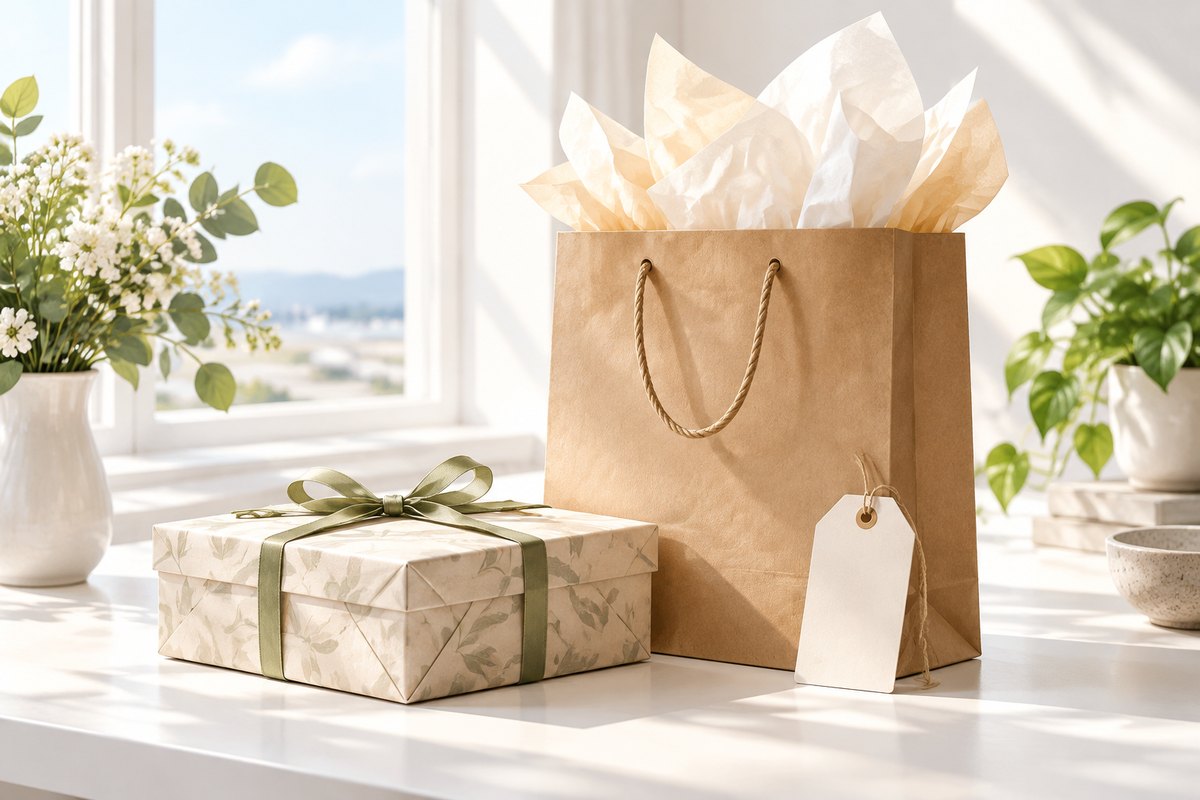
TSA’s travel-tips page answers the wrapping question, and the answer is a request rather than a ban. Passengers traveling with gifts are asked “to use gift bags, which they can easily open, or gift boxes with lids they can remove”, so officers can inspect a present if they need to and “avoid the possibility of opening fully wrapped presents.” Those words matter: a wrapped box is not prohibited. It is simply the one style the agency asks you to skip.
What TSA asks for instead of paper and tape
A gift bag with tissue paper, or a box with a lift-off lid, looks finished on Christmas morning and opens in one motion at the checkpoint. That is the whole ask. The wrapping kit can travel with you; the sorting section below returns to when to use it.
One habit to give up: treating the hold as a sealed vault. On the same page, TSA writes that “there are times when we need to physically inspect a piece of luggage”, and that if a checked bag stays locked, “the locks may have to be cut.” Pack a wrapped gift as if someone will open it, because someone can.
A rule and a recommendation are different things
Some of what TSA publishes is a rule with a number on it: containers of 3.4 ounces or less, one quart bag per passenger. Some is advice for a smoother day. The gift-bag sentence is advice; the snow-globe quart condition is a rule. Telling them apart saves an argument at the lane. The snow-globe, knives and food pages in the agency’s What Can I Bring directory all close with the same line, quoted once here: “The final decision rests with the TSA officer on whether an item is allowed through the checkpoint.”
Snow globes: the gift that gets left behind
TSA gives the snow globe its own item page. It is also the gift where the rule and the recommendation point in different directions. That page, TSA’s snow globe page, leads with both verdicts: “Carry On Bags: Yes (Less than or equal to 3.4oz/100 ml allowed)” and “Checked Bags: Yes.” The work is in the condition underneath.
The 3.4-ounce test, and the base that has to fit too
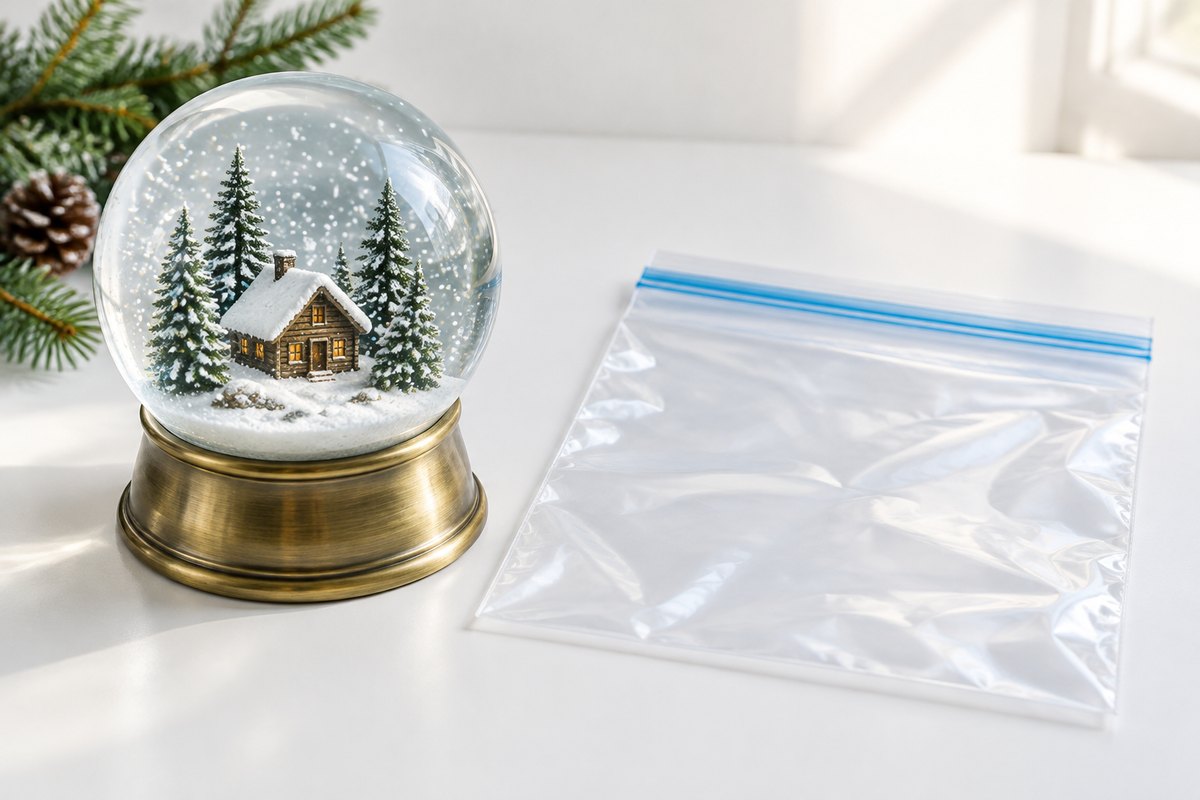
Snow globes “that appear to contain less than 3.4 ounces of liquid (approximately tennis ball size) can be packed in your carry-on bag ONLY if the entire snow globe, including the base, is able to fit into your one quart-sized, resealable plastic bag.” Two tests, and the second is the one people fail: the liquid must look like less than 3.4 ounces, and the whole object, pedestal included, must close inside the quart bag. “Larger snow globes must be packed in checked baggage.”
Why TSA’s tips page still sends them to the hold
The travel-tips page is blunter: snow globes “should be in checked bags due to the liquid inside them.” Both statements are true, because they are different kinds of statements. One is the rule: a tennis-ball globe may ride in the cabin if it wins the quart bag. The other is the recommendation: the hold is where globes travel without a fight over shared liquid space. Small and treasured goes at your feet if it fits whole; the rest goes downstairs.
Jam, honey and the rest of the liquid gifts
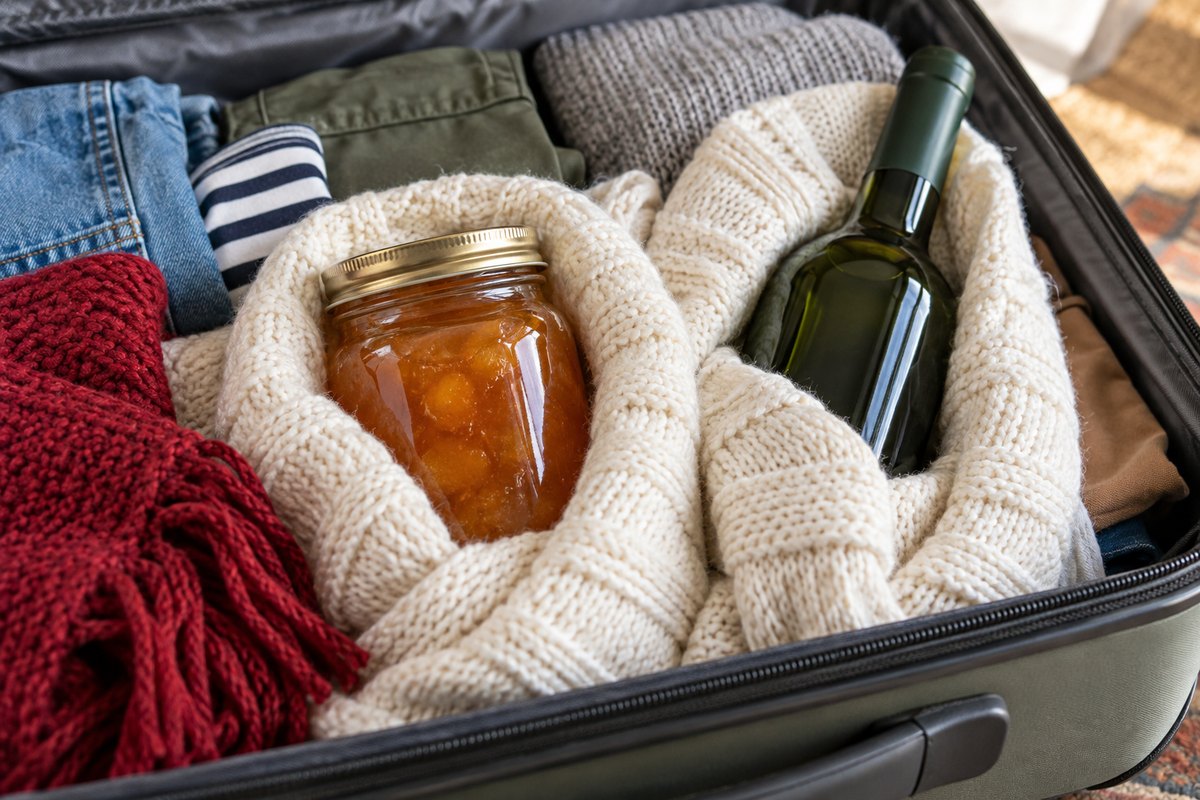
The food gifts that slow checkpoints are the jars: jam, preserves, honey, sauces, maple syrup. TSA’s travel-tips page names the category outright: “certain foods, such as sauces, jam, preserves and wine – which are considered liquids or gels.” That sentence lands jam and wine beside toothpaste.
The spill test, in TSA’s own words
The rule collapses into one sentence from TSA’s travel-tips page: “If you can spill it, spread it, spray it, pump it or pour it, and it’s larger than 3.4 ounces, it should go in a checked bag.” A jar of jam is a jar of shampoo with better intentions. The companion rule lives on the liquids rule page, which limits carry-ons “to travel-sized containers that are 3.4 ounces (100 milliliters) or less per item” and sends anything larger “in checked baggage.” The full 3-1-1 walkthrough is in our carry-on packing checklist.
One quart bag, and what it does to a snow globe
The quart bag is one per passenger, and everything small shares it: the toothpaste, the hand cream, the airport honey, and any snow globe lucky enough to fit. A globe that qualifies for the cabin “ONLY if the entire snow globe … is able to fit into your one quart-sized, resealable plastic bag” claims the same space. Once the bag is full, the next small item is out of the cabin. Tick the small items in the sorter below and it counts them.
Wine and spirits: two percentages and a proof
Alcohol is the gift family where the number on the bottle decides everything. TSA’s food page draws two lines, at 24 percent and at 70 percent.
Twenty-four percent, seventy percent
“Alcoholic beverages with more than 24% but not more than 70% alcohol are limited in checked bags to 5 liters (1.3 gallons) per passenger and must be in unopened retail packaging. Alcoholic beverages with 24% alcohol or less are not subject to limitations in checked bags.” Table wine sits under the 24 percent line: checked, no volume limit. Whiskey sits between the lines: checked, five liters, shop-sealed. At the far end, the page lists “alcoholic beverages with more than 70% alcohol (over 140 proof), including grain alcohol and 151 proof rum” and marks it No in both columns.
A 750 ml bottle in the cabin
A standard bottle cannot ride in the cabin. The carry-on column is the mini-bottle rule: a bottle of 3.4 ounces or less that “must be able to comfortably fit into a single quart-sized bag.” One narrow exception exists on itineraries that start abroad, covered at the bottom of this page.
Cookies, candy and canned goods
Sweets are the easy column. The cookie tin, the box of chocolates and the fruitcake travel in either bag, any size.
Solid food travels either way; all food is X-rayed
TSA’s food page says it for candy and bread alike: “Solid food items (not liquids or gels) can be transported in either your carry-on or checked bags.” Chocolate sauce is another matter. And food is X-rayed in either bag, the second half of the food answer in the agency’s FAQ: “Yes, you may pack food in your carry-on or checked bag, but remember all food must undergo x-ray screening.”
Cans: allowed, but not promised
Canned goods are the asterisk of the food aisle. TSA lists them under “Yes (Special Instructions)” and spells out what that means: items “could require additional screening that might result in the item not being allowed through the checkpoint. We suggest that you pack this item in your checked bag, ship it to your destination or leave it at home.” A can is not banned. It is simply not guaranteed.
Knives and power banks: two gifts with hard rules
Two December staples carry rules that do not bend for the holidays: the pocket knife and the power bank. Each has one bag it belongs in as a rule, with a narrow exception for the dullest blades.
The exception for butter knives and plastic cutlery
TSA’s knives page gives the pair of verdicts first, “Carry On Bags: No” and “Checked Bags: Yes”, then prints the exception the shorthand drops: “Except knives with rounded-blades, blunt edges without serration/teeth such as butter knives, or plastic cutlery.” The pocket knife and the multi-tool are checked-bag gifts. One courtesy goes with them, in the page’s words: “Any sharp objects in checked bags should be sheathed or securely wrapped to prevent injury to baggage handlers and inspectors.”
Power banks and spare batteries ride with you
The power bank is a fine present and a strict one to fly with. The FAA, the Federal Aviation Administration, writes the rule, and its PackSafe page leaves no ambiguity: spare batteries “must be carried in carry-on baggage only”, including “power banks and cell phone battery charging cases”, and “the battery terminals must be protected from short circuit” by a case, tape or retail packaging. Lithium ion batteries are limited to 100 watt hours each; up to two spares of 101 to 160 watt hours need airline approval; nothing above 160 watt hours is allowed in either bag, and the page warns that “Many airlines … may have stricter quantity and Wh limits.” Our carry-on packing checklist covers packing battery gear before the airport.
Sort the pile: the two-bag method
The method is unglamorous and it works. Split the pile into the bag that stays with you and the bag that goes downstairs, one verdict at a time. The sorter below does the splitting for the gift types that come up in December.
Sort my gifts into two bags
Tick the presents you are carrying and see which bag each one belongs in. Tap or click to open.
Scope: US checkpoint rules. The officer at the lane has the final word.
The kit that saves a present
One small kit handles nearly anything the rules throw at a gift: bubble wrap for the checked bag, two or three gift bags with tissue paper, tape, a marker for re-labeling an opened bag, and a spare quart bag for the liquids test.
Wrap at the destination
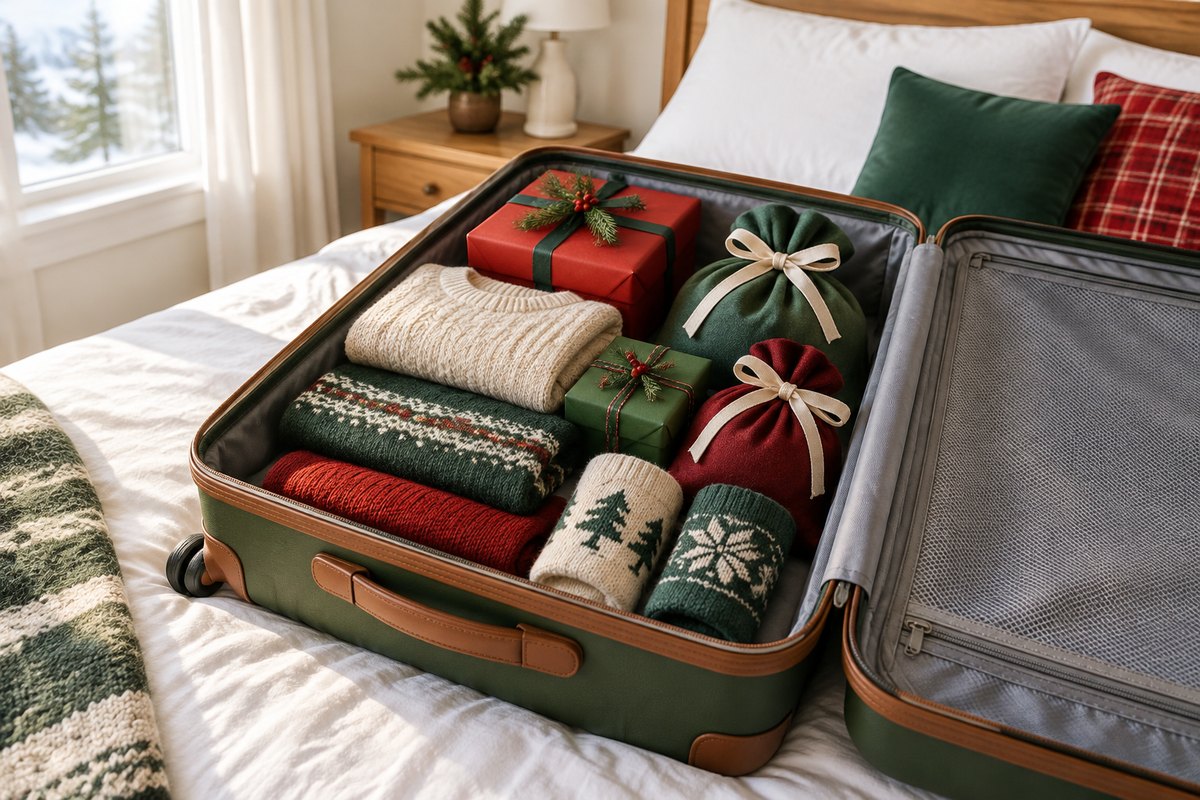
The simplest protection for a fragile present is a decision: leave the paper off and wrap where the gift is going. Clothes make fine padding in a pinch, and a gift bag at the other end takes ten seconds at the kitchen table. For presents still on the list, our guide to what to bring to a dinner party and our list of unusual housewarming gifts both give you something worth carrying.
For the suitcase itself, here is a packing walkthrough worth watching before the trip.
When the checkpoint is not American
Everything above covers a US checkpoint, because TSA writes that rulebook. A flight leaving another country is screened by that country's rules, and a connecting itinerary can meet two sets in one day.
The one US exception worth knowing on a connection
There is one place where an oversized liquid can still ride in a US-bound cabin: duty-free bought abroad and carried through a US connection. The liquids rule page allows duty-free liquids over 3.4 ounces in the carry-on when three conditions hold. First: "The duty free liquids were purchased internationally and you are traveling to the United States with a connecting flight." Next: "The liquids are packed in a transparent, secure, tamper-evident bag by the retailer and do not show signs of tampering when presented to TSA for screening." And the condition that strands people: "The original receipt for the liquids is present and the purchase was made within 48 hours."
One boundary to state plainly: screening is where this guide stops. Bringing goods into a country is a customs question, not a security one. The answer belongs to the destination country and differs from place to place.
So the pile on the bed becomes two piles tonight: one that travels at your feet, one that goes downstairs at bag drop. A sorted bag is a boring bag, which is the only kind worth packing.
Frequently asked questions
Can you take wrapped presents on a plane?
Yes. Nothing in the rules bans wrapping paper, so a wrapped gift may ride in either bag. The catch is inspection. TSA asks passengers to use gift bags or gift boxes with removable lids so officers can look inside without undoing the paper, and an officer may open a wrapped present at the checkpoint or inside a checked bag.
Can you bring a snow globe on a plane?
Only a small one, in your carry-on. TSA's snow globe page allows a globe that appears to hold less than 3.4 ounces of liquid (about tennis-ball size) in the cabin only if the entire globe, base included, fits inside your one quart-sized resealable bag. Larger snow globes go in checked baggage, and the travel tips page recommends checking them either way.
Can you bring jam or honey in your carry-on?
Only in containers of 3.4 ounces or less. TSA counts sauces, jam and preserves among the liquids or gels, so a full-size jar belongs in a checked bag. Anything you can spill, spread, spray, pump or pour that is larger than 3.4 ounces goes in the hold, and food is X-rayed in either bag.
Can you bring a bottle of wine on a plane?
In the cabin, no: a 750 ml bottle is a checked bag gift. Table wine is 24 percent alcohol or less, and TSA sets no checked-bag volume limit for that band. Above 24 percent and up to 70 percent, spirits are capped at 5 liters per passenger and must be in unopened retail packaging, and anything over 70 percent alcohol (over 140 proof) is not allowed in either bag.
Do gifts have to go in checked baggage?
No. Solid gifts travel in either bag: cookies, candy and chocolate are allowed in carry-on and checked baggage alike, and a wrapped gift can ride in the cabin too. The checked bag is where liquid gifts over 3.4 ounces, larger snow globes and most knives belong, and it is open to inspection just like the carry-on.
Can you bring a power bank as a gift?
You can carry it, but it cannot go in a checked bag. The FAA requires spare lithium batteries, including power banks and phone charging cases, to travel in carry-on baggage only, with battery terminals protected from short circuit. Lithium ion batteries are limited to 100 watt hours each, up to two spares of 101 to 160 watt hours need airline approval, nothing above 160 watt hours is allowed in either bag, and airlines may set stricter limits.
Sources
Every rule on this page comes from a TSA or FAA page read in November 2026. Where a page is guidance rather than a rule, the section above says so.
- Transportation Security Administration, Travel Tips: the gift-bag and lidded-box request, the snow-globe tip, the spill test, and the note that checked luggage can be physically inspected.
- Transportation Security Administration, Liquids, Aerosols, and Gels Rule: the 3.4-ounce per item limit, the one-quart bag, and the duty-free exception for inbound international connections.
- Transportation Security Administration, Snow Globes (What Can I Bring?): the tennis-ball test and the quart-bag condition for carry-on snow globes.
- Transportation Security Administration, Food (What Can I Bring?): solid food in either bag, canned foods, and the alcohol table at 24 percent, 70 percent and 140 proof.
- Transportation Security Administration, Knives (What Can I Bring?): checked-bag rule, the butter-knife and plastic-cutlery exception, and the sheathing line.
- Transportation Security Administration, Frequently Asked Questions: the food-and-X-ray answer.
- Transportation Security Administration, What Can I Bring?: the line that the final decision rests with the TSA officer.
- Federal Aviation Administration, PackSafe: Lithium Batteries (last updated August 11, 2026): spare batteries and power banks in carry-on only, terminal protection, the 100 watt hour limit and the two larger spares that need airline approval.
Researched and written by Richie with the help of modern digital tools. Images: AI-generated illustration.
Leave a Reply