A prime rib is ordered by the bone, and the bone is the part of the price the counter does not explain. You are hosting a holiday dinner, the roast is the centerpiece, and the two numbers you get are a weight and a price per pound, neither of which says how many people it feeds.
The bone is the tell: it is weight you pay for and cannot eat. What moves a host from half a pound a head to a full pound is not only appetite. It is whether the roast is the only thing on the plate, and how much you want left over for Monday.
So this page answers how much prime rib per person, and it does the arithmetic in the open. You get the pounds by head count, the bone count to ask for at the counter, the oven time from the federal roasting chart, and the bill before the sides. Every number below comes with the case it covers, so you can see which one fits your table.
In this article
At a glance: how much prime rib per person
| Cut and appetite | Per person | For 8 people |
|---|---|---|
| Boneless rib roast, regular appetite | 1/2 lb (8 oz) | 4 lb |
| Boneless rib roast, hearty appetite | 3/4 lb (12 oz) | 6 lb |
| Bone-in rib roast, regular appetite | 3/4 lb (12 oz) | 6 lb |
| Bone-in rib roast, hearty appetite | 1 lb (16 oz) | 8 lb |
| Bone-in rib roast, one of several dishes, at 1/2 to 3/4 lb a head | 1/2 to 3/4 lb | 4 to 6 lb |
| Leftovers, a sandwich each | add 1/4 lb | add 2 lb |
| Leftovers for a few days | add 1/2 lb | add 4 lb |
Read that table as a starting point with a known bias. A caterer feeds a room and would rather have a little left than run out, so the per-person figure carries a cushion. A home cook who wants a platter of carved slices may want more. The head-count table below shows both ends of the range side by side, and the built-in planner does the same arithmetic on your own numbers.
What the bone costs you, pound for pound
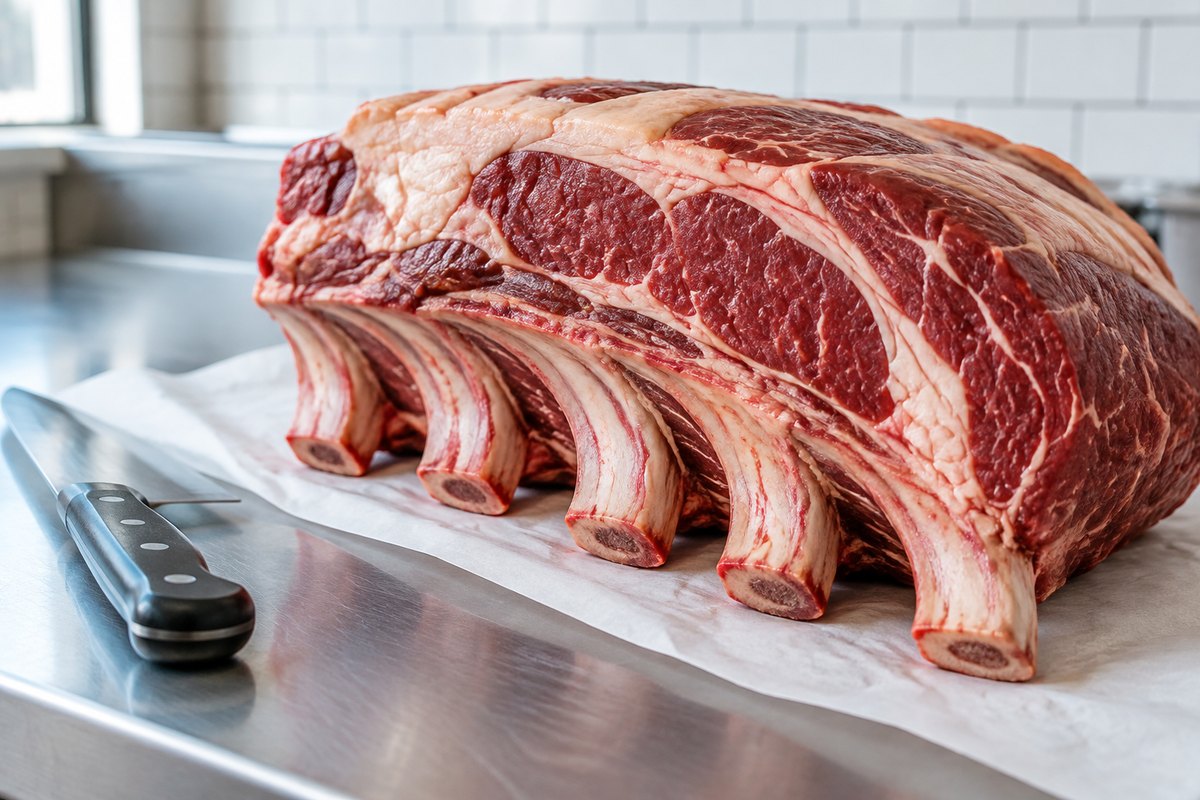
Bone-in is priced by the same per-pound sign as everything else on the counter, and part of that pound is bone. It is a different product, not a discount and not a trick, and it is why the two cuts need different per-person figures.
Why one bone feeds two people
Both guides used here converge on the bone count. CG Public House and Catering, a Washington caterer, states it plainly: one rib bone feeds about two people. Tasting Table, in its guide to buying prime rib, gives the same rule from a different kitchen: “one rib for every two diners.” A ten-guest dinner, it says, wants “about 10 pounds (or five ribs).” Two kitchens, one arithmetic.
The two guides disagree at first
The same two guides explain why the per-person number moves, and they do not agree at first glance. Tasting Table’s guide opens backwards: “one pound per person if the prime rib is boned, and about a half pound per person if not.” Its butcher section settles it: “If opting for bone-in, ask for one pound of the chuck end per person, or one rib for every two diners,” then “Halve the order for boneless meat.” One more sentence covers the table with other dishes: “reduce your bone-in order to about a half-pound to three-quarters of a pound per person.” With those terms fixed, the caterer’s three-quarters sits at the top of the buffet range, its full pound is the bone-in figure from the butcher rule, and its half pound boneless is the halved boneless order.
Once the bone terms are pinned down, the numbers form a single range, moved by four things: whether the bone is in, whether the roast is the only thing on the plate, how hungry the table is, and whether you want leftovers. Half a pound a head is the light end, and that is boneless meat. A table where the roast shares the plate pulls the bone-in number toward the bottom of its range. A pound is the heavy end, for bone-in meat as the main event. Once you know which lever you are pulling, the argument ends.
The same logic explains why a turkey needs a bigger number per head: so much of the bird is frame. A ham is the other centerpiece with a label problem: the ham per person guide starts with the packaging, not the bone.
Prime rib for 6, 8, 10, 12 and 20 people
Here is how much prime rib per person works out at the head counts people actually search for. Each cell is raw weight to buy, before leftovers, rounded to the nearest half pound.
| People | Bone-in, 3/4 lb each | Bone-in, 1 lb each | Boneless, 1/2 lb each | Boneless, 3/4 lb each |
|---|---|---|---|---|
| 6 | 4.5 lb | 6 lb | 3 lb | 4.5 lb |
| 8 | 6 lb | 8 lb | 4 lb | 6 lb |
| 10 | 7.5 lb | 10 lb | 5 lb | 7.5 lb |
| 12 | 9 lb | 12 lb | 6 lb | 9 lb |
| 20 | 15 lb | 20 lb | 10 lb | 15 lb |
Twenty people is where one roast becomes awkward. A twenty-pound bone-in roast is a heavy piece for a home oven, and it may not fit the pan you own. Two smaller roasts cook in the same oven and give you more end cuts, which some people at the table will prefer. The time per pound changes when you split the meat, so use the thermometer rather than the clock. The caterer’s own table stops at a full seven-bone section of about fourteen pounds for fourteen to sixteen people, so a party of twenty is already past the single-roast case.
Buy for the sandwiches you actually want
Leftover roast beef is not a by-product. For some hosts it is the reason to buy a bigger roast. So decide on purpose how many sandwiches you are planning, and add the weight for them.
This page’s working numbers are a quarter pound per person for a sandwich each, and half a pound per person if the roast is meant to carry lunches for a few days. Those are additions to the per-person rate, not replacements for it. Tasting Table makes the same point in one line of its guide to buying prime rib: a generous buy leaves enough for “a couple of delicious, deli-worthy roast beef sandwiches.” The caterer’s guide puts it as feeding everyone “with a little to spare.”
Prime rib is a cut, not a grade
This is the label trap, and it costs money. “Prime rib” is the name of a cut, the rib roast, also sold as a standing rib roast. “Prime” is also the name of the top USDA quality grade. The two uses of the word are unrelated, and a package can say prime rib without containing a Prime-grade roast.
The USDA’s own definitions are the clearest way to see the difference. Prime beef comes from young, well-fed cattle, has at least slightly abundant marbling, and is “generally sold in upscale restaurants.” Choice is “high quality, but has less marbling than Prime,” with at least a small amount. Select is leaner still, with at least a slight amount, and the agency notes it “may lack some of the juiciness and flavor of the higher grades.”
At the counter, that means one question: which grade is this roast, and what does each grade cost today. The grade shield on the packaging is the proof. Marbling is what the price is buying, and on a holiday table a Choice roast with good marbling is a legitimate choice.
The cut also comes in two ends, and they are not the same roast. Tasting Table describes prime rib as sold in two parts, the first cut at the loin end and the second cut at the chuck end. It flags the loin end as a mistake to avoid when cooking prime rib, describing it as “leaner and more uniform”, and makes the case for the chuck end because “the fat that marbles the chuck end provides moisture and flavor.” If you want the wider map of where the rib sits on the animal, the site’s guide to beef cuts covers it.
What to ask at the counter
Four questions cover the ground, and none of them requires you to sound like a butcher.
Ask for the weight and the bone count together. The two numbers should agree with your arithmetic, and the bone count is the fastest sanity check you have: about one bone per two pounds at the caterer’s rate.
Ask the price per pound for bone-in and boneless at the same grade. That single comparison tells you what the bone is costing you, and the difference can be smaller than the sticker suggests.
Ask them to tie the roast, and ask whether it will fit a standard roasting pan. If it will not, ask them to take a bone out rather than switching to a different cut. You keep the roast you planned and the pan you own.
Order ahead for the holiday week. A four-bone roast is a specific request, and the case at a busy counter can empty.
The oven: time, temperature and the one number that decides
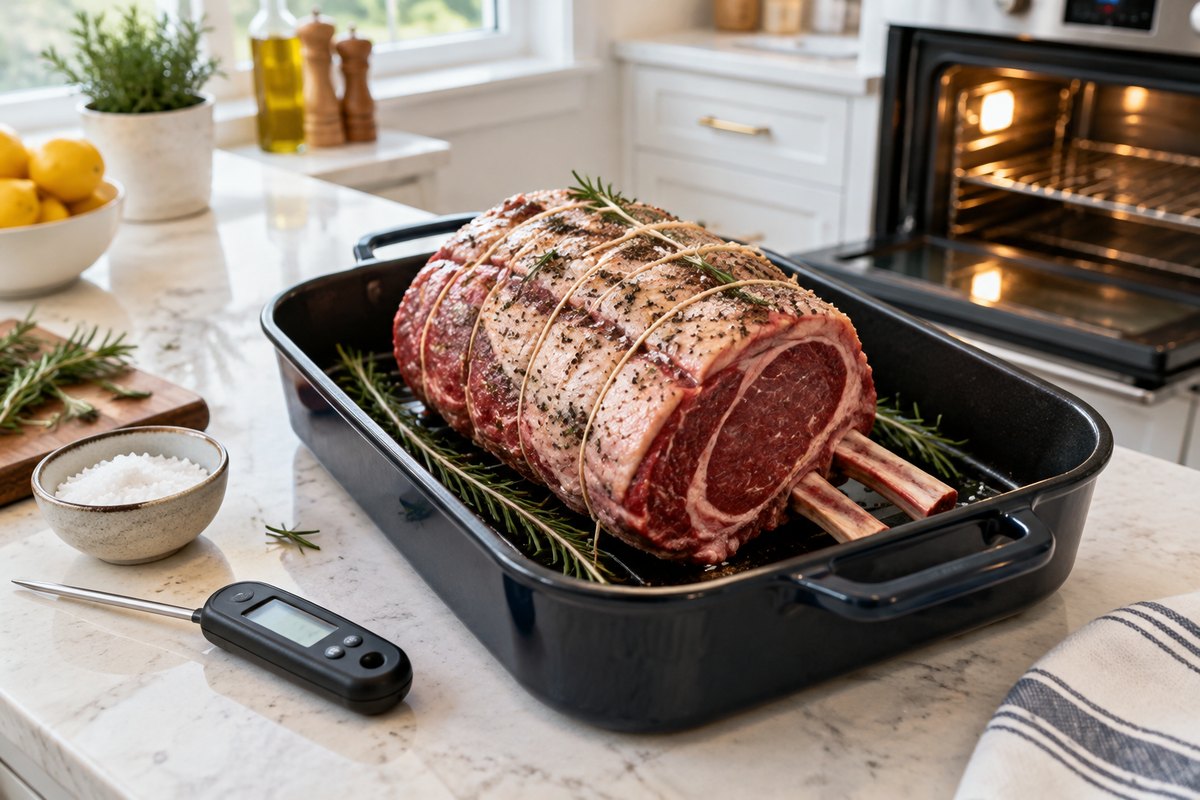
The federal roasting chart gives two timing bands at 325°F (163°C). A bone-in rib roast of 4 to 6 pounds takes 23 to 25 minutes a pound. A boneless rib roast of the same weight takes 28 to 33 minutes a pound. The boneless figure is higher, which is the opposite of what the bone’s reputation would suggest. Follow the chart for the cut you bought, and do not reason your way to a different number.
The chart’s 4 to 6 pound limit
That chart has a scope, and it matters at the holidays: it covers 4 to 6 pound roasts. A ten-pound roast is outside the tested range, so the chart becomes a starting point rather than a schedule. Start checking early, and expect the meat to be the authority.
The temperature that decides
The number that actually decides is the internal temperature. US federal food safety guidance for beef roasts is 145°F (63°C) with a rest time of three minutes. Put an instant-read thermometer into the thickest part of the roast, away from the bone, and read it rather than guessing from the color of the juices. The three-minute rest is the safety minimum, not a serving instruction: a longer rest makes the roast easier to carve and lets the juices settle.
The caterer’s guide goes further and prints pull temperatures for steakhouse doneness: 110 to 115°F for rare, 120 to 125°F for medium-rare, and 130 to 135°F for medium, with a rest of 20 to 30 minutes. Its own food safety note says the USDA recommends at least 145°F with a three-minute rest, and that “the lower pull temperatures above are the steakhouse doneness preference most prime rib lovers expect.” This page states the federal figure because it is the one with a safety basis. The pull table is the restaurant convention, which every cook decides for themselves.
One more thing about time. The chart assumes an oven set to 325°F. A convection oven and a pan crowded with vegetables both move the clock. The thermometer absorbs all of that variation. The clock cannot.
What the video shows
The video below shows a four-bone chuck-end rib roast going into the oven, from Certified Angus Beef’s channel. Watch the size of the roast against the pan: that is a roast built for a crowd, and the bone count is the first thing to notice.
What the prime rib costs before the sides
The national average is not a prime rib price
Prices move, so treat any number here as a benchmark rather than a quote. The US Bureau of Labor Statistics publishes a monthly average retail price for “all uncooked beef roasts.” For September 2026 that average was $9.097 a pound, against $9.040 in September 2025. It is a category average across beef roasts, not a prime rib price, so use your butcher’s price for the roast in front of you.
The arithmetic at two prices
The arithmetic is still useful. Six pounds at the September average, $9.097 a pound, is about $54.58. Seven and a half pounds, which feeds about ten people at the three-quarter-pound rate, is about $68.23. At double the category average, those same roasts run about $109 and about $136. The bone sits inside that price at the per-pound rate, which is why the weight on the label matters more than the price per pound alone.
The bone decides the number. It is weight you pay for, it is the part of the purchase that tells the counter how many people you are feeding, and it is what a head count turns into. Take your head count in, ask for the bones, and the rest follows. If you are also working out how much to pour, the punch math runs on the same guests-and-hours logic.
Roast sizer
Enter your head count and the cut, and get the pounds, the bone count, the oven estimate and the bill. Tap or click to open.
The centerpiece rates are 1/2 lb a person boneless and 3/4 lb a person bone-in, with a quarter pound more for a hearty appetite, from the catering guide cited above. The one-of-several-dishes setting cuts the bone-in figure to half a pound, which is Tasting Table’s buffet rule; the boneless figure stays at half a pound, the light end of the range above. The oven estimate multiplies your pounds by the federal chart’s 28 to 33 minutes a pound boneless or 23 to 25 minutes a pound bone-in at 325°F, and that chart covers 4 to 6 pound roasts, so start checking early. The bones line uses about one bone per two pounds. Without JavaScript you can still use the tables above.
Frequently asked questions
How much prime rib per person for 10 people?
Plan on 7.5 pounds of bone-in rib roast for ten people at three-quarters of a pound each, or 10 pounds at a full pound each if the table is hungry or you want leftovers. For a boneless roast, the same ten people need 5 pounds at half a pound each, or 7.5 pounds at three-quarters of a pound each.
How many bones should I ask the butcher for?
The caterer’s table pairs each bone with about two pounds of roast, and its rule of thumb is one rib bone per two diners at a pound each. A four-bone roast runs about eight pounds, which the table serves to eight people. If your head-count arithmetic lands between bone counts, ask for the larger roast.
How many people does a 4-bone roast serve?
A four-bone roast runs about eight pounds. The caterer’s table serves it to eight people at a pound each, or ten at the three-quarter-pound rate, and more again if it is one of several dishes at a buffet.
How long does prime rib take per pound?
The federal roasting chart gives 23 to 25 minutes a pound for a bone-in rib roast and 28 to 33 minutes a pound for a boneless one, both at 325°F, for roasts of 4 to 6 pounds. A larger roast falls outside that tested range, so start checking early and rely on an instant-read thermometer. Federal guidance is 145°F with a three-minute rest.
Is prime rib the same as a standing rib roast?
Yes. Prime rib and standing rib roast are two names for the same cut of beef, the rib roast. The word “prime” is also the top USDA quality grade, so a package labeled prime rib may describe the cut only. Check for the grade shield if the grade matters to you, and ask the price for each grade.
What are the first cut and the second cut?
Prime rib is sold in two parts. The first cut is the loin end, which is leaner and more uniform. The second cut is the chuck end, which carries more marbling, and it is the end Tasting Table recommends for roasting. Ask which end you are buying.
Sources
Every sourced number on this page comes from one of these, read in November 2026. Where a source covers a narrower case than the question, the sentence carrying the number says so.
- FoodSafety.gov, Cook to a Safe Minimum Internal Temperature (last reviewed November 21, 2024): beef roasts at 145°F (63°C) with a three-minute rest.
- FoodSafety.gov, Meat and Poultry Roasting Charts (last reviewed September 21, 2023): the 325°F oven setting, and 23 to 25 minutes a pound bone-in against 28 to 33 minutes a pound boneless for rib roasts of 4 to 6 pounds.
- USDA Agricultural Marketing Service, Beef Grading Shields: the Prime, Choice and Select definitions and their marbling language.
- U.S. Bureau of Labor Statistics, Average Retail Food and Energy Prices, U.S. and Midwest Region: all uncooked beef roasts at $9.097 a pound in September 2026, against $9.040 in September 2025.
- CG Public House and Catering, Prime Rib Serving Guide: the per-person rates, the one-pound-per-two-people boneless rule, one rib bone per two people, the roast-by-bone table, and the pull-temperature table with its food-safety note.
- Tasting Table, The Per-Person Rule To Buy Prime Rib For A Party (February 14, 2025): the published per-person rule, the buffet rule, the leftover-sandwich line, and the first-cut and second-cut guidance.
This article is for general information and entertainment, not financial advice. Researched and written by Richie with the help of modern digital tools. Images: AI-generated illustrations.

Leave a Reply