A frozen pizza is a compromise until you treat the box as a starting point instead of the finished product. The crust is already made, the cheese is already on, and the oven is already hot, which means the only work left is the work that makes it taste like something you would order: a few fresh things, added at the right minute.
I love pizza, basically any kind, and I could eat it every day. Some of that is probably psychological: the taste brings back Friday nights as a kid, when convincing my parents to order a pie was reason enough to celebrate. As an adult I still watch for the delivery car, and I still wince at what regular delivery does to a food budget. Whenever I go to a restaurant, I look carefully at the toppings they add, to get inspiration for my copycat version at home.
What I discovered is that the gap between a frozen pizza and a restaurant one is mostly toppings and timing, not dough. Heat it in the oven, add fresh ingredients at the right moment, and the difference is real. Here are nine upgrades, when to add each one, and a tool that times them to whatever box is in your freezer.
In this article
The base matters less than what you put on it
I start with a Trader Joe’s Four-Cheese frozen pizza. It cost $3.99 in 2018, and the style matters more than the brand: a plain cheese pie leaves room for whatever you add, while a fully loaded frozen pizza is already committed to someone else’s idea of dinner.
That is the whole logic of upgrading a frozen pizza. You are not making pizza from scratch, and you should not try. You are buying a decent crust and a base layer of cheese, then doing the part the factory cannot: fresh herbs, better cheese, vegetables that still have texture, and cured meat that has not been baked into leather.
Nine upgrades, and when to add each
Timing matters as much as the ingredient list. Put everything on at the start and the wet things steam the crust; put everything on at the end and the cheese never melts into the pie. The nine below are grouped by the moment they belong to, and the tool further down turns them into a schedule for your own box.
Before it goes in
1. Brush the rim with olive oil or garlic butter. A thin coat on the exposed crust gives you the buttery, salty edge that restaurant pizza has. Tasting Table makes this one of its own upgrades, brushing the crust with olive oil or a quick garlic butter and finishing it with sea salt, and it notes that olive oil does not turn bitter at high heat. A pastry brush is the only equipment you need.
2. Slice vegetables thin, then season them. Peppers, onions, mushrooms and zucchini should be sliced thin enough to cook through in the time the pizza bakes, and tossing them with a little olive oil, salt and Italian seasoning before they go on makes them taste like a topping instead of a garnish. Seasoning is the step that is easiest to forget in the rush to the oven.
3. Add cured meat, and add the soft kind late. Prosciutto and salami add richness to a plain cheese pie, which is The Kitchn’s second upgrade. A prosciutto that spends the full bake in a hot oven dries out, so drape it on after the pizza comes out. Harder cured meats and cooked bacon can go on before the bake.
At the two-minute mark
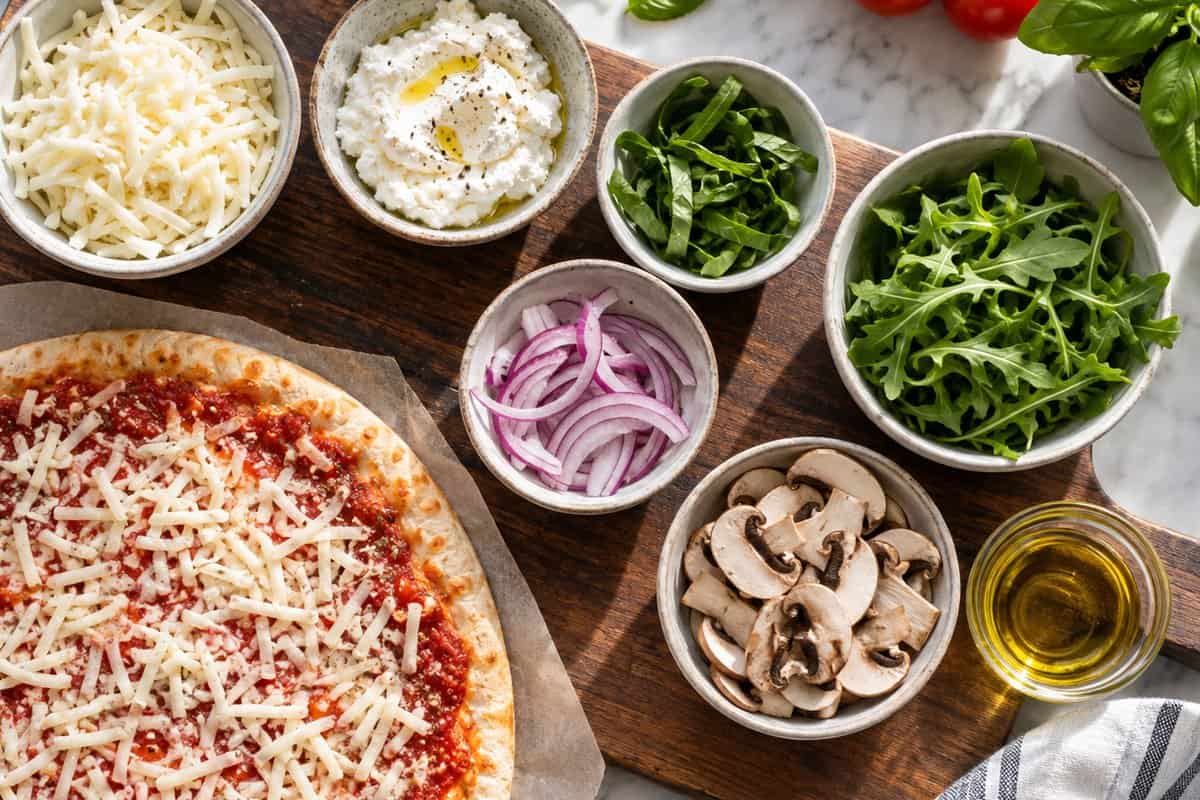
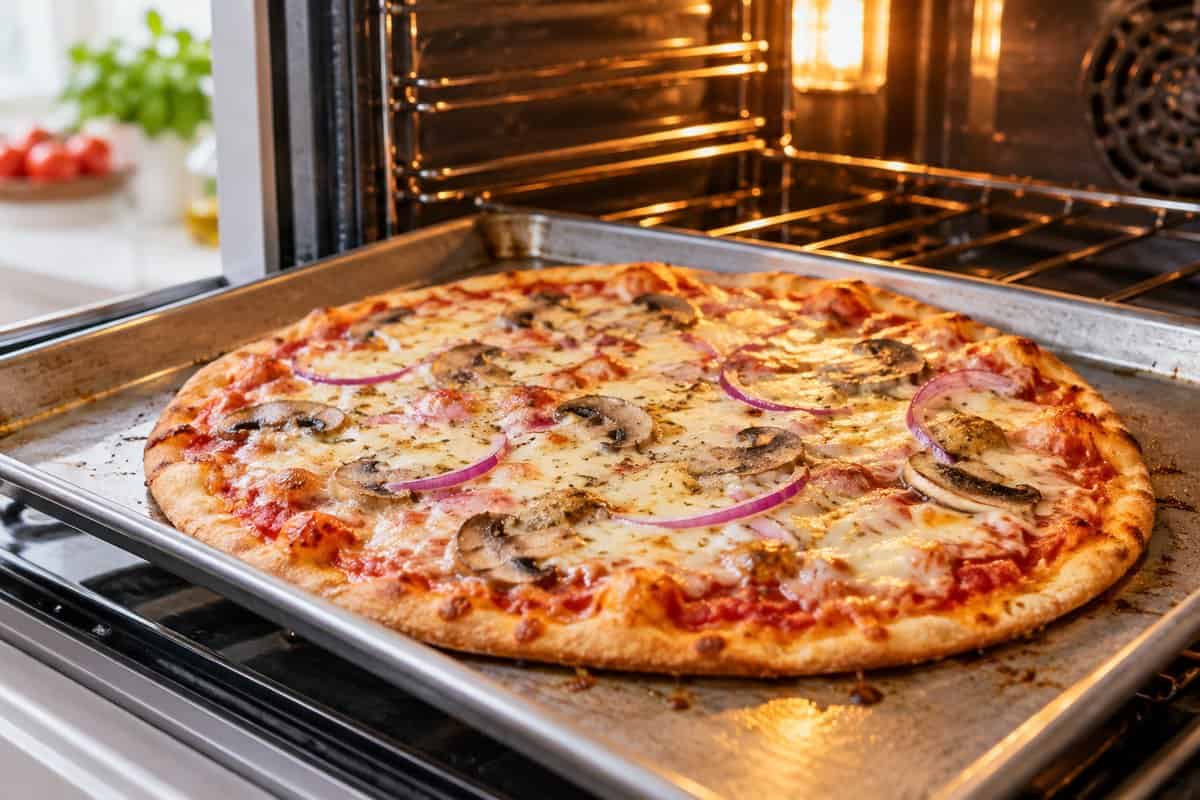
4. Pull it early and add more cheese. This is the core of my method: bake the pizza for almost the full time on the box, take it out two or three minutes early, add the cheese you want melted, and put it back to finish. A light sprinkle is plenty: Tasting Table, which recommends adding cheese partway through, warns that too much cheese or too many toppings weighs the pie down and stops the layers underneath from cooking. The Kitchn’s list uses the same late-add idea for burrata and for eggs, which go on in the last few minutes for that reason.
5. Add fresh mozzarella or ciliegine. When I want it richer, I swap the ricotta for ciliegine, the small fresh mozzarella balls, scattered over the top for the last few minutes. They melt into soft pockets rather than a blanket, which is a different and better texture.
6. Dollop ricotta into the gaps. Ricotta does not melt and spread like mozzarella, which is the point: spoon small dollops between the other toppings and they stay creamy against the sharper, saltier bites. It is the closest thing to a restaurant finish you can do with a tub of cheese.
7. Dust it with garlic powder and dried oregano. Both are pantry staples, both are in my list below for a reason, and both do more for a frozen pizza than another handful of cheese. Add them at the pull so they land on the cheese while it is still melting.
After it comes out
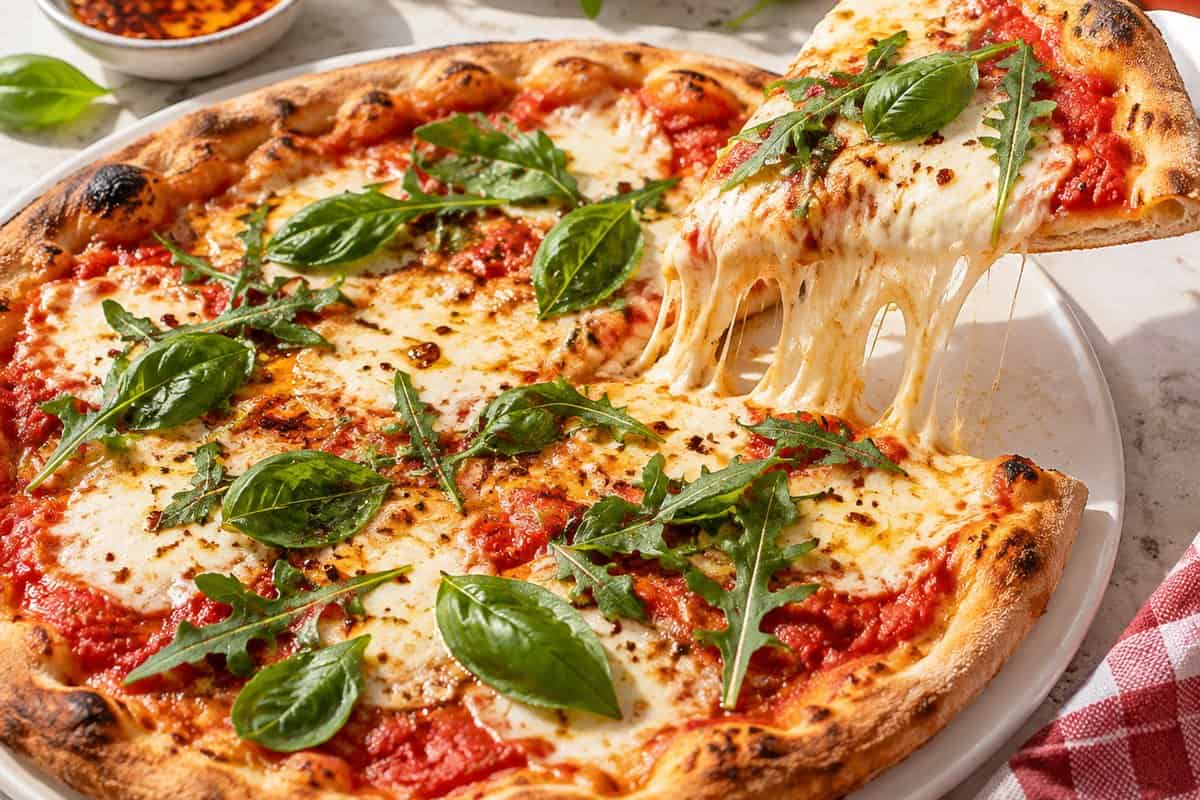
8. Finish with arugula or basil. Both wilt in a hot oven; put them on the pizza as it comes out and they soften just enough from the residual heat while keeping their color and bite.
9. Add a finishing oil, pesto or truffle oil. A small drizzle of good olive oil, a spoon of pesto thinned with a little oil, or a few drops of truffle oil gives the crust a glossy, aromatic finish. Go easy with truffle oil; a few drops season the whole pie and a tablespoon overwhelms it.
Two more from my own list did not make the nine: sun-dried tomatoes and pesto are both worth keeping in the rotation, and a little bacon, cooked first, adds smoke without adding water. The full pantry list: extra shredded cheese, basil, sun-dried tomatoes, fresh tomatoes, pesto, pre-sliced mozzarella, ricotta, dried oregano, dried garlic, bacon, arugula, prosciutto, pancetta, truffle oil and garlic butter for the crust.
Time it to your own box
Every box has a different total time, so the useful thing is not a fixed recipe but a schedule. Enter the minutes your box gives, tick the upgrades you are using, and the tool prints the minute to do each one. It times the toppings only; the package still decides the oven temperature and the total bake. If you are feeding a crowd rather than one pie, the pizza-party plan covers pan pizzas and a topping bar.
Upgrade timeline: when to add each topping
Enter your box’s total bake time and tick your upgrades, and it prints the minute to add each one. Tap or click to open.
The timeline uses the last three minutes as the pull window and the first minute for the crust brush. It does not change your box’s temperature or total time, and it assumes the package directions are the baseline.
The mistake that makes it soggy
Water is the enemy, and most of it comes from the vegetables. Tomatoes, mushrooms and zucchini release liquid as they cook, and leafy greens release a surprising amount. If they go on raw and the pizza bakes for twelve minutes, that liquid ends up in the crust.
Three habits fix it. Slice watery vegetables thin so they give up their water quickly rather than stewing. Cook or squeeze the wettest ones first, and keep spinach and kale off the raw pile entirely. And do not overload the pie: a mountain of toppings insulates the crust from the heat, which is how you get a pale, limp slice under a hot topping pile. Tasting Table makes both points: slice watery vegetables thin, cook spinach and kale before they go anywhere near the crust, and expect soup if you skip it. The Kitchn's list handles the same problem from the other direction, sautéing greens with oil and garlic first.
If you are building the pie from a crust and a can instead, turning tomato paste into pizza sauce is the place to start.
One more, from the food-safety side: if you thaw a frozen pizza before baking, thaw it in the refrigerator, never on the counter. Bacteria multiply fastest between 40 and 140 F, and a kitchen counter sits right inside that band. A pizza left out for an afternoon is not worth the risk.
Oven, pan and the box directions
The package directions are the baseline, not a suggestion. They are written for that specific crust and that specific topping load, and following them is the difference between a pizza that is cooked through and one that is burnt on the bottom and cold in the middle. If you want a crisper base, preheat a sheet pan or a pizza steel and slide the pizza onto it; a preheated pan or steel does more for the base than a hotter dial.
Two guides take the opposite of that patient view. Tasting Table suggests taking the oven to its highest bake setting and baking for five to eight minutes, watching closely, and The Kitchn suggests turning the oven as high as it goes and cutting the time. On a thin frozen pie the rim can char before the center is hot, so the pan under the pizza plus the box's own time and temperature is the safer route. Try the hot oven once if you like a cracker edge, and watch it the whole time.
If you are serving mozzarella sticks alongside, as I sometimes do, the Trader Joe's breaded ones I buy list 425 F for 9 to 10 minutes on the box I have, which is close to the 400 to 425 F range The Kitchn gives for most frozen pizza boxes, so the two can share an oven without juggling settings. Read your own packages, though; the times differ by brand.
Watch seven upgrades in under a minute
If you want to see the idea in action, this 49-second short from the cooking channel ThatDudeCanCook runs through seven upgrades on a plain frozen pizza in under a minute, which is about the right length for it.
Leftovers and the two-hour clock
Cold pizza the next morning is one of the better arguments for making a bigger pie, and it has rules like anything else. The USDA says leftovers should be refrigerated within two hours of coming out of the oven, or within one hour if the room is above 90 F, and that they keep three to four days in the refrigerator or three to four months in the freezer.
Reheat to 165 F, whether in the oven, a skillet or the microwave, and cover it so it heats through without drying out. A covered skillet keeps the crust from going leathery; the microwave is faster.
Frequently asked questions
What is the best frozen pizza to upgrade?
A plain cheese pizza gives you the most room, because you are not fighting toppings the factory already chose. I use Trader Joe's Four-Cheese, but any thin-crust cheese pie works. A fully loaded frozen pizza is better left as it is.
How do you keep a frozen pizza crust from getting soggy?
Keep water off it. Slice watery vegetables thin, cook the wettest ones first, add greens after baking, and do not pile on so many toppings that the crust cannot crisp. A preheated sheet pan or pizza steel helps too.
Can you add toppings to a frozen pizza before baking?
Yes, for anything that needs cooking: seasoned vegetables, hard cured meat, or a drizzle of oil on the crust. Cheese and soft cheese go on two to three minutes before the end, and fresh herbs and greens go on after it comes out.
Do you have to thaw a frozen pizza before baking?
The box usually says no, and the package directions are the safest guide. If you do thaw one, do it in the refrigerator, never on the counter, and follow the cooking time the package gives for that case.
How long do pizza leftovers keep?
The USDA says leftovers keep three to four days in the refrigerator and three to four months in the freezer, refrigerated within two hours of baking and reheated to 165 F.
That's my take
Keep at least one frozen pizza in the freezer. It saves a late-night craving when everything is closed, and with a handful of fresh toppings it stops being a compromise and starts being dinner. Are you a pizza lover like me? Tell me which topping should be on my list next.
Sources
Where each claim comes from:
- Tasting Table, The 14 Absolute Best Ways To Elevate Frozen Pizza (Sara Klimek, January 5, 2023): crust brushing, seasoning vegetables, adding cheese midway, overloading, resting before slicing, and thawing in the refrigerator.
- The Kitchn, 15 Incredible Upgrades for Frozen Pizza (Lia Picard, updated August 17, 2020): the finishing olive oil, high-heat baking, the broiler finish, and adding soft toppings late.
- USDA Food Safety and Inspection Service, Leftovers and Food Safety (updated July 31, 2020): the two-hour rule, refrigerator and freezer times, and reheating to 165 F.
- USDA Food Safety and Inspection Service, "Danger Zone" (40 F - 140 F) (updated June 28, 2023): the temperature range where bacteria multiply fastest.
I'm Lily, a lawyer and aspiring Miami fashion entrepreneur sharing life hacks and my favorite tidbits on lifestyle, shopping, fashion, and beauty.
Featured photo: Thomas Schweighofer on Unsplash.
Updated November 2026 by Richie with the help of modern digital tools.


Lily, You are my idol. I do this all the time. The Trader Joe 4 cheese is one of my favorite palette’s to work with.
p.s. I worked 10 years at a private label frozen pizza manufacturing company
Tom
Tom you made my day; great minds think alike! LOL Oh wow, you worked at a frozen pizza company!! I bet that job had some tasty perks…My first job was selling chocolate covered almonds and other nuts! I ate so many it took me a while to be able to eat them again!! 🙂
Great idea!
I’ve definitely not though about doing this, and enjoy supreme pizzas regularly lol.
Thanks for sharing
Thanks Chris! Oh, you can definitely have a ball getting creative with all the toppings: anchovies, mushrooms, olives, Canadian bacon, green peppers…. you name it! LOL. Thanks for stopping by! Lily
As far as I can remember, we have always done pizza Friday with our kids, an easy meal at the end of a crazy week. Enhanced frozen pizza is by far the cheapest:) We also have pita pizza night where we each make our own pizza using pita bread, really fun with younger kids:)
Hi Caroline! Oh yes, pizza Friday is a most cherished memory from my childhood; one day when we have kids I see ourselves making it a tradition with them. 🙂 I love your idea of everyone getting to make their own pizza! Sounds like a lot of fun!!!
Great post Lily, pizza is hands down the greatest invention in world history so this has to be one of the greatest posts as well! And taking perfectly acceptable store bought pizza and making it better is one of those frugal miracles that make life better without costing very much at all!
Thanks a lot Steve!! “Frugal miracle”, I love it! We sure do love pizza, you’re right pizza is an invention with no equal. Thanks for stopping by! 🙂
Lily
Great article! Frozen pizzas are a life saver when hunger strikes late at night and on a tight budget. I like adding extra cheddar cheese to my pizza and some leftover chicken! Yum! I’m going to have to make one tonight because now I’m craving it! Lol
Thanks Jelitza! I hear you, I was craving it as I wrote the post; also that GIF of the cheese pizza at the top is very hard to resist. LOL. I was drooling when I first saw it! LOL. Adding extra cheese is a must! Cheese just makes life better!!! 🙂 🙂 🙂
I love Trader Joe’s 4 cheese pizza! I am happy with it just by itself but I have never thought to enhance the pizza with extra toppings. Thanks for the tip! One of my goals is to learn to make pizza from scratch, apparently it is easy??
Isn’t that pizza awesome? I’ve had it by itself too and it’s pretty good. I’ve never made pizza from scratch, that’s also one of my goals. I’ve seen people make it and it doesn’t look hard. I actually saw that Trader Joe’s sells the prepared dough in a small clear bag and the toppings right next to it. While it’s not technically from scratch, I think it’s a good start. 🙂
That is a great idea. We have a pizza stone. It makes the crust crispy and delicious. I now know what we will be having for dinner tonight.
Haha Thanks Dave! Bon appetit! 🙂
Wow Lily!
You sure know how to hack a pizza!
Your tips sound awesome!! And I love pizza! It’s like one of my favorite… I seriously have a weakness for it 🙁
It’s unfortunate that I don’t know where I can find Trader Joe’s in Toronto… the last time I google searched, I only found one in Niagara Falls which is a bit far from me. I don’t even think we have many selections here in…
The pic of your pizza looks fantastic btw! I would love to try some of that.