The night before a trip, every suitcase turns into a physics problem: a week of life versus one overhead bin. This carry-on packing checklist does the arithmetic for you. Pick a trip length, tick what the trip involves, and the list rebuilds itself with real clothing counts, then copies or prints clean. The rules quoted below come from the TSA, the FAA, and the airlines’ own pages, read in October 2026, and each one carries its link.
The scope: one adult, one carry-on bag plus one personal item, trips from a weekend to two weeks, weather from mild to cold. No kids’ sizes, no month-long expeditions. The counts are planning arithmetic, shown in full.
In this article
Build your carry-on packing checklist
The tool below builds a list from four questions: how long, what kind of trip, what conditions, and whether you will wash clothes en route. The counts follow the arithmetic shown in the next section, every add-on names its purpose, and the assumptions line travels with every copy or printout.
Tick items as you pack. A tick survives a rebuild while its row means the same thing; when your answers change what a row is or how many it holds, that row resets and the status line says so, because a tick on the old list should not masquerade as one on the new. Ticks live in this page session only. Then, when the list is right, copy it to a notes app or print it. The button marked Print / save as PDF opens your browser’s print dialog: the article prints with the list, minus the controls, the contents menu, and the buttons.
Build your carry-on checklist
Pick your trip length, trip type, conditions, and laundry plan for a list you can copy or print. Tap or click to open.
Trip: 7 days (one week away) · no trip add-ons · domestic route · mild weather · no laundry · one adult, one carry-on plus one personal item
Travel-day outfit (worn, never packed)
Wear the bulkiest things on travel day so they never eat bag space. They count toward your outfits but never enter the bag.
Clothes (packed)
Toiletries and liquids
One quart-sized bag per person; every liquid, gel, and aerosol container 3.4 oz / 100 ml or less. Most hotels provide a hair dryer; other amenities vary, so call ahead and pack only what is missing.
TSA item pages list bar soap and solid deodorant as carry-on yes with no size cap. A gel deodorant is a gel and rides in the bag.
Personal item (never check this)
If your carry-on is gate-checked, everything in this group stays in the cabin with you.
Keep prescriptions in their original packaging, which also keeps them clearly labeled; medically necessary liquids above 3.4 oz are allowed in reasonable quantities when declared to a TSA officer for inspection.
Remove them before any gate check and protect the terminals. Lithium-ion spares up to 100 Wh and lithium-metal spares up to 2 g ride without approval; with approval, up to two larger spares (101-160 Wh, 2-8 g).
Rules that apply to every trip
- Liquids at US checkpoints: one quart-sized bag per person, containers 3.4 oz / 100 ml or less; larger containers go in checked bags. Medically necessary liquids and infant or child nourishment are exempt in reasonable quantities; declare medically necessary liquids to a TSA officer at the checkpoint for inspection. (TSA)
- Spare lithium batteries and power banks: carry-on only, never checked. Remove them before any gate check and protect the terminals. Lithium-ion spares up to 100 Wh and lithium-metal spares up to 2 g of lithium ride without airline approval; with approval, up to two larger spares (101-160 Wh, 2-8 g). Airlines may set stricter limits. (FAA)
- Airline size limits are exact maximums including wheels and handles, but the allowance itself depends on your fare and operating carrier: some Basic Economy fares and some smaller aircraft allow only a personal item. Check your airline before you fly. (airline baggage pages)
Assumptions: one adult, one carry-on plus one personal item. A range counts its longest trip: a weekend counts 3 days, 4 to 6 counts 6, and 8 to 14 counts 14. Counts cover packed items; travel-day worn items are listed separately. With laundry on, a wash happens around day 6 and repeats around day 12 at two weeks, before the clean stack runs out. The counts are this desk’s planning arithmetic from the methods cited below, not numbers published by any source; whether everything fits depends on your bag and how tightly you pack.
The seven-day list, with the math shown
Here is where the numbers come from, because a checklist that will not show its work is just an opinion with checkboxes. The default list packs one adult for seven mild-weather days with no laundry; the table below shows the worn-versus-packed split.
Tops run one per day, minus the one on your back: pack 6, wear 1, total 7. The rhythm behind the count is Nomadic Matt’s packing method: carry 7 to 10 days of clothes, then wash and repeat. The packed-versus-worn split is this desk’s bookkeeping.
Bottoms, instead, run on rewears. You wear the bulkiest pair on travel day and pack 2 more, each getting 2 to 3 wears, which covers seven days. The formula the tool runs: packed bottoms equal ceil((days − 1) ÷ 3), at least 1, and capped at 2 packed when laundry is on. Jeans and travel pants earn their space; five pairs of anything does not.
Meanwhile, underwear and socks follow Tortuga’s one-per-day rule for short trips: pack 7 for seven days. The eighth pair is this desk’s addition, worn on travel day from the dresser rather than the bag. Sleepwear is one set, reworn, never seeing daylight.
Worn versus packed
| Item group | Worn on travel day | Packed | Total |
|---|---|---|---|
| Tops | 1 | 6 | 7 |
| Bottoms | 1 (the bulkiest) | 2 | 3 |
| Underwear | 1 (from the dresser) | 7 | 8 |
| Socks | 1 (from the dresser) | 7 | 8 |
| Sleepwear | 0 | 1 | 1 |
| Shoes | 1 (bulkiest) | 1 (compact) | 2 |
| Light jacket or sweater | 1, or packed flat | 0 | 1 |
The pouch that never gets checked
One pouch, however, never leaves your side. Passport, ID, boarding passes, wallet, medications, phone charger, and any power bank ride in the personal item, not the carry-on. Part of that is law, part is prudence: spare lithium batteries are carry-on by federal rule and must come out first if your bag is gate-checked (FAA), while cameras and valuables ride along because losing them hurts, not because any agency requires it. SmarterTravel’s guidance lands in the same place: keep anything you cannot replace where you can see it.
Flip the laundry option and the math changes, not the method: tops cap at 5 packed, underwear and socks at 6 packed, with a wash around day 6 and another around day 12 at two weeks, each landing before the clean stack runs out. For the washing itself, hotel guest laundry or the wash-and-press moves in our hotel-hacks guide both work.
Weekends, long trips, and chronic overpackers
Start with the weekend: a 2-to-3-day trip counts as 3 days and shrinks the list to 2 tops packed plus 1 worn, 1 bottom packed, and 3 pairs each of underwear and socks packed plus the pair you wear. Same rules, same pouch; a weekend is not exempt from the liquids bag.
Next, 4 to 6 days, counted as 6: 5 tops packed, 2 bottoms packed, 6 pairs each of underwear and socks packed plus the pair you wear. Still no laundry needed.
At 8 to 14 days, counted as 14, the worksheet defaults to laundry, because that is what keeps a two-week list small: 5 tops packed, 2 bottoms, 6 pairs each of underwear and socks, washed around day 6 and again around day 12. Turn laundry off and the counts grow day for day, up to 13 tops and 14 pairs of underwear and socks at two weeks. At that point laundry stops being a tip and becomes the plan.
For the chronic overpacker, Nomadic Matt’s fix is arithmetic: write down everything you think you will need, then cut it in half. His follow-up question beats the fashion question: will I use this enough to justify the weight? This desk’s boundary: halve the clothes, never the documents, the medications, or the batteries. And shoes resolve by job: cold puts weather-resistant boots on your feet; business claims the packed pair; the beach claims it when business does not, and business plus beach adds flip-flops or water shoes as a conditional third row.
The rules: sizes, liquids, batteries
Three rulebooks decide whether the bag flies: your airline’s size limit, the TSA liquids rule, and the FAA’s battery rules.
Airline size limits are exact maximums
Carry-on size limits include wheels and handles, and fitting a sizer at the gate is a physical test, not a fare guarantee: on United, most Basic Economy travelers may bring only a personal item, and on Delta‘s smaller Delta Connection flights, 50 seats or fewer, only personal items come aboard. Some international airlines also regulate hand-luggage weight. The four big US carriers, from their own baggage pages:
| Airline | Carry-on limit |
|---|---|
| Southwest | 24 × 16 × 10 in, plus one personal item |
| American | 22 × 14 × 9 in including handles and wheels, plus a personal item up to 18 × 14 × 8 in |
| Delta | 22 × 14 × 9 in |
| United | 9 × 14 × 22 in, measured with the handle and wheels |
The 3-1-1 liquids rule
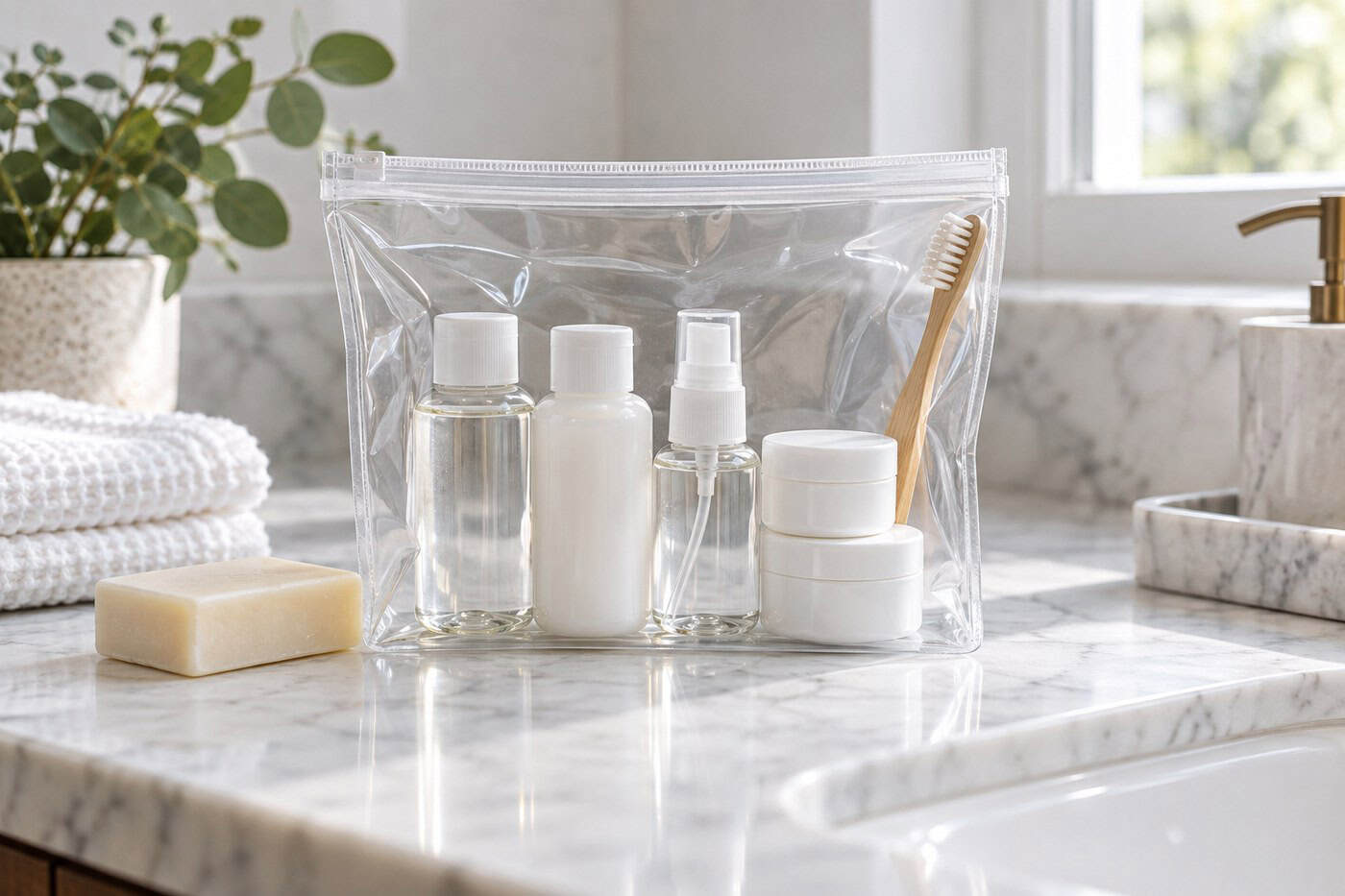
The TSA liquids rule is simple: one quart-sized bag of liquids, aerosols, gels, creams, and pastes per person, each container 3.4 oz / 100 ml or less, and containers larger than that packed in checked baggage. Medications and infant or child nourishment are exempt from the bag; medically necessary liquids above 3.4 oz ride in reasonable quantities, but you must declare them to a TSA officer at the checkpoint for inspection (TSA’s medical-conditions page). TSA’s own explainer is below:
Batteries ride with you
Spare lithium batteries and power banks are carry-on only. If your bag is checked at the gate or planeside, the FAA requires them removed first and kept in the cabin, terminals protected from short circuits. The size math is watt-hours: look for the Wh rating on the battery, and if it is missing, Wh equals volts times amp-hours. Lithium-ion spares up to 100 Wh need no approval; with airline approval you may carry up to two larger spares of 101 to 160 Wh. Lithium-metal spares cap at 2 grams of lithium without approval; with approval, up to two spares of 2 to 8 grams. Airlines may set stricter limits. Note that phones and laptops with batteries installed inside follow separate FAA guidance; this rule covers spares and power banks.
Toiletries without the liquids-bag panic
The quart bag is where packing lists fall apart, so run it like a budget. Start with the surprising line items: TSA counts peanut butter as something you can carry at 3.4 oz or less, aerosol shaving cream gets the same verdict, and sunscreen is a yes at 3.4 oz or less. The rule covers liquids, aerosols, gels, creams, and pastes; for anything ambiguous, TSA’s What Can I Bring? item pages give the verdict item by item, and the final decision rests with the TSA officer.
Then cut line items by going solid. TSA’s item pages list bar soap and solid deodorant as allowed in carry-ons with no size qualifier, so they use zero slots in the liquids bag. Solid means genuinely solid: a gel deodorant is a gel, and gels ride in the bag. What remains is a travel-size toothpaste and the one or two liquids that matter to you.
Medications sit outside this budget: medically necessary liquids above 3.4 oz are allowed in reasonable quantities when you declare them to a TSA officer at the checkpoint (TSA’s medical-conditions page); keep prescriptions in their original packaging, and carry medications in the personal item. For international routes, Princess Cruises’ packing list adds a copy of the prescription if needed for customs clearance.
Packing order: fold heavy, roll light
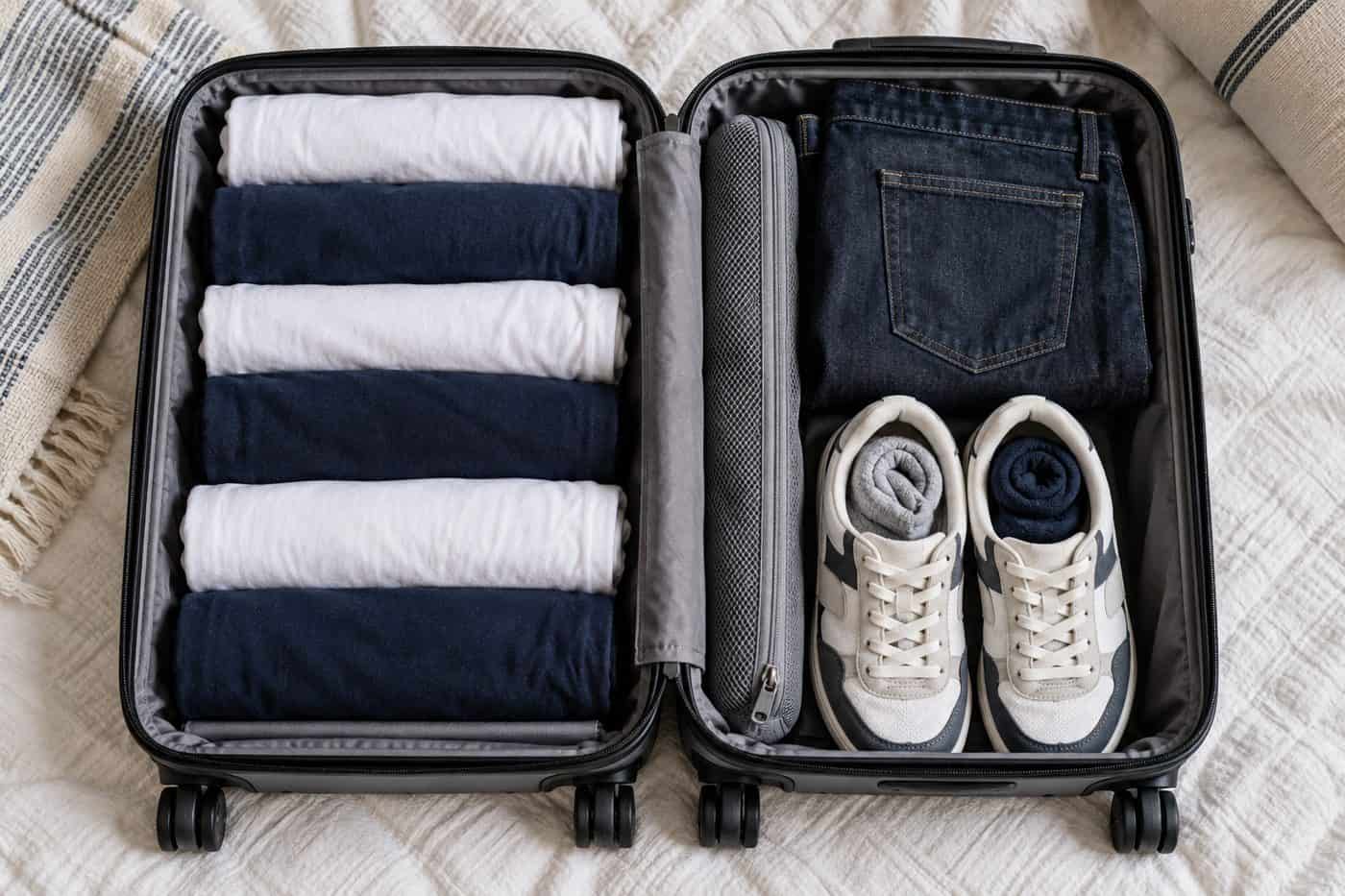
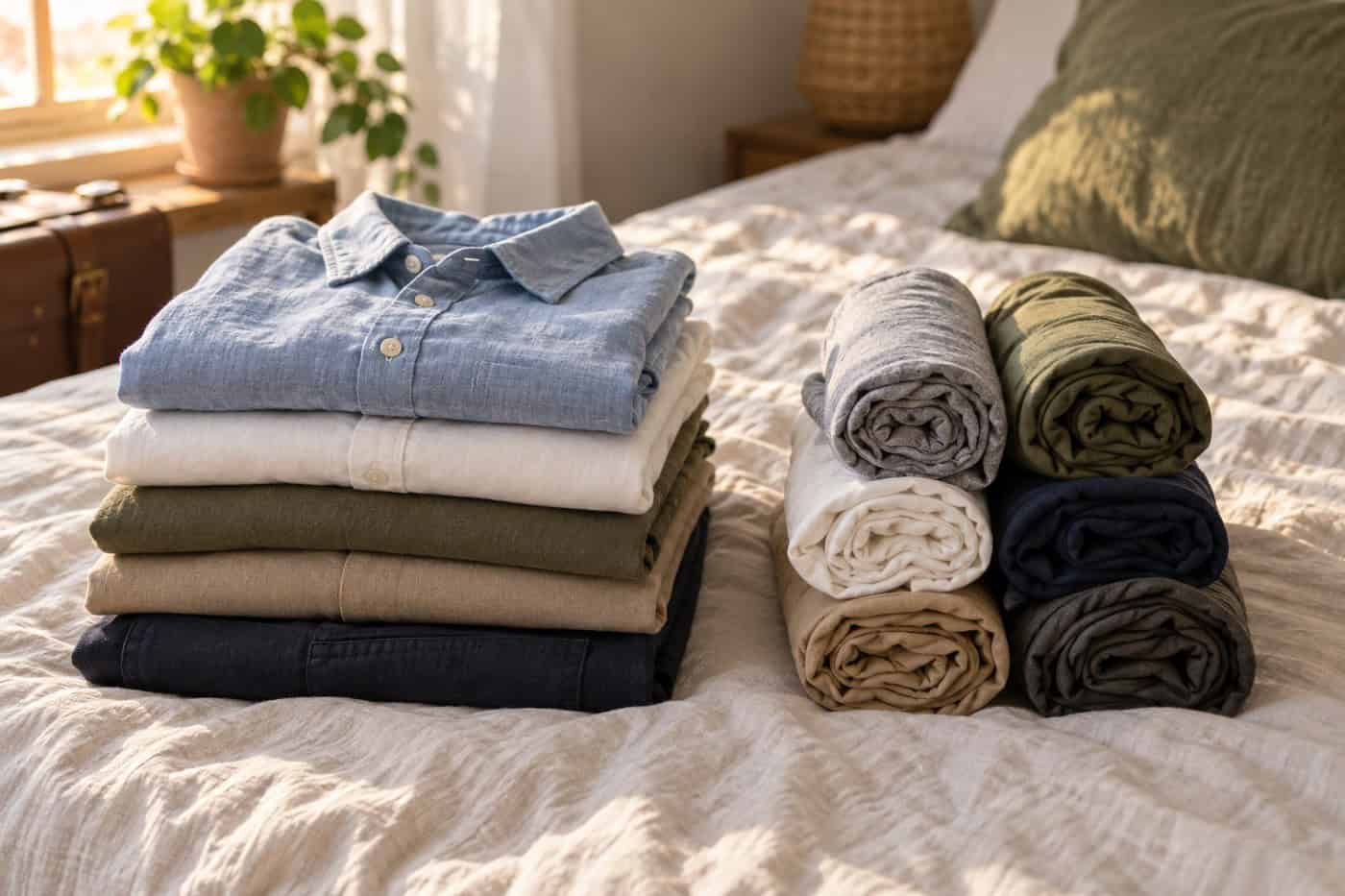
There is no single best way to pack clothes; SmarterTravel says so directly, and the winning method is the one you will actually do twice. So here is the order that keeps a week visible. Heavy items go flat first: jeans and sweaters folded along the bag’s bottom and edges. Light items get rolled: t-shirts, camisoles, and shorts rolled tight into the gaps. Socks go inside spare shoes, which packs the shoes and the sock drawer at once.
Keep the top layer negotiable: the quart bag goes where you can reach it, because screening may ask for it, and the pouch stays in the personal item, within reach. Business clothes break the pattern: Tortuga’s business-trip method folds wool suits rather than rolling them and carries the blazer on your body or folded over the top layer.
Trip add-ons: beach, cruise, business, cold, international
Beach adds a swimsuit and cover-up, both on Princess Cruises’ official packing list, and swaps the packed shoes for flip-flops or water shoes unless business claims that pair. Sunscreen joins the quart bag at 3.4 oz or less, per TSA’s sunscreen entry.
Cruise adds a smart-casual evening outfit, a light scarf or shawl, and a multi-port USB charger. Most evenings on Princess ships run smart-casual. Formal nights are optional, though formalwear is required in selected venues on those nights. Your sailing’s own dress code is the authority. The scarf covers shoulders when a dress code asks. Princess cabins have standard outlets, but USB charging ports are available on some ships only. One oddity from the same list: Princess ships bar irons and steamers from staterooms; the self-service laundry rooms hold the irons. Check your own cruise line’s policy.
Business adds a blazer or suit jacket, worn en route or folded per Tortuga’s business-trip method; a laptop and charger in the personal item, never checked; itinerary and boarding-pass copies for border security, where paper beats a dead phone; and the same list’s shoe rule: wear the heavier or bulkier pair on travel day and pack the lighter one. The worksheet gives business the packed pair, so dress shoes ride in the bag, not on your feet. For wrinkle rescue on arrival, see our guide to de-wrinkling a business suit on the road.
Cold weather and international routes
Cold swaps the light jacket for an insulated coat worn on travel day and adds a warm mid-layer plus hat, gloves, and scarf, following SmarterTravel’s wear-the-bulky-items rule.
International adds copies of passports, IDs, and reservations, plus a plug adapter for destinations whose sockets differ from home; the tool adds the row only when you tick the international box, and SmarterTravel lists adapters and document copies among the international basics. Princess’s list flags passport validity: some countries want six months beyond your return date.
Run the week-away list, then cut one thing you almost packed. The bag that closes is the one you argued with; every item that survives has earned its weight.
Carry-on packing FAQ
What is the TSA 3-1-1 rule?
One quart-sized bag per person, every container 3.4 oz / 100 ml or less, and larger containers packed in checked baggage. Medications and infant or child nourishment are exempt from the bag, and medically necessary liquids above 3.4 oz ride in reasonable quantities when declared to a TSA officer at the checkpoint. It applies at US security checkpoints.
Can you really fit 7 days of clothes in a carry-on?
For one adult in mild weather, the seven-day plan is compact: 6 tops packed plus 1 worn, 2 bottoms packed plus the bulkiest worn, 7 pairs each of underwear and socks packed plus the pair you wear, one set of sleepwear, and two pairs of shoes. Whether it all fits depends on your bag. Cold weather or a cruise adds rows rather than changing the base counts, and the tool above shows exactly what it adds.
Can a power bank go in checked luggage?
No. Spare lithium batteries and power banks are carry-on only, and if your bag is checked at the gate the FAA requires them removed first and kept in the cabin.
What size carry-on do airlines allow?
Southwest allows 24 × 16 × 10 in. American and Delta cap carry-ons at 22 × 14 × 9 in, and United at 9 × 14 × 22 in, measured with the handle and wheels. Limits are exact maximums, fares differ on overhead-bin space, and each airline’s own baggage page is the authority.
Should you roll or fold clothes?
Fold heavy items flat, roll light items into the gaps, and stuff socks into spare shoes. SmarterTravel’s position is that no single method wins; the one you will repeat wins.
Do you need a personal item besides your carry-on?
Southwest and American state the pair explicitly on their baggage pages, but the allowance depends on your fare and operating carrier: most United Basic Economy trips and United’s CommutAir flights allow only a personal item, and Delta’s smaller Delta Connection flights do too. The personal item carries the pouch that never gets checked: documents, medications, batteries, and valuables.
Sources and how this was made
Sources behind this article, all read in October 2026: TSA’s liquids rule, its medical-conditions page, and its item pages for peanut butter, shaving cream, sunscreen, bar soap, and solid deodorant; the FAA’s spare lithium battery guidance; carry-on policies from Southwest, American, Delta, and United; SmarterTravel’s carry-on packing list; Nomadic Matt’s packing method; Princess Cruises’ packing list; and Tortuga’s business-trip packing list. The clothing counts are this desk’s planning arithmetic derived from those methods, not numbers published by the sources.
Researched and written by Richie with the help of modern digital tools. Images: AI-generated.

Leave a Reply